
- Catalogs
- Netherlocks
- How to prevent overpressurisation of heat exchangers


How to prevent overpressurisation of heat exchangers
How to prevent overpressurisation of heat exchangers
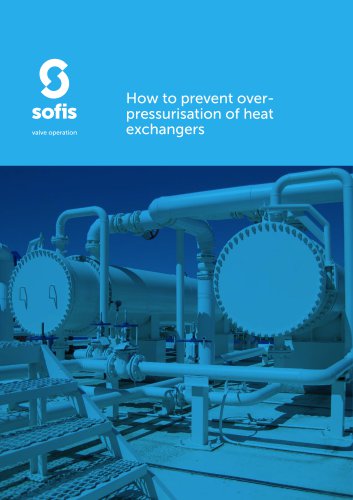
Heat exchangers are critical components in process plants, used to transfer heat between a process medium and a heating or cooling medium. They are essential for pre-heating, re-heating, pre-cooling, or re-condensing process fluids and gases, often found around fractionating columns.
Preventing Over-Pressurization
To prevent over-pressurization, it is crucial to maintain continuous product flow and adhere to strict procedures during heat exchanger changeovers. Over-pressurization can occur due to:
- Heating of residue when the heating medium flows but the hydrocarbon flow is blocked.
- Frozen-up particles when the cooling medium flows but the hydrocarbon flow is blocked.
- Blocked relief capacity leading to pressure build-up.
Safety Procedures
To avoid incidents:
- Never isolate all heat exchangers simultaneously.
- Open outlet valves first when starting up.
- Close inlet valves first when shutting down.
- Ensure a Pressure Safety Valve (PSV) is always online.
Common Solutions
Standard operating procedures and alarms are commonly used to prevent incidents, but they may not be sufficient due to human error and delayed response to alarms.
Valve Interlocks for Safe Changeovers
Valve interlocks ensure operators follow correct procedures through a key transfer system, preventing shortcuts and ensuring safe sequence operations. This system involves:
- Interlocking inlet and outlet valves.
- Using uniquely coded keys to operate valves in the correct sequence.
- Ensuring only one heat exchanger is switched to maintenance at a time.
Custom Solutions
Valve interlock systems can be customized to meet local requirements, integrating additional safety measures like drain valves and pressure or temperature switches.
Contact Information
For more information on custom solutions for safe heat exchanger changeovers, contact Sofis Global via email at [email protected] or call +31 (0)172 471339.
Catalog excerpts
How to prevent over-pressurisation of heat exchangers
Open the catalog to page 1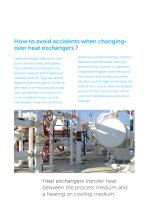
Heat exchangers heat up or cool down process fluids and gasses. They transfer heat between the process medium and a heating or cooling medium. They are widely applied in process plants, either to pre-heat or re-heat process fluids such as reboilers, or to pre-cool or re-condense them, such as condensers. They are commonly found around fractionating columns. Reboilers boil the liquid from the bottom of the column. Condensers condense the gases from the top of the column, before injecting them into the column again to increase the yield of the column. Heat exchangers are part of the core process,...
Open the catalog to page 2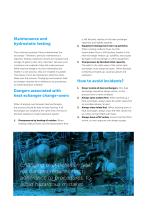
Maintenance and hydrostatic testing The continuous product flow contaminates the exchanger. Therefore, periodic maintenance is required. Testing of pressure vessels for transport and storage of gases is also very important, because such containers can explode if they fail under pressure. While heat exchangers must be maintained and tested in a live process, they are installed in parallel. This allows one to be maintained, while the other takes over the process. Changing over between heat exchangers requires strict adherence to procedures, to avoid hazardous mistakes. Dangers associated with heat...
Open the catalog to page 3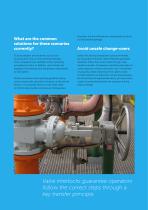
What are the common solutions for these scenarios currently? To avoid dangers and incidents, such as loss of production time, or environmental damage, most companies have standard written operating procedures in place. In addition, most vessels are equipped with pressure and temperature transmitters to raise alarms. Written procedures and operating guidelines alone cannot ensure safe operations however, as the human factor is not excluded. Alarms on the other hand do inform about sudden pressure and temperature increases, but this information is presented too late to act and prevent damage. Avoid...
Open the catalog to page 4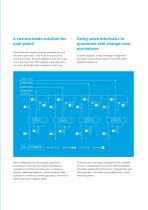
A custom made solution for your plant! Valve interlocks are permanently mounted on each inlet and outlet valve. They must be unlocked to operate the valve. Keys are trapped in their lock. Only one is free at a time. With uniquely coded keys you can only operate the right valve at the right time. Valve changeover can be complex operational processes. If a process that requires operators to complete more than one step once, or reverse a process, additional sequence control products help operators to follow non-linear sequences, and ensure that an operation happens safely. Using valve interlocks...
Open the catalog to page 5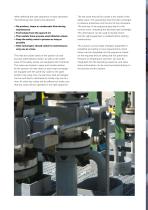
When defining the right sequence of valve operation, the following rules need to be adressed: • No product, steam or condensate flow during maintenance • First isolate from the quench oil • Then isolate from process water/dilution steam • Keep the safety valve in process as long as possible • Heat exchangers should switch to maintenance only one at a time. The inlet and outlet valves of the quench oil and process water/dilution steam, as well as the outlet valve of the safety valves, are equipped with interlocks. The valves are locked in open and closed position. All the quench oil inlet valves...
Open the catalog to page 6
Contact us Do you want to know more about our custom-made solutions avoiding unsafe heat exchanger change-overs? • Mail us at [email protected] • Call us at +31 (0)172 471339 • Visit sofisglobal.
Open the catalog to page 7All Netherlocks catalogs and technical brochures
 SFC interlocks
16 Pages
Archived catalogs
 Multi Rotation Lock (MRL)
2 Pages
 Ninety Degree Lock (NDL)
2 Pages
 Closure Locks (CL)
1 Page
 Hybrid Lock (NL-H)
1 Page
 Netherlocks Power Wrench
8 Pages


- Valve actuator
- Limit switch
- Position indicator
- Pneumatic valve actuator
- Double-acting valve actuator
- Linear valve actuator
- Locking device
- Valve locking device
- Actuator limit switch
- Valve indicator
- Valve actuator limit switch
- Valve testing device
- Portable valve actuator
- Valve solenoid interlock
- Partial run testing device
- Valve actuator locking device