

Instruction manual and data sheet Torque Sensor Series 2300
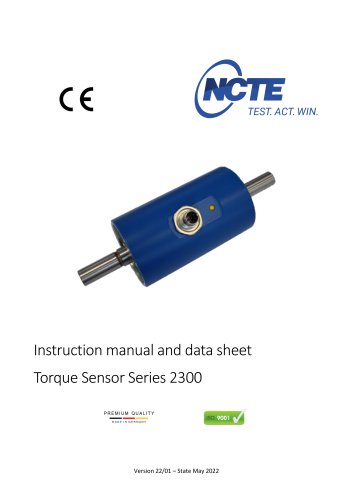
Instruction manual and data sheet Torque Sensor Series 2300
This document serves as the instruction manual and data sheet for the Torque Sensor Series 2300 by NCTE AG, detailing installation, operation, and maintenance procedures. It should be accessible at the usage site.
Customer Service and Warranty
Support is available through NCTE AG. The warranty lasts 12 months from delivery, provided proper use and maintenance guidelines are followed.
Scope of Delivery
The package includes a calibrated sensor, signal processing unit, a 5m connection cable, and a calibration certificate.
Declaration of Conformity
The product adheres to EMC Directive 2014/30/EU, ensuring electromagnetic compatibility.
Safety Instructions
The sensor is intended for measuring torque and speed within specified limits. Unauthorized modifications void the warranty. Personnel must be trained and understand safety instructions.
Torque Sensor Series 2300 Overview
This series is cost-effective for professional torque measurement, suitable for automotive testing, process monitoring, and medical engineering, offering various output signals and integrated electronics.
Assembly and Disassembly
Proper alignment is crucial during installation. Only use the supplied cable to maintain sensor function. Disassembly should be torque-free.
Interface Description
Mechanical and electrical interfaces are provided for power and signal transmission.
Starting Up
Follow specific steps to connect and record sensor output, ensuring no voltage peaks.
Operation and Maintenance
Operate within nominal torque for optimal performance. Regular inspections and recalibrations are recommended.
Data Sheet Highlights
- Nominal torque: up to 100 Nm
- Speed: ≤ 10000 rpm
- Accuracy: ≤ ±0.5%
- Operating temperature: -30°C to +85°C
- Protection class: IP50
- Output options: 0-10V, 4-20 mA, CAN-Bus, USB
The document details the specifications for the Series 2300 sensors, including the measuring range for axial force and limits for transverse force and bending moment. It stresses the importance of operating within the specified nominal torque range and recalibration in case of overload.
Technical Characteristics
The accuracy class is defined, with linearity deviation and rotational signal uniformity both less than ±0.5% ME. Detailed output signal specifications, including cut-off frequency, analog signal ranges, and calibration parameters, are provided. Temperature effects on zero point drift and signal drift are also specified.
Power Supply and General Information
The sensor operates on a supply voltage of 5-28 VDC, with a maximum current consumption of 45 mA. It has a protection class of IP 50 and operates within a temperature range of -30°C to +85°C.
EMV Emission Data
The sensor complies with various EMV immunity and interference standards, including IEC 61000-4-2 for static electricity discharge and IEC 61000-4-3 for electromagnetic HF-field.
Dimensions and Wiring
Dimensions for different nominal torque ranges are provided, along with a wiring diagram for the connector. The document specifies the use of a Binder Plug Series 712-M9 for power supply and outputs.
Order Options and Accessories
Various order options are available, including different measuring ranges and angle sensor configurations. Accessories such as brackets and readout units are listed, with specific order numbers provided.
Contact Information
Contact details are provided for further discussions regarding series products and accessories.
Catalog excerpts
Instruction manual and data sheet Torque Sensor Series 2300 PREMIUM QUALITY
Open the catalog to page 1
Copyright © NCTE AG® Torque Sensor Series 2300 Instruction Manual and Data Sheet. This instruction manual is property of NCTE AG®, D-82041 Oberhaching Unauthorized duplication, even in part, is not permitted. State: May 2022
Open the catalog to page 2
Instruction manual
Open the catalog to page 3
Dear customers, Thank you for your decision to buy our sensor products. You have chosen a high quality and extremely precise torque measuring system. This manual contains all the information necessary for you and the installation, operating and maintenance personnel to use your measuring system under the intended conditions of use. It contains important information to ensure proper and safe installation and operation. For these reasons, the Instruction manual must always be available at the place of use of the torque measuring system and always ready to hand. We reserve the right to make changes...
Open the catalog to page 5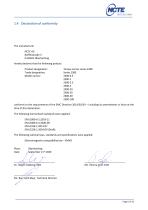
The manufacturer NCTE AG Raiffeisenalle 3 D-82041 Oberhaching hereby declares that the following product Product designation: Trade designation: Model names: conforms to the requirements of the EMC Directive 2014/30/EU – including its amendments in force at the time of this declaration. The following harmonized standards were applied: EN 61000-6-2:2019-11 EN 61000-6-4:2020-09 EN 61326-1:2013-07 EN 61326-1:2018-09 (Draft) The following national laws, standards and specifications were applied: Electromagnetic compatibility law – EMVG Place: Date: ______________________________ Mr. Bernhard Mayr,...
Open the catalog to page 6
Please note the enclosed sheet on the warning notes. 2.1 Intended use The sensors of the series 2300 are designed exclusively for measuring torque and/or speed. The respective load range can be taken from the data sheet and must not be exceeded. Proper use also includes compliance with the commissioning, assembly, operating, ambient and maintenance conditions specified by the manufacturer. Any use beyond these is considered improper. The manufacturer is not liable for any damage resulting from such use. 2.2 Duration of use A factory recalibration should be executed annually. See corresponding...
Open the catalog to page 7
Torque Sensor Series 2300 The 2300 series is the most cost-effective entry into professional torque measurement technology. 3.1 Short description This series is mainly used in automotive test facilities, professional testing construction, climatic exposure test cabinets (exceeding dew point), process monitoring and medical engineering. Transmitted torque can be measured statically and dynamically in real time. Each sensor can be configured individually with a lot of extras, such as angle sensor. Series 2300 offers a wide range of output signals such as 0-10 V, 4-20 mA, CAN-Bus or USB. USB is...
Open the catalog to page 8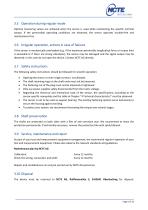
3.5 Operation during regular mode Optimal measuring values are achieved when the sensor is used while maintaining the specific nominal torque. If the permissible operating conditions are observed, the sensor operates trouble-free and maintenance-free. 3.6 Irregular operation, actions in case of failures If the sensor is mechanically overloaded (e.g. if the maximum permissible longitudinal force or torque limit is exceeded or if there are strong vibrations), the sensor may be damaged and the signal output may be distorted. In this case do not open the device. Contact NCTE AG directly. 3.7 Safety...
Open the catalog to page 9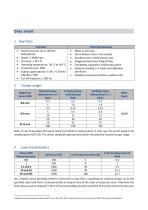
Any irregular stress (bending moment, transverse or axial force, exceeding the nominal torque) up to the specified static load limit is only permissible as long as none of the other stresses can occur. Otherwise the limit values must be reduced. If 30 % of the limit bending moment and 30 % of the limit transverse force are Specified values only apply to direct axial force on the shaft. If the axial force acts on the circlip, only 50 % of the force is permissi
Open the catalog to page 10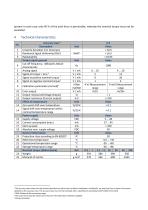
present in each case, only 40 % of the axial force is permissible, whereby the nominal torque must not be exceeded. The accuracy class means that the linearity deviation as well as the circulation modulation, individually, are each less than or equal to the value specified as the accuracy class. The accuracy class must not be confused with a classification according to DIN 51309 or EA-10/14. %ME: Related to the measuring range. The exact sensor-specific values can be found in the calibration certificate supplied. Wiring connected.
Open the catalog to page 11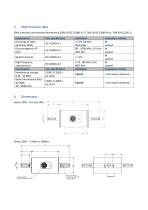
EMV immunity and emitted interference (DIN EN IEC 61000-6-2 / DIN EN IEC 61000-6-4 / DIN EN 61326-1)
Open the catalog to page 12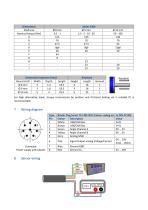
For high alternating loads, torque transmission by positive and frictional locking via a suitable fit is recommended. 7 Wiring diagram 8 Sensor wiring Type
Open the catalog to page 13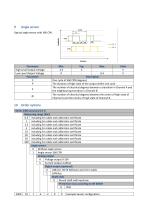
Optical angle sensor with 360 CPR. 10 Order options Series 2300 accuracy 0,5 % Measuring range [Nm] 0.5 including 5m cable and calibration certificate including 5m cable and calibration certificate including 5m cable and calibration certificate including 5m cable and calibration certificate including 5m cable and calibration certificate including 5m cable and calibration certificate including 5m cable and calibration certificate including 5m cable and calibration certificate Angle sensor Without angle sensor Analog output A Voltage output 0-10V Digital output (optional) U USB incl. NCTE Software...
Open the catalog to page 14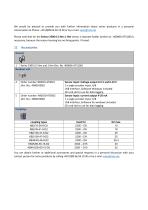
We would be pleased to provide you with further information about series products in a personal conversation at Phone: +49 (0)89 66 56 19 30 or by e-mail: [email protected] Please note that for the Sensor 2300 0.5 Nm; 1 Nm sensor a separate holder (article no.: 400006-ATS100) is necessary, because the sensor housing has no fixing points / thread. You can obtain further or additional accessories and special requests in a personal discussion with your contact person for series products by calling +49 (0)89 66 56 19 30 or by e-mail: [email protected].
Open the catalog to page 15
Your experts for magnetostrictive sensors
Open the catalog to page 16All NCTE AG catalogs and technical brochures
- Dynamic torque sensor
- Rotary torque sensor
- Static torque sensor
- Analog torque sensor
- Digital torque sensor
- DC torque sensor
- Compact torque sensor
- USB torque sensor
- Bidirectional torque sensor
- IP50 torque sensor
- IP65 torque sensor
- Torque sensor for the automobile industry
- CAN Bus torque sensor
- CAN torque sensor
- 5VDC torque sensor