


ROTARY BALL SPLINE SPB type

ROTARY BALL SPLINE SPB type
The NB Rotary Ball Spline SPB type is designed for applications requiring both linear and rotational motion. It integrates a spline nut with angular contact bearings, offering compactness, high rigidity, accuracy, and speed.
Structure and Advantages
The SPB type features a spline shaft, spline nut, flange outer ring, and angular contact bearings. This configuration allows for simultaneous linear and rotational motion, enhancing performance in precision applications.
Preload and Clearance
Preload levels are categorized into standard, light (T1), and medium (T2), adjusted via a spacer for optimal performance. Users are advised not to adjust the spacer themselves.
Handling Precautions
Proper handling is crucial to maintain the integrity and performance of the rotary ball spline. Users should adhere to specified preload settings and avoid unauthorized adjustments.
Accuracy
Accuracy is measured at specific points, with groove torsion indicated per 100mm of the spline shaft. High-grade and precision-grade tolerances are provided for various part numbers, ensuring precise motion control.
Specifications
Specifications include part numbers, preload symbols, and operating conditions. The document provides detailed tables on preload and clearance, operating conditions, and accuracy measurements.
Contact Information
NB Corporation provides contact details for its offices in the USA, Europe, and Japan, offering support and further information.
Note
Specifications are subject to change, and users are advised to consult NB Corporation for the latest information, especially regarding lubrication and maximum revolutions.
Catalog excerpts

ROTARY BALL SPLINE LINEAR + ROTATIONAL MOTION COMPACT HIGH RIGIDITY ・ ・ HIGH ACCURACY HIGH SPEED ・
Open the catalog to page 1
ROTARY BALL SPLINE SPB type STRUCTURE AND ADVANTAGES The NB rotary ball spline SPB type combines a spline nut and a set of angular contact bearings in a compact, high accurate, and high-speed rotation-capable assembly, providing both linear and rotational motion at the same time. Figure 1 Structure of SPB type PRELOAD AND CLEARANCE The amount of clearance and preload for the spline nut is expressed in terms of the clearance in the rotational direction. Three levels of preload are available: standard, lightT1 and mediumT2 , . The preload is properly adjusted by the spacer for the angular contact...
Open the catalog to page 2
ROTARY BALL SPLINE ACCURACY The NB rotary ball spline is measured for accuracy at the points shown in Figure 2. Figure 2 Accuracy Measurement Points Note: he support area is the portion where, for example, radial bearings are attached in order to support the spline shaft. T The part attachment area is the portion to which other parts, such as gears, are attached. ④ and ⑤ indicate radial runout during rotational motion. Table 3 Tolerance of Spline Shaft Groove Torsion Max. accuracy grade The groove torsion is indicated per 100mm, arbitrarily set as the effective length of the spline shaft section....
Open the catalog to page 3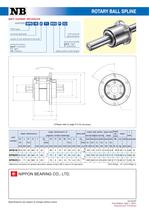
ROTARY BALL SPLINE part number structure nominal diameter number of nuts attached to one shaft preload symbol blank: standard with special accuracy grade blank: high spline shaft total length ?SPlease refer to page P-2 for accuracy. ^Maximum revolutions for grease lubrication, please contact NB in case of oil lubrication. 930 Muirfield Drive, Hanover Park, Western Regional Office TOLL FREE: Eastern Regional Office 41 Orchard Street, Ramsey, Specifications are subject to change without notice. First Edition: April 1, 2011 Reproduction Prohibited
Open the catalog to page 4All NB catalogs and technical brochures
 SLIDE SHAFT SPINDLE SHAFT
24 Pages
 STROKE BUSH SLIDE ROTARY BUSH
14 Pages
 TOPBALLR
13 Pages
 SLIDE BUSH
74 Pages
 SLIDE GUIDE
40 Pages
 FIT Series
2 Pages
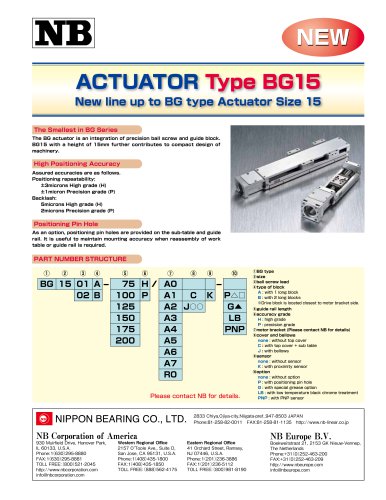 Actuator BG15
2 Pages
 Linear System General Catalog
293 Pages
 Slide Guide SEBS-BS
4 Pages
 TOPBALL Slide Products
28 Pages
 Compact Slide Way NYT/NYTS
2 Pages
 BALL SPLINE SSP-AM type
2 Pages
 SLIDE SCREW
4 Pages
 ACTUATOR
39 Pages
 LINEAR SYSTEM
21 Pages




Archived catalogs
 General Catalog
289 Pages
 NB - Slide Way
14 Pages
 NB - Rotary Ball Spline
2 Pages
 NB - Actuator
55 Pages
 NB - Slide Bush
4 Pages
 NB - Slide Rotary Series
14 Pages
 NB - Miniature Slide Table
6 Pages
 NB - Gonio way
8 Pages
 NB - Slide guide
18 Pages
 NB - Lienar system
23 Pages
- Actuator
- Linear actuator
- Electric actuator
- Compact actuator
- Screw actuator
- Linear motion system
- Precision actuator
- Ball screw actuator
- Positioning actuator
- Steel linear guide
- Ball bearing linear guide
- Ball screw
- Slide carriage block
- Compact linear guide
- Precision linear guide
- Machining spindle
- High-speed actuator
- Metal ball screw
- Track linear guide
- Roller linear guide