


LINEAR SYSTEM

LINEAR SYSTEM
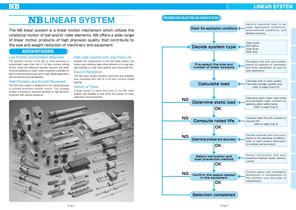
The NB linear system is a high-precision mechanism designed to convert rotational motion into linear motion using ball and/or roller elements. It aims to reduce machinery size and weight while ensuring high precision and smooth movement.
Advantages
- Low Friction and Excellent Response: Offers low dynamic friction for excellent motion response and positioning accuracy, especially in high-speed applications.
- High Precision and Smooth Movement: Precision grinding ensures smooth motion and high precision.
- High Load Capacity and Long Travel Life: Supports large rolling elements for high load capacity and longevity.
- Ease of Installation: Reduces machining and assembly time compared to traditional bearings.
- Variety of Types: Available in various types and sizes to meet different application needs.
Selection Process
- Identify machine type, application, and environmental conditions.
- Pre-select size and number based on experience.
- Calculate load and average variable load.
- Determine static load rating and allowable static moment.
- Compute rated life and compare to required life.
- Decide preload and accuracy based on conditions.
- Select lubrication and dust prevention methods.
- Confirm space and installation dimensions.
Load and Moment
The system must handle load and moment, defined by static load rating and allowable static moment to prevent deformation and ensure longevity.
Life of a Linear System
Life is determined by the distance traveled before material fatigue causes flaking, with rated life defined as the distance 90% of systems travel before flaking.
Load Calculations
Considers factors like hardness, temperature, and applied load coefficients, with equations provided for calculating rated life and applied load.
Tables and Figures
- Table 1-1: Minimum Static Safety Factor
- Figure 1-1: Load and Moment Illustration
- Figure 1-2: Hardness Coefficient
- Figure 1-3: Temperature Coefficient
- Table 1-2: Contact Coefficient
- Table 1-3: Applied Load Coefficient
Details calculations for equivalent loads in vertical and horizontal directions, including tables for different conditions. The dynamic equivalent load is calculated by summing vertical and horizontal loads.
Rigidity and Preload
Rigidity is crucial for precision applications. Preloading enhances rigidity by reducing elastic deformation, categorized into standard, light, and medium.
Static Safety Factor and Rated Life
Calculated using static equivalent load, considering coefficients like hardness and temperature. Formulas provided for rated life and lifetime in hours.
Frictional Resistance and Operating Environment
Dynamic friction coefficient varies with load. Formula provided for frictional resistance. Discusses temperature impact and dust prevention importance.
Lubrication
Essential for reducing friction and wear. Recommends specific oils and greases, with guidelines for relubrication intervals and properties of greases.
Handling and Use Precautions
Outlines precautions to avoid shock loads, maintain mounting accuracy, and protect from dust. Provides guidelines for extending system life.
Maintenance and Accessories
NB offers maintenance kits with nozzles and grease dispensers. Details on nozzle types and applications provided.
Catalog excerpts
LINEAR SYSTEM LINEAR SYSTEM PROCESS FOR SELECTING NB LINEAR SYSTEM Check the application conditions The NB linear system is a linear motion mechanism which utilizes the rotational motion of ball and/or roller elements. NB offers a wide range of linear motion products of high precision quality that contribute to the size and weight reduction of machinery and equipment. Decide system type ADVANTAGES Low Friction and Excellent Response Despite the compactness of the NB linear system, the system uses relatively large rolling elements on a long raceway resulting in a high load capacity and a long travel life. Slide Guide Ball Spline Slide Bush Slide Way High Load Capacity and Long Travel Life The dynamic friction of the ball or roller elements is substantially lower than that of full-face surface sliding friction. Since the difference between dynamic and static frictional resistance is small, motion response is excellent in terms of positioning accuracy and in high speed applications with acceleration and deceleration. I dentify machine type to be u s e d , a p plic atio n c o n ditio n s , environmental conditions, and desired accuracy. High Precision and Smooth Movement The NB linear system is designed for the rolling elements to achieve extremely smooth motion. The raceway surface is finished by precision grinding for high precision movement with optimal clearance. Pre-select the size and number of linear systems Ease of Installation The NB linear system shortens machining and assembly time compared with that of a full-face surface sliding bearing. Calculate load Variety of Types A wide variety of types and sizes of the NB linear systems are available to best serve the purpose for every application and requirement. Determine static load OK Compute rated life OK Determine preload and accuracy OK Select lubrication and dust prevention method Confirm the space needed in the equipment Pre-select the size and number based on balance of machinery and other equipment as well as past experience. Calculate load on each system. Calculate average variable load. (refer to page Eng-6-8) Determine basic static load rating and allowable static moment by applying static safety factor. (refer to page Eng-3) Compute rated life and compare to required life. (refer to page Eng-4) D e cid e p reloa d a n d accu racy based on the operating conditions. (refer to each product description for preload and accuracy) Select lubrication and dust prevention method. (seals, bellows, covers) Confirm space and installation dimensions in consideration of the machine size and ease of maintenance.
Open the catalog to page 1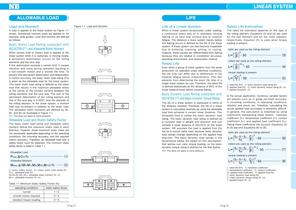
LINEAR SYSTEM ALLOWABLE LOAD Figure 1-1 Load and Moment A load is applied to the linear system as Figure 1-1 shows. Sometimes moment loads are applied to, for example, slide guides. Load and moment are defined as follows. Basic Static Load Rating (compliant with ISO14728-21) and Allowable Static Moment When excess load or impact load is applied to the linear system while it is stationary or moving slowly, a permanent deformation occurs on the rolling elements and the race way. If this deformation exceeds a certain limit, it causes vibration and noise during operation resulting in a non-smooth...
Open the catalog to page 2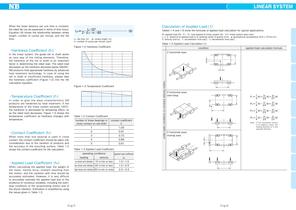
LINEAR SYSTEM ・ 3 10 Lh 2・ L ・n1・60 …………………… 9 ℓS L h: life time hr ℓ : stroke length S m cpm n1: number of cycles per minute In the linear system, the guide rail or shaft works as race way of the rolling elements. Therefore, the hardness of the rail or shaft is an important factor in determining the rated load. The rated load decreases as the hardness decrease below 58HRC. NB products hold appropriate hardness by advanced heat treatment technology. In case of using the rail or shaft of insufficient hardness, please take the hardness coefficient (Figure 1-2) into the life calculation equation....
Open the catalog to page 3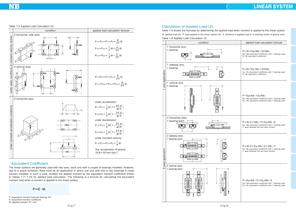
LINEAR SYSTEM Calculation of Applied Load 2 Table 1-5 Applied Load Calculation (2) applied load calculation formula 2 horizontal, side axes Table 1-6 shows the formulas for determining the applied load when moment is applied to the linear system. W: applied load (N) P: load applied to the linear system (N) ℓ: distance to applied load or to working center of gravity (mm) Table 1-6 Applied Load Calculation 3 condition applied load calculation formula 1 horizontal axis, 1 bearing Ep1: Mp equivalent coefficient with 1 bearing used Er: Mr equivalent coefficient Ey1: My equivalent coefficient with...
Open the catalog to page 4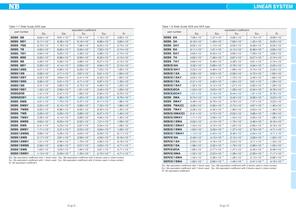
LINEAR SYSTEM Table 1-7 Slide Guide SEB type Table 1-8 Slide Guide SEB and SER type part number SEBS 7BY SEBS 9BS SEBS 9B Ep1: Mp equivalent coefficient with 1 block used Ep2: Mp equivalent coefficient with 2 blocks used in close contact Ey1: My equivalent coefficient with 1 block used Ey 2: My equivalent coefficient with 2 blocks used in close contact Er: Mr equivalent coefficient part number Ep1: Mp equivalent coefficient with 1 block used Ep2: Mp equivalent coefficient with 2 blocks used in close contact Ey1: My equivalent coefficient with 1 block used Ey 2: My equivalent coefficient with...
Open the catalog to page 5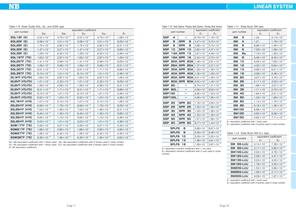
LINEAR SYSTEM Table 1-9 Slide Guide SGL, GL, and SGW type Table 1-10 Ball Spline・Rotary Ball Spline・Stroke Ball Spline equivalent coefficient part number E1 E2 part number Ep1: Mp equivalent coefficient with 1 block used Ep2: Mp equivalent coefficient with 2 blocks used in close contact Ey1: My equivalent coefficient with 1 block used Ey 2: My equivalent coefficient with 2 blocks used in close contact Er: Mr equivalent coefficient Table 1-11 Slide Bush SM type equivalent coefficient part number E1 E2 E1: equivalent coefficient with 1 bush used E 2 : equivalent coefficient with 2 bushes used in...
Open the catalog to page 6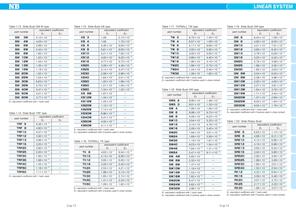
LINEAR SYSTEM Table 1-13 Slide Bush SM-W type equivalent coefficient part number E1 E2 3W Table 1-15 Slide Bush KB type equivalent coefficient part number E1 E2 E1: equivalent coefficient with 1 bush used E 2 : equivalent coefficient with 2 bushes used in close contact E1: equivalent coefficient with 1 bush used E1: equivalent coefficient with 1 bush used E 2 : equivalent coefficient with 2 bushes used in close contact Table 1-20 Slide Rotary Bush equivalent coefficient part number E1 E2 E1: equivalent coefficient with 1 bush used E 2: equivalent coefficient with 2 bushes used in close contact...
Open the catalog to page 7All NB catalogs and technical brochures
 SLIDE SHAFT SPINDLE SHAFT
24 Pages
 STROKE BUSH SLIDE ROTARY BUSH
14 Pages
 TOPBALLR
13 Pages
 SLIDE BUSH
74 Pages
 SLIDE GUIDE
40 Pages
 FIT Series
2 Pages
 Actuator BG15
2 Pages
 Linear System General Catalog
293 Pages
 Slide Guide SEBS-BS
4 Pages
 ROTARY BALL SPLINE SPB type
4 Pages
 TOPBALL Slide Products
28 Pages
 Compact Slide Way NYT/NYTS
2 Pages
 BALL SPLINE SSP-AM type
2 Pages
 SLIDE SCREW
4 Pages
 ACTUATOR
39 Pages




Archived catalogs
 General Catalog
289 Pages
 NB - Slide Way
14 Pages
 NB - Rotary Ball Spline
2 Pages
 NB - Actuator
55 Pages
 NB - Slide Bush
4 Pages
 NB - Slide Rotary Series
14 Pages
 NB - Miniature Slide Table
6 Pages
 NB - Gonio way
8 Pages
 NB - Slide guide
18 Pages
 NB - Lienar system
23 Pages
- Actuator
- Linear actuator
- Electric actuator
- Compact actuator
- Screw actuator
- Linear motion system
- Precision actuator
- Ball screw actuator
- Positioning actuator
- Steel linear guide
- Ball bearing linear guide
- Ball screw
- Slide carriage block
- Compact linear guide
- Precision linear guide
- Machining spindle
- High-speed actuator
- Metal ball screw
- Track linear guide
- Roller linear guide