


NASH Condenser Exhauster Saves Energy

NASH Condenser Exhauster Saves Energy
Catalog excerpts
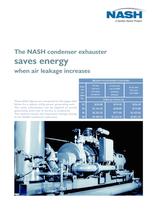
The NASH condenser exhauster saves energy when air leakage increases SEE HOW MUCH MONEY IS INVOLVED INVOLVED Steam cost per million These dollar figures are computed on the pages that follow for a typical utility power generating unit. The same calculations can be applied to actual generating units now in service or projected. The analysis reveals the impressive energy savings of the NASH condenser exhauster. You lose Or this much this much with a NASH NASH with steam condenser jet ejectors exhauster Btu So you save this much with NASH NASH Dollars per 24-hour day $1 $550.80 $194.40 $356.40 $2 $1,101.60 $338.80 $712.80 $4 $2,203.20 $777.60 $1,425.60 $8 $4,406.40 $1,555.20 $2,851.20
Open the catalog to page 1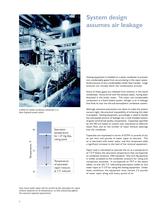
System design assumes air leakage Venting equipment is installed on a steam condenser to prevent non-condensable gases from accumulating in the vapor space. Small amounts of non-condensables inhibit heat transfer. Large amounts can virtually block the condensation process. Some of these gases are released from solution in the liquid condensate. Some arrive with the exhaust steam, having been dissolved in the boiler water. The major non-condensable component in a fossil fueled system, though, is air in leakage that finds its way into the sub-atmospheric condenser system. A NASH AT-2006E condenser...
Open the catalog to page 2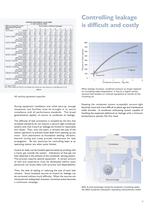
VENTING EQUIPMENT CAPACITIES Note: These tables are based o air leakage only and the air vapor mixture at 1 inch HgA and 71.5°F. Controlling leakage HEI venting equipment capacities When leakage increases, condenser pressure no longer depends on circulating water temperature. It rises to a higher suction pressure that enables air-removal equipment to handle all the During equipment installation and initial start-up, enough manpower and facilities must be brought in to assure compliance with all performance standards. This broad generalization applies, of course, to condenser air leakage. The...
Open the catalog to page 3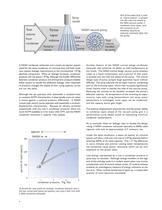
Spray nozzle Total volume from condenser Partial vapor volume NASH vacuum pump Total volume to pump Partial air volume A NASH condenser exhauster and a steam jet ejector system sized for the same condenser air-removal duty will both meet new-system leakage requirements at the conventional 1.0"Hg absolute rating point. When air leakage increases, condenser pressure will rise above 1.0"Hg. Although the smaller differential between condenser pressure and atmospheric pressure enables either system to handle the additional leakage, their responses to pressure changes the slopes of their rising capacity...
Open the catalog to page 4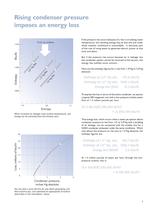
Rising condenser pressure imposes an energy loss If the pressure rise occurs because of a rise in circulating water temperature, the resulting energy loss-at that site and under those weather conditions-is unavoidable. It becomes part of the cost of using steam to generate electric power at that time and place. From l.p. turbine Enthalpy 1100 But if the pressure rise occurs because air in leakage into the condenser system cannot be removed at full vacuum, this energy loss justifies some concern. Here are the enthalpy figures for a rise from 1.0"Hg to 3.0"Hg absolute: 1.5 "H gA bs 1.0 . "H gA...
Open the catalog to page 5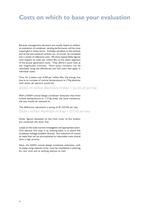
Costs on which to base your evaluation Because management decisions are usually based on dollars, an evaluation of condenser venting performance will be most meaningful in those terms. Enthalpy penalties at the exhaust end of the low-pressure turbine can, of course, be translated into a variety of reference units. We show typical dollar figures with respect to costs per million Btu at the steam segment of the power generation cycle. They afford a quick look at the magnitudes involved. More exact numbers can be calculated using the efficiencies and fuel costs that apply in individual cases. Thus,...
Open the catalog to page 6
Some other benefits that support the choice Only one aspect of condenser exhauster performance has been emphasized in the foregoing discussion. But a NASH condenser exhauster’s ability to cope with excess air leakage is not the only reason for its preference by consulting engineers and by the owners and operators of steam power plants. Its durability has been thoroughly demonstrated. Any initial concern about a motor-driven vacuum pump with one moving part in place of ejectors without any major moving parts has been dispelled by experience. The NASH pump is widely recognized as a rugged machine,...
Open the catalog to page 7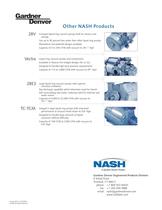
O t h e r N A S H Pr o d u c t s 2BV Compact liquid ring vacuum pumps built for serious cost savings Use up to 50 percent less water than other liquid ring pumps Monoblock and pedestal designs available Capacity of 4 to 350 CFM with vacuum to 29+” HgV Vectra Liquid ring vacuum pumps and compressors Available in feature rich budget designs (XL or GL) Designed to handle high back pressure requirements Capacity of 115 to 2,860 CFM with vacuum to 29” HgV 2BE3 TC-TCM Large liquid ring vacuum pumps with superior corrosion resistance Top discharge capability which eliminates need for trench Self-recirculating...
Open the catalog to page 8All Nash catalogs and technical brochures
 XM-150
2 Pages
 XM-150 Compresso
2 Pages
 CL series
4 Pages
 liquid ring compressors
8 Pages
 905 series
4 Pages
 Vectra SX series
6 Pages
 Vectra GL series
8 Pages
 NASH VetRAPAKS
6 Pages
 Vectra XL series
8 Pages
 2BE1 series
1 Page
 2BE4 series
4 Pages
 Vectra XL
1 Page
 Vectra XL 750 & XL 950
1 Page
 Vectra GL
1 Page
 TC/TCM Two-stage
2 Pages
 P2620
P26201 Page
 2BV7
2BV72 Pages
 2BV5
2BV52 Pages
 2BE4
2BE42 Pages
 2BE3
2BE31 Page
 2AV2
2AV22 Pages
 Nash - Oil and Gas Industry
8 Pages
 Paper Industry
8 Pages
 NASH Vacuum Pumps
2 Pages
 Pharmaceutical Industry
8 Pages
 Wittig Rotary Vane
2 Pages
 Nash - Paper Industry
5 Pages
 Nash - Filter Applications
6 Pages
 TC/TCM Brochure - English
4 Pages
 2BE4 Data Sheet - English
2 Pages


Archived catalogs
 NASH 2BE5
4 Pages
 "SV" Standardized Systems
102 Pages
 VectraPak Brochure - English
6 Pages
 CL Brochure - English
8 Pages
 Nash 905 Brochure - English
4 Pages
 Nash - New Series Vectra SX
4 Pages
 Nash - Oilsealed packages
6 Pages
 2AV1 Data sheet - English
2 Pages
 2AV2 Data sheet - English
2 Pages
 2BV5 Data Sheet - English
2 Pages
 2BV7 Data Sheet - English
2 Pages
 TC-TCM Data Sheet - English
2 Pages


- Air compressor
- Nash stationary compressor
- Nash vacuum generator
- Industrial compressor
- Electrically-powered compressor
- Nash single-stage vacuum pump
- Lubricated compressor
- Nash lubricated vacuum generator
- Nash lubricated vacuum pump
- Compact vacuum generator
- Nash gas compressor
- Compact vacuum pump
- Multi-stage compressor
- High-pressure compressor
- Multi-stage vacuum pump
- Rugged compressor
- Two-stage compressor
- Gas vacuum generator