
- Catalogs
- Narda Safety Test Solutions GmbH
- Datasheet_EF6092

Datasheet_EF6092

Datasheet_EF6092
- Frequency Range: 100 MHz to 60 GHz, covering high-frequency communications including mobile radio and satellite links.
- Measurement Capability: Isotropic (non-directional) measurement using three orthogonally arranged dipoles with detector diodes.
- Dynamic Range: High dynamic range with a measurement range of 0.7 to 400 V/m (CW) and 0.7 to 61.4 V/m (True RMS).
- Design: The probe head is made of foam material for sensor protection and optimal RF characteristics.
- Type of Frequency Response: Flat
- Dynamic Range: 55 dB
- Damage Levels: CW damage level at 1600 V/m and peak damage level at 1900 V/m.
- Uncertainty: Varies with frequency and measurement conditions, with specific dB values provided for different ranges.
- Temperature Range: Operating: -10 °C to +50 °C; Non-operating: -40 °C to +70 °C
- Humidity: 5 to 95% RH at ≤ 28 °C
- Size and Weight: 318 mm x 66 mm Ø, 90 g
Catalog excerpts

www.narda-sts.com E-FIELD PROBE EF6092 A General public and occupational field exposure A Broad frequency range with high dynamic range A Isotropic (non-directional) measurement The probe contains three orthogonally arranged dipoles with detector diodes. The diode voltages each correspond to the RMS value of the spatial components. The isotropic measurement result is obtained by addition within the probe. APPLICATIONS The probe detects electric fields from 100 MHz up to 60 GHz. This frequency range covers almost the entire range of high frequency communications, right up to mobile radio and satellite links. The linearity and sensitivity of the probe ensure its suitability for checking human safety limit values in the occupational and general public environments. PROPERTIES The probe is designed with mechanical and electrical properties ideal for field use. The probe head is made of foam material to provide effective protection for the sensors, while having excellent RF characteristics. The detector elements are also largely protected against overload, since their destruction limit is well above all the human safety limit values. CALIBRATION The probe is calibrated at several frequencies. The correction values are stored in an EPROM in the probe and are automatically taken into account by the NBM instrument. Calibrated accuracy is thus obtained regardless of the combination of probe and instrument. NSTS 0416-E0307C 1 / 2 Subject to change
Open the catalog to page 1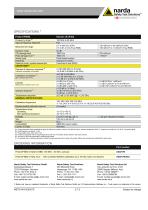
(a) Unless otherwise noted specifications apply at reference condition: device in far-field of source, ambient temperature 23±3 °C, relative air humidity 40 % to 60 %, sinusoidal signal (b) Cutoff frequency at approx. -6 dB (c) Pulse length 1psec, duty cycle 1:100 (d) Frequency response can be compensated for by the use of correction factors stored in the probe memory (e) Accuracy of the fields generated to calibrate the probes (f) Uncertainty due to varying polarization (verified by type approval test for meter with probe). Ellipse ratio included and calibrated for each probe Narda Safety Test...
Open the catalog to page 2All Narda Safety Test Solutions GmbH catalogs and technical brochures
 NIM-511/513
4 Pages
 NBM-580
4 Pages
 Narda EMF Monitors
8 Pages
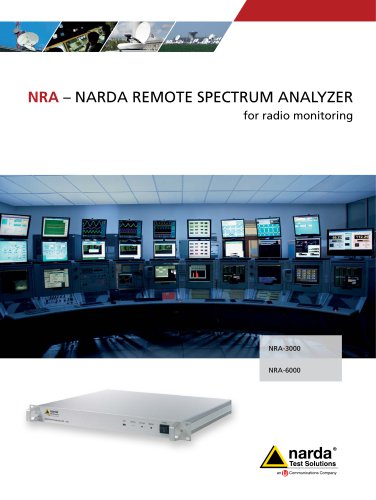
 NRA-RX Narda Remote Analyzer
12 Pages
 Area monitoring
16 Pages
 HUMAN SAFETY
8 Pages
 EHP-200A
7 Pages
 THM 1176
6 Pages
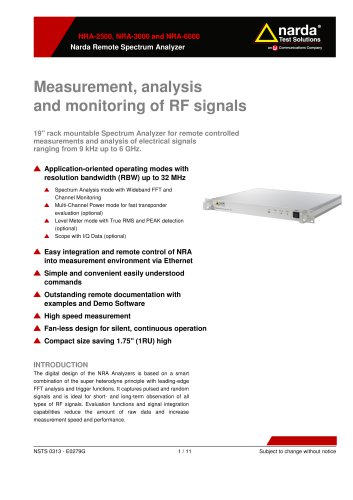 NRA-2500, NRA-3000 and NRA-6000
11 Pages
 L3-500 3-phase LISN
2 Pages
 L3-100 3-phase LISN
2 Pages
 L3-64 3-phase LISN
2 Pages
 L3-32 3-phase LISN
2 Pages
 L1-500 Single-path LISN
2 Pages
 7010 All-in-one EMI Receiver
2 Pages
 SRM-3006
24 Pages
 EFC-400LF
6 Pages
 EHP-50D
12 Pages
 ELT-400
8 Pages
 EFA-300
10 Pages
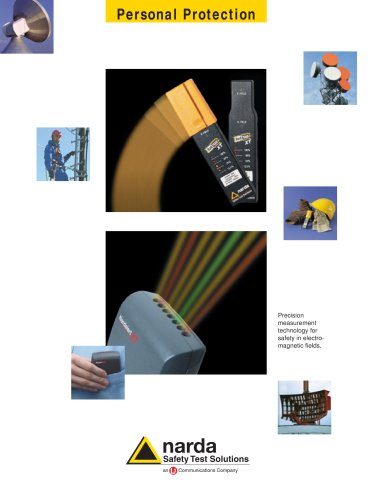
 RadMan XT
5 Pages





Archived catalogs
 SMARTS II
4 Pages
 Narda Area Monitor AMS 8060
5 Pages
 Narda Area Monitor AMB 8057
8 Pages
 Nardalert XT
6 Pages
 Data sheet NBM-520
7 Pages
 EHP-200
7 Pages
 EHP-50
9 Pages
 THM1176-PDA
6 Pages
 Simulation Software EFC-400
2 Pages
 ELECTROMAGNETIC FIELDS
12 Pages
 EFA-200/300 Low Frequency
16 Pages



- Measuring device
- Benchtop analyser
- 3D software solution
- Integration analyzer
- Simulation software solution
- Portable gauge
- Radio antenna
- Power quality analyzer
- Power meter
- 2D software
- Measurement monitoring module
- Environmental monitoring system
- Electrical network analyzer
- Spectrum analyzer
- Digital power meter
- Directional antenna
- Alarm monitoring module
- Power monitoring module
- Field measuring instrument
- Portable power meter