
- Catalogs
- Nanjing Huamai Technology Company
- Military Cable / Emergent Cable

Military Cable / Emergent Cable

1 / 1 PageView full catalog
Military Cable / Emergent Cable
Product catalog summary
Description
The military cable features tight buffer fibers stranded around a central strength member, wrapped with aramid yarn, and completed with an outer sheath.
The military cable features tight buffer fibers stranded around a central strength member, wrapped with aramid yarn, and completed with an outer sheath.
Features and Applications
- Compact, lightweight, and flexible design.
- Aramid yarn provides excellent tensile strength.
- Superior bending, crush, and corrosion resistance.
- Suitable for harsh environments, temporary, and emergency cabling.
- Used for communication between radars or in oil fields.
Structure & Material
- Fiber: G.652D, G.657A1, G.657A2, 50/125μm, 62.5/125μm.
- Tight buffer: Nylon, Hytrel.
- Central strength member: FRP.
- Strength member: Aramid yarn.
- Outer sheath: TPU, color black.
Cable Property
| Number of Cores | Diameter (mm) | Tensile Strength (N) | Crush Resistance (N/100mm) | Bending Radius (mm) |
|---|---|---|---|---|
| 2 | 5.0±0.2 | 800 (Long term), 1800 (Short term) | 5000 (Long term), 20000 (Short term) | 5·D (Static), 10·D (Dynamic) |
| 4 | 5.0±0.2 | 800 (Long term), 1800 (Short term) | 5000 (Long term), 20000 (Short term) | 5·D (Static), 10·D (Dynamic) |
| 6 | 6.0±0.2 | 800 (Long term), 1800 (Short term) | 5000 (Long term), 20000 (Short term) | 5·D (Static), 10·D (Dynamic) |
Note: D = Cable diameter.
Fiber Characteristics
| Fiber Type | Attenuation (Max, dB/km) | Bandwidth (Min, MHz·km) |
|---|---|---|
| SMF B1.3, B6 | 0.40 (1310 nm), 0.30 (1550 nm) | — |
| MMF A1a | 3.5 (850 nm), 1.5 (1300 nm) | 200~800 (850 nm), 200~1200 (1300 nm) |
| MMF A1b | 3.5 (850 nm), 1.5 (1300 nm) | 160~800 (850 nm), 200~1000 (1300 nm) |
Environmental Performance
- Transportation & Storage: -40℃ to +70℃
- Installation: -20℃ to +60℃
- Operation: -30℃ to +60℃
- RoHS compliant
Note: All values can be customized.
See more
Catalog excerpts
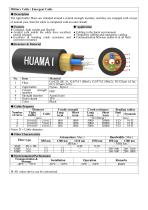
Military Cable / Emergent Cable ♦ Feature ♦ Compact, light weight and flexible ♦ Aramid yarn makes the cable have excellent tensile strength ♦ Excellent in bending crush resistance and corrosion resistance ♦ Description The tight buffer fibers are stranded around a central strength member, and they are wrapped with a layer of aramid yarn, then the cable is completed with an outer sheath. ♦ Application ♦ Cabling in the harsh environment ♦ Temporary cabling and emergency cabling ♦ Communication between radars or in oil field ♦Structure & Material
Open the catalog to page 1All Nanjing Huamai Technology Company catalogs and technical brochures
 Flat Fiber Ribbon Cable
1 Page
 Indoor Armored Cable
1 Page
 MPO Cable
1 Page
 Round Drop Cable
1 Page
 RRU Cable
1 Page
 Sensing Cable
1 Page
 Simplex Cable
1 Page
 Tight Buffer Fiber
1 Page
 Zip Cord Cable
1 Page
 100G DWDM Mux / Demux Module
3 Pages
 1310/1550 WDM Device
2 Pages


Related Searches
- Digital imager
- Power generator
- Diesel generator set
- Industrial genset
- 50 Hz generator set
- LED lighting
- Stationary genset
- Monitoring camera system
- Multi-strand cable
- Detection camera system
- Gas detector
- HD camera module
- Optical cable
- Air-cooled generator set
- Single-phase generator set
- Flame-retardant cable
- Lithium battery
- Armored cable
- Optical data cable
- Electrical cabinet
*Prices are pre-tax. They exclude delivery charges and customs duties and do not include additional charges for installation or activation options. Prices are indicative only and may vary by country, with changes to the cost of raw materials and exchange rates.
About DirectIndustry
DirectIndustry is a marketplace that offers B2B players a complete experience, from product sourcing to purchase. DirectIndustry is an entity of VirtualExpo Group.
Are you a buyer?
Are you a supplier?