
- Catalogs
- Multiquip, Inc.
- Generator Handbook

Generator Handbook

Generator Handbook
Portable power is crucial on jobsites, and Multiquip generators are known for their reliability. This handbook provides guidelines for generator sizing and explains basic electrical terminology.
Generators convert mechanical energy into electrical energy, measured in voltage, amperage, and watts. Voltage drives electricity flow, amperage measures current flow, and watts indicate electrical power. Direct Current (DC) flows in one direction, while Alternating Current (AC) changes direction periodically.
Frequency, in Hertz (Hz), indicates how often AC changes direction. In the US, standard household current is 60 Hz. Phase refers to AC system circuits, with single-phase and three-phase systems used for different applications.
Generators are rated by maximum and continuous output, with continuous output being key for sizing due to heat effects on efficiency. Starting amperage is higher than running amperage.
Identify load type (resistive or inductive) and calculate total wattage using the formula (Volts x Amps = Watts). The One-Two-Three Method helps size generators by considering starting wattage requirements.
Generator output decreases with altitude and high temperatures. Output drops by 3.5% per 1,000 feet above sea level and efficiency decreases by 1% for every 10°F above 60°F.
Safety is critical when using generators. Use Ground Fault Circuit Interrupters (GFCI) and ensure proper grounding. Avoid wet conditions and combustible materials. Proper training and maintenance are essential.
Important features include voltage regulation, copper windings, brushless excitation, and safety components like circuit breakers and GFCIs. Consider these when selecting a generator.
Appendix A lists wattage requirements for electric motors, while Appendix B provides guidance on extension cord gauge based on distance and amperage.
This document includes reference charts for wattage requirements of various construction and residential appliances, highlighting those with higher starting amperage needs.
- Sanders: Require 2600 starting watts and 1200 running watts.
- Saws: Circular saws need 2200 to 3900 starting watts and 950 to 2000 running watts. Jig saws require 400 starting watts and 300 running watts, while cutoff saws need 3500 starting watts and 2500 running watts.
- Water Pumps: Submersible pumps require 1750 to 5000 starting watts and 500 to 1500 running watts. Non-submersible pumps need 2250 to 5250 starting watts and 600 to 1600 running watts.
- Air Conditioners: Require 3600 starting watts and 1300 running watts.
- Kitchen Appliances: Broilers, coffee makers, and electric ranges need 1000 to 1400 watts. Gas clothes dryers require 850 starting watts, while electric models need 5700 starting watts.
- Fans and Heaters: Attic fans require 450 starting watts, and heating pads need 65 watts.
- Miscellaneous: Refrigerators require 1200 starting watts and 330 running watts. Televisions and vacuum cleaners need 300 and 900 starting watts, respectively.
Items marked with ** typically require higher starting amperage. Estimated wattage is provided for all items.
Catalog excerpts
Generator Handbook
Open the catalog to page 1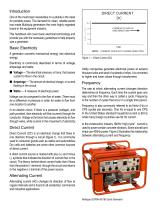
DIRECT CURRENT DC 12 CURRENT FLOWS IN ONE DIRECTION-► Introduction One of the most basic necessities on a jobsite is the need for portable power. The demand for clean, reliable power has made Multiquip generators the most highly regarded brand in the equipment industry. This handbook will cover basic electrical terminology and provide you with the necessary guidelines to help properly size a generator. Basic Electricity A generator converts mechanical energy into electrical energy. Electricity is commonly described in terms of voltage, amperage and watts: ■ Voltage—The electrical pressure, or...
Open the catalog to page 2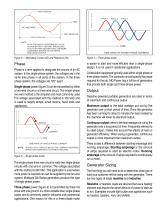
60 OF THE ABOVE REFERENCED CYCLE OCCUR WITHIN 1 SECOND, PRODUCING 60 CYCLES PER SECOND (CPS), OR MORE COMMONLY KNOWN AS A 60 HERTZ SINE-WAVE OUTPUT. TIME SINE WAVE OF THREE-PHASE CURRENT Figure 2 — Alternating Current (AC) and Frequency (Hz) Figure 4 — Three phase power is easier to start and more efficient than a single-phase design. It is not used in residential applications. Phase is a term applied to designate the circuits of an AC system. In the single-phase system, the voltages are in the same time phase in all parts of the system. In the threephase system, the voltages are 120° apart....
Open the catalog to page 3
Inductive, or capacitive, loads are devices that use an electric motor and require more wattage for start up than continuous operation. Examples of inductive loads include concrete mixers, submersible pumps and air compressors. Next, ask your customer to provide you with the voltage, amperage, and wattage of the tools that will be run off the generator. With this information you can easily determine the total wattage requirement of the equipment being used. This is accomplished by using the power formula. Power Formula Use this formula to size a generator to fit your customer’s needs. Volts x...
Open the catalog to page 4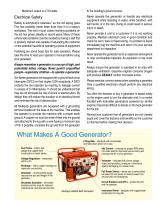
Maximum output is 4,710 watts. to the building’s ground source. Electrical Safety “Safety is everybody’s business,” so the old saying goes. This has probably never been truer than it is in today’s workplace. The rise in court cases involving accidents on the job has grown steadily in recent years. Many of these unfortunate accidents could be avoided by having a staff that is properly trained and capable of educating the customer on the potential hazards of operating a piece of equipment. Following are some basic tips for safe operation. Please take the time to read your operator’s manual before...
Open the catalog to page 5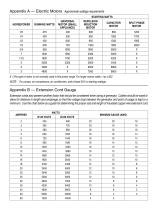
Appendix A — Electric Motors Approximate wattage requirements
Open the catalog to page 6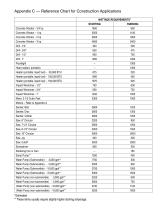
These items usually require slightly higher starting amperage.
Open the catalog to page 7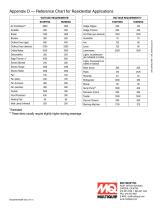
* Estimated ** These items usually require slightly higher starting amperage. MULTIQUIP E-MAIL: [email protected] www.multiquip.com
Open the catalog to page 8All Multiquip, Inc. catalogs and technical brochures
 DIS100SSK4F
1 Page
 DIS185SSI4F
1 Page
 GloBug Balloon Systems Brochure
16 Pages
 MQ Equipment Guide
56 Pages
 Studio generator brochure
8 Pages
 LED GLOBUG
8 Pages
 MUD TUB
1 Page
 Mix-N-Go Concrete Mixers
2 Pages
 Essick Mixers
8 Pages
 Generators
4 Pages
 Portable Generators
4 Pages
 Diesel Powered Generators
2 Pages
 Generators and Welders
8 Pages
 Light Towers
8 Pages
 MLT
MLT2 Pages
 GloBug Lighting Systems
8 Pages
 H2LT
H2LT5 Pages
 Dewatering Pumps
8 Pages
 Trash Pumps
8 Pages
 Electric Submersible Pumps
8 Pages
 Ride-On Trowels Brochure
8 Pages
 Concrete Vibrators Brochure
8 Pages
 Walk-Behind Trowels Brochure
8 Pages
 Tile Saws Brochure
4 Pages
 Masonry Saws Brochure
8 Pages
 Welders Brochure
8 Pages
 Plate Compactors Brochure
8 Pages
 Welder/Generators Brochure
8 Pages
 Rammers Brochure
8 Pages


