

Reactor Selection for the Line Side of DC Motor Controllers

Reactor Selection for the Line Side of DC Motor Controllers
Introduction
This application note provides guidance on selecting the appropriate reactor for DC motor drives. It outlines step-by-step methods to ensure optimal reactor selection, enhancing drive protection and power quality.
Reactor Selection for DC Motor Controllers
MTE three-phase AC reactors can be used on the input of DC motor controllers to protect drives and improve power quality. A 3% impedance MTE reactor is recommended to reduce supply voltage notching caused by three-phase DC motor drives.
Quick Selection Guidelines
For lower horsepower applications, select reactors directly from the MTE reactor selection table. For higher horsepower DC drives, which may require more line current than AC drives of the same horsepower, choose the reactor for the next larger horsepower rating. Specific recommendations include:
- 600 Vac, > 75 HP DC
- 480 Vac, > 100 HP DC
- 208-240 Vac, > 20 HP DC
Mathematical Selection Method
To calculate the required reactor, gather the full-load DC current, three-phase supply voltage, and supply frequency. The current demand from the AC supply is approximately 0.85 times the full load amps of the DC motor. The inductance for 3% impedance is calculated using the formula:L = (Z * V) / (I * 2 * π * f * √3)
Where:
- L = inductance in Henries
- Z = percent impedance desired (0.03)
- V = supply voltage (line to line)
- I = fundamental load current from AC line (Amperes)
- f = supply frequency (Hz)
Example Calculation
For a DC motor drive with 480V 60 Hz three-phase power, a 500Vdc, 125 HP motor with a full load current of 205A:
- Full load current demand: 0.85 * 205 = 175 Amperes
- Required inductance: L = (.03 * 480) / (175 * 2 * 3.1416 * 60 * 1.732) = 0.126 mH
Catalog excerpts
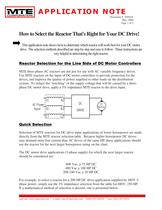
web site: www.mtecorp.com e-mail: [email protected] (800) 455-4MTE fax: (262) 253-8222 MTE three-phase AC reactors are not just for use with AC variable frequency drives. Use MTE reactors on the input of DC motor controllers to provide protection for the drives, and improve the quality of power supplied to other loads on the distribution system. To reduce the "notching" of the supply voltage that will be caused by a three- phase DC motor drive, apply a 3% impedance MTE reactor to the drive input. > Selection of MTE reactors for DC drive input applications of lower horsepower are made directly from the MTE reactor selection table. Because higher horsepower DC drives may demand more line current than AC drives of the same HP, these applications should use the reactor for the next larger horsepower rating on the chart. The DC motor drive applications (3-phase supply) for which the next larger reactor should be considered are: 600 Vac, > 75 HP DC 480 Vac > 100 HP DC 208-240 Vac > 20 HP DC For example, to select a reactor for a 200 HP DC drive application supplied by 480V 3-phase power, simply use the 3% impedance selection from the table for 480V, 250 HP. If a mathematical method of selection is desired, one is presented below. >
Open the catalog to page 1All MTE catalogs and technical brochures
 Noise Suppression Network
2 Pages
 Guard-AC? PLUS
2 Pages
 RFI and EMI Filters
2 Pages
 Matrix PureSine ®
2 Pages
 RL Line/Load Reactors
2 Pages
 RLW Reactors
2 Pages

Archived catalogs
 Motor Protection Filters
2 Pages
 Harmonic Filters
4 Pages
 RFI / EMI Filter Tutorial
17 Pages
 Line Reactor Tutorial
15 Pages
 Load Reactor Tutorial
13 Pages
 Motor Protection Filter Tutorial
11 Pages
 Harmonic Filter Tutorial
36 Pages
 Matrix Filters®
2 Pages
 DC Link Chokes
2 Pages
 MTE Corporation - Catalog
9 Pages


