


- Company
- Products
- Catalogs
- News & Trends
- Exhibitions
Sustainability

Sustainability
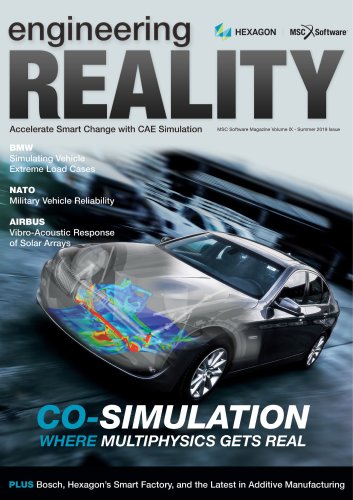
The editorial highlights the significance of sustainability in engineering, emphasizing the role of computer-aided engineering (CAE) in tackling global environmental challenges. MSC Software's CEO, Paolo Guglielmini, outlines the company's vision for a smarter design ecosystem to improve product quality and manufacturing efficiency.
The 2020 release of MSC Software's Cradle CFD solutions focuses on multiphysics simulations, including tools like Actran FEA coupling for aeroacoustics and new turbomachinery applications to boost productivity.
Keith Hanna, Vice President of Marketing, discusses CAE's contribution to sustainable development, featuring customer stories on sustainability efforts, such as lightweight aircraft wings and thermal effect reduction in video displays.
Chris Kinser from General Motors discusses virtual testing's role in developing safe autonomous vehicles, highlighting emission and noise pollution reduction through smarter technologies and electrification.
The magazine covers co-simulation stories from companies like Samsung and Panasonic, and the US Army's use of MaterialCenter for additive manufacturing data management, emphasizing its transformative potential for sustainability.
Volkswagen's use of MSC Nastran Modules is discussed, showcasing benefits like efficient model management and handling large models without ID collisions, enhancing agility and collaboration in engineering development.
The magazine discusses engineering advancements, including Ford's reduction of physical prototyping, Audi's traffic simulation for connected cars, and NVIDIA's use of GPUs to enhance MSC Nastran performance.
The magazine concludes with insights into smart generative design, integrated computational materials engineering, and AI integration in CAE products.
General Motors focuses on integrating autonomous mobility, emphasizing electric vehicles due to their environmental benefits and technological advantages.
GM partners with Hexagon/MSC for autonomous driving strategy, utilizing their sensor and simulation technologies to enhance vehicle testing and development.
GM aims to develop advanced mobility solutions by focusing on customer needs, with efforts concentrated in the United States, particularly San Francisco.
GM emphasizes safety in automated driving, focusing on use cases and implementable features rather than strictly adhering to SAE levels of autonomy.
Super Cruise is GM's advanced driver assistance feature allowing hands-free driving on supported roads, combining adaptive cruise control and lane-centering control with a driver attention system.
GM acquired Cruise Automation to enhance self-driving software capabilities, focusing on testing in complex urban environments like San Francisco.
The document discusses global environmental challenges, emphasizing sustainable development and the impact of human activities like CO2 emissions and plastic waste.
Manufacturers are encouraged to adopt sustainable practices due to declining natural resources, legislation, societal pressures, and consumer choices.
Sustainable design engineers must address constraints related to energy, water, food, health, and other basic human needs, leading to efficient operations and minimal environmental impact.
CAE is pivotal in developing efficient, high-quality products with minimal prototypes, reducing material waste and energy usage, particularly in power generation and renewable energy sectors.
CAE tools are instrumental in designing eco-friendly aircraft, such as the Airbus A350-1000 and Boeing 787 Dreamliner, featuring advanced technologies for reduced fuel consumption and emissions.
The automotive industry is shifting towards electric vehicles and lightweight materials to meet emission regulations, with CAE solutions aiding in optimizing vehicle design for sustainability.
Material resources face pressure due to finite availability and recycling challenges, with CAE simulations requiring accurate material properties for sustainability.
Sustainability is a priority in the global economy, with CAE playing a vital role in embedding sustainability into design and manufacturing processes.
This section emphasizes sustainable engineering design solutions to enhance product performance, quality, manufacturability, and recyclability, highlighting CAE simulation's role in minimizing waste.
Ford collaborates with MSC Software to reduce physical prototyping through Hardware-in-the-loop (HIL) testing, integrating physical components with virtual models for efficient testing.
The document explores CADLM technology for accurate design decisions, describing the creation of Reduced Order Models (ROMs) to predict vehicle behavior in real-time.
This section introduces MSC Apex Generative Design, a digital solution connecting design to virtual manufacturing simulation, optimizing the additive manufacturing process.
The document discusses the need for generative design, particularly in the context of MSC Apex Generative Design, which aids design engineers in creating organic topologies suitable for 3D printing.
Despite its potential, AM faces challenges such as shrink lines, cracking, and overheating, hindering its widespread adoption for mass production.
MSC Apex Generative Design automates the generative design process, ensuring manufacturability by generating design candidates that meet user expectations.
The tool allows users to specify manufacturing constraints, minimizing 3D printing costs by evaluating material requirements and support structures.
MSC Apex Generative Design employs a rewritten finite element solver and optimization engine for efficient design space exploration.
The document presents a case study involving the design of a wheel carrier for a formula student team, demonstrating the tool's capability to handle complex load cases.
MSC Apex Generative Design bridges the gap between design and AM, enabling the production of designs validated for AM.
The document discusses the use of finite element models to analyze acoustic cavities in aerospace structures, exploring hybrid and fully modal solutions.
The methodology was applied to the new VEGA C structures, focusing on interstage structures sensitive to acoustic loads.
Avio's engineering team utilized Actran's Virtual SEA approach for the fairing structure, extending vibro-acoustic analysis to higher frequencies.
Avio is a leading group in space launchers and propulsion systems, operating in Italy, France, and French Guyana.
Adient uses FTI's Formingsuite COSTOPTIMIZER to evaluate design manufacturability, focusing on Forming Limit Diagrams (FLD).
The article highlights the optimization of 3D composite structures using CATFIBER© software, allowing for early design stage trade-off studies.
The document discusses the analysis of complex laminates for aerospace applications, focusing on material width, tow combinations, and fiber deviation angles.
The document emphasizes the importance of transferring composite properties to a structural mesh for sizing purposes using the Digimat Platform.
Daimler Trucks uses MSC Nastran for finite element analysis to predict fatigue life and improve product development cycles.
The document describes the use of Adams-Marc co-simulation to model washing machine dynamics, focusing on reducing vibrations.
This document discusses the use of co-simulation techniques in modeling washing machine dynamics and the integration of GPU acceleration in MSC Nastran.
The document outlines the modeling of washing machine dynamics using Adams models, providing realistic boundary conditions and faster simulation times.
Material data is gathered through various tests, processed to extract model coefficients for characterizing non-linear material models.
The coupling between Adams and Marc is established using MSC CoSim, allowing for transient dynamics simulation to evaluate deformation and contact.
The document discusses the integration of GPUs in MSC Nastran to accelerate computational tasks, offering significant speedup for dense and sparse matrix operations.
Examples from the automotive industry demonstrate the performance improvements achieved with GPU acceleration.
The document concludes that leveraging co-simulation and GPU acceleration provides significant benefits in terms of simulation speed and accuracy.
Adding GPUs to computationally intensive operations significantly speeds up processes, with newer GPU models offering substantial improvements.
The US Army's CCDC Armaments Center leverages Additive Manufacturing (AM) for metals to enhance design flexibility and reduce part weight.
Key challenges include the complexity of AM material properties and the need for process qualification and certification.
The CCDC Armaments Center conducted benchmark tests using 4340 steel powder to evaluate AM processes.
Data management is crucial for AM, with the CCDC Armaments Center using MSC Software’s MaterialCenter to manage data.
The document discusses the implementation of PTC Windchill as the ePDM system for additive manufacturing within the US Army.
The US Army CCDC Armaments Center plans to integrate material data management with enterprise software and collaborate with other military services.
Developed by Hexagon and MSC Software, the 10x ICME Solution addresses challenges in material development by reducing costs and improving productivity.
This section explores vehicular ad hoc networks (VANETs) and their potential to enhance traffic safety and efficiency.
This document discusses a multi-resolution traffic simulation approach that combines nanoscopic and microscopic simulations.
The simulation area is divided into high-resolution and low-resolution zones, with vehicles in the high-resolution area simulated with a nanoscopic model.
A synthetic scenario with a 50 km road was created to test the coupling concept, with timesteps set at 20 ms for the high-resolution area.
The multi-resolution simulation maintained real-time performance throughout, with a significant reduction in computation time compared to the nanoscopic-only approach.
The multi-resolution simulation approach effectively reduces computation time while maintaining high fidelity in critical areas.
The document covers a case study on using MSC software for fatigue simulation analysis of concrete mixer trucks.
MSC Adams was used to build a full vehicle model, incorporating various subsystems like suspension and powertrain.
Virtual proving ground simulations were conducted to analyze stress and fatigue, with sensitivity studies identifying key parameters affecting stress results.
The document discusses the use of a test bench to control vehicle dynamics through pre-programmed events, allowing for virtual testing on a proving ground.
Analog Way has developed high-performance video processing systems, utilizing Cradle CFD simulation to optimize thermal management.
The document highlights the role of additive manufacturing in prototype production, particularly for turbine blades.
MSC Nastran is used for aerospace and automotive structure analysis, offering streamlined workflows for powertrain simulations.
Catalog excerpts

Makes Good Business Sense Achieve Excellent Indoor Air Circulation Virtual Autonomous Driving & Active Safety Metals AM Data Management Co-Simulation of a Washing Machine
Open the catalog to page 1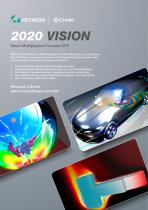
2020 VISION Smart Multiphysics Focused CFD With the 2020 release of MSC Software’s Cradle CFD solutions, multiphysics focused CFD is now easier than ever. Get the most accurate answers every time with best-in-class co-simulation toolchains: • • • • • Actran FEA coupling for high fidelity aeroacoustics Discrete Element Modeling co-simulation for accurate predictions Photorealistic postprocessing to visualize accurate multiphysics New turbomachinery vertical application enhances user productivity New multiphase cavitation models Request a Quote www.mscsoftware.com/cfd
Open the catalog to page 2
Design & Engineering Simulation for solutions that will help solve our sustainability challenges this century. Our Vice President of Marketing, Keith Hanna, articulates how CAE will be in the vanguard of delivering practical engineering solutions to future sustainable development in his commentary on page 14. As Ola pointed out in Las Vegas, this is a real business opportunity for all industries, as well as a way to resolve some of the biggest and most complex problems facing humanity today. At HxGN LIVE, I shared our vision of a smarter design ecosystem where better decisions can be made at...
Open the catalog to page 3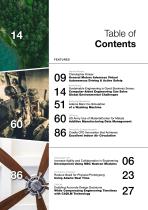
General Motors: Christopher Kinser General Motors Advances Virtual Autonomous Driving & Active Safety Keith Hanna: Sustainable Engineering is Good Business Sense: Computer-Aided Engineering Can Solve Global Environmental Challenges Samsung Electronics: Adams Marc Co-Simulation of a Washing Machine US Army: US Army Use of MaterialCenter for Metals Additive Manufacturing Data Management Panasonic Ecology Systems: Cradle CFD Innovation that Achieves Excellent Indoor Air Circulation Increase Agility and Collaboration in Engineering Development Using MSC Nastran Modules Ford Motor Company: Reduce...
Open the catalog to page 4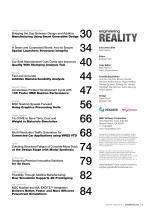
Bridging the Gap Between Design and Additive Manufacturing Using Smart Generative Design Avio: A Smart and Connected World: Avio to Ensure Spatial Launchers Structural Integrity Adient: Car Seat Manufacturer Cuts Costs and Improves Quality With Stamping Analysis Tool Coriolis: Fast and Accurate Additive Manufacturability Analysis Daimler Trucks: Accelerates Product Development Cycle with 10X Faster MSC Nastran Performance NVIDIA: MSC Nastran Speeds Forward Using Graphics Processing Units Roger Assaker: 10x ICME to Save Time, Cost and Weight in Materials Simulation AUDI: Multi-Resolution Traffic...
Open the catalog to page 5
Volkswagen AG Increase Agility and Collaboration in Engineering Development Using MSC Nastran Modules By Dr. Bruns Dr.-Ing. Jürgen Bruns, CAE-Methods, Volkswagen AG Bhoomi Gadhia, Product Marketing Manager, MSC Software 6 | Engineering Reality Magazine
Open the catalog to page 6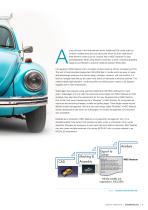
s we all know in the finite element world, traditional FEA model build-up contains multiple parts and sub-structures which are then organized in finite element codes (such as ‘include’ files in MSC Nastran) for easy exchangeability. While using these include files, a strict numbering guideline needs to be followed to avoid ID collisions between INCLUDEs. It is required in MSC Nastran that a complete model is built-up without overlapping of ID’s. This sort of build provides independent INCLUDE files to handle which are easy to reuse and interchange whenever the vehicle design changes. However,...
Open the catalog to page 7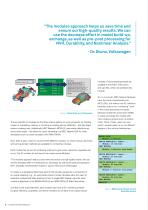
“The modules approach helps us save time and ensure our high-quality results. We can use the decrease effort in model build-up, exchange, as well as pre-post processing for NVH, Durability, and Nonlinear Analysis.” - Dr. Bruns, Volkswagen modules. Post-processing results are available in the HDF5, F06, punch, and op2 files, which are partitioned by module. Figure 2: Model Build up at Volkswagen The key benefits of modules are that they reduce reliance on a pre-processor for creating copies of, translating, rotating, or mirroring an existing primary MODULE – this also helps reduce modeling time....
Open the catalog to page 8
Autonomous Vehicle Testing With Christopher Kinser, General Motors, Milford, Michigan, USA ngineering Reality Magazine recently interviewed Chris Kinser from General Motors, the Director of their Global Autonomous Driving Center in Michigan and an industry expert in rapidly emerging sector of vehicles (AVs). He has a long history of working on electrification and autonomous driving systems, and his team in Milford is responsible for vehicle integration of several General Motors’ advanced technology programs, including self-driving vehicles, as well as automated driving and active safety technologies....
Open the catalog to page 9
What does your role in General Motors involve and what is GM’s overall approach to the fast-emerging Self-Driving opportunity? I am the Director of the Global Autonomous Driving Center at our Milford, Michigan proving ground where I manage a large engineering team. We believe that autonomous technology will play a key role in our vision of a world of zero crashes, zero emissions and zero congestion through the enormous potential benefits it holds for society in the form of increased safety and access to transportation. General Motors is in a unique leadership position when it comes to developing...
Open the catalog to page 10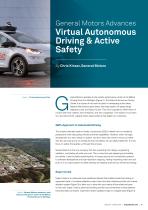
General Motors Advances Virtual Autonomous Driving & Active Safety By Chris Kinser, General Motors Figure 1: Cruise Autonomous Cars eneral Motors operates a total vehicle performance center at the Milford Proving Ground in Michigan (Figure 2). The Global Autonomous Driving Center is a subset of this work focused on developing active safety features like advance park assist, lane keep assist, full-speed range adaptive cruise, and Super Cruise. This work is guided by GM’s vision of a future with zero crashes, zero emissions, and zero congestion. The mission of our team is to provide smooth, capable...
Open the catalog to page 11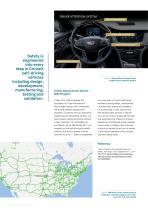
Safety is engineered into every step in Cruise’s self-driving vehicles including design, development, manufacturing, testing and validation. Figure 3: General Motor’s Super Cruise Cadillac Driver Attention System Cruise Autonomous Vehicle (AV) Program In May 2016, GM completed the acquisition of Cruise Automation a Silicon Valley startup with considerable self-driving software development expertise. Combined with our expertise in engineering and developing vehicles, our teams began testing self-driving vehicles in San Francisco, CA, Scottsdale, AZ and Warren, MI. By September 2017, we revealed...
Open the catalog to page 12All MSC SOFTWARE - HEXAGON MANUFACTURING INTELLIGENCE catalogs and technical brochures
 Corporate Presentation
41 Pages
 Annual Report 2022
88 Pages
 Sustainability Report 2022
58 Pages

Archived catalogs
 Simufact Welding
8 Pages
 CO-SIMULATION
92 Pages
 ODYSSEE (CADLM)
5 Pages
 MaterialCenter Brochure
12 Pages
 Actran
12 Pages
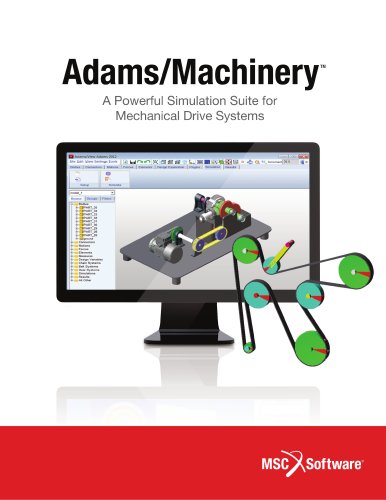 Adams/Machinery
12 Pages







- Automation software solution
- Management software solution
- Analysis software solution
- Process software
- Real-time software
- Computer-aided design software
- Cloud-based software
- Control software
- Design software solution
- Monitoring software solution
- 3D software solution
- Industrial software
- Measurement software
- Interface software
- Visualization software solution
- Quality software
- Simulation software solution
- Automated software
- Development software
- Network software