
- Catalogs
- MSC SOFTWARE - HEXAGON MANUFACTURING INTELLIGENCE
- MSC Nastran Explicit Nonlinear


- Company
- Products
- Catalogs
- News & Trends
- Exhibitions
MSC Nastran Explicit Nonlinear
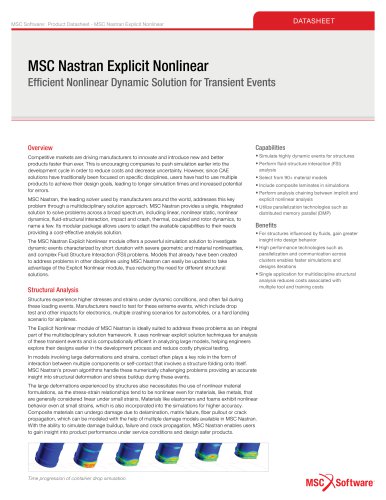
MSC Nastran Explicit Nonlinear
MSC Nastran Explicit Nonlinear is designed to address the need for efficient nonlinear dynamic solutions for transient events in competitive markets. It integrates multiple disciplines into a single solution, reducing simulation times and potential errors. This module is particularly effective for dynamic events with severe geometric and material nonlinearities and complex fluid-structure interactions (FSI).
The module is ideal for testing extreme dynamic conditions such as drop tests and crash scenarios. It uses nonlinear explicit solution techniques to efficiently analyze large models, allowing for early design exploration and reduced physical testing. It handles large deformations, nonlinear material formulations, and composite material damage modeling.
- Simulate highly dynamic events
- Perform FSI analysis
- Choose from over 90 material models
- Include composite laminates
- Chain implicit and explicit nonlinear analysis
- Utilize parallelization technologies
- Enhanced insight into fluid-influenced structures
- Faster simulations and design iterations
- Cost reduction through a single application for multidiscipline analysis
MSC Nastran combines Lagrangian and Eulerian methods to solve FSI problems, enabling accurate analysis of fluid-influenced structures. Adaptive meshing technology reduces simulation runtime by efficiently managing mesh generation.
MSC Nastran supports distributed memory parallel (DMP) for adaptive Euler mesh capability, improving performance runtimes and ensuring balanced processing across multiple cores.
With over 90 material models, MSC Nastran supports various material properties, including isotropic, orthotropic, and anisotropic, to simulate metals, composites, plastics, and more.
MSC Nastran offers a variety of finite elements for model discretization, including beam, shell, plate, continuum, plane stress, plane strain, axisymmetric, 3-D solid, truss, membrane, and more.
- Aerospace: Bird strike, seat impact, composite crash, ditching, jet engine containment
- Automotive: Crash, bumpers, component crush, tire performance, hydroplaning, fuel tank sloshing, airbags, rollover events
- Defense: Blast, IED, ballistics, impact, weapon design
- Consumer: Drop tests, bottles, containers, composites, paper feeding, boats, forming
Catalog excerpts
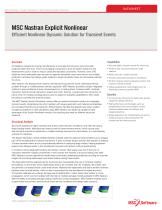
MSC Software: Product Datasheet - MSC Nastran Explicit Nonlinear MSC Nastran Explicit Nonlinear Efficient Nonlinear Dynamic Solution for Transient Events Competitive markets are driving manufacturers to innovate and introduce new and better products faster than ever. This is encouraging companies to push simulation earlier into the development cycle in order to reduce costs and decrease uncertainty. However, since CAE solutions have traditionally been focused on specific disciplines, users have had to use multiple products to achieve their design goals, leading to longer simulation times and increased potential for errors. • Simulate highly dynamic events for structures • Perform fluid-structure interaction (FSI) MSC Nastran, the leading solver used by manufacturers around the world, addresses this key problem through a multidisciplinary solution approach. MSC Nastran provides a single, integrated solution to solve problems across a broad spectrum, including linear, nonlinear static, nonlinear dynamics, fluid-structural interaction, impact and crash, thermal, coupled and rotor dynamics, to name a few. Its modular package allows users to adapt the available capabilities to their needs providing a cost-effective analysis solution. The MSC Nastran Explicit Nonlinear module offers a powerful simulation solution to investigate dynamic events characterized by short duration with severe geometric and material nonlinearities, and complex Fluid Structure Interaction (FSI) problems. Models that already have been created to address problems in other disciplines using MSC Nastran can easily be updated to take advantage of the Explicit Nonlinear module, thus reducing the need for different structural solutions. • Select from 90+ material models • Include composite laminates in simulations • Perform analysis chaining between implicit and explicit nonlinear analysis • Utilize parallelization technologies such as distributed memory parallel (DMP) Benefits • For structures influenced by fluids, gain greater insight into design behavior • High performance technologies such as parallelization and communication across clusters enables faster simulations and designs iterations • Single application for multidiscipline structural Structural Analysis Structures experience higher stresses and strains under dynamic conditions, and often fail during these loading events. Manufacturers need to test for these extreme events, which include drop test and other impacts for electronics, multiple crashing scenarios for automobiles, or a hard landing scenario for airplanes. The Explicit Nonlinear module of MSC Nastran is ideally suited to address these problems as an integral part of the multidisciplinary solution framework. It uses nonlinear explicit solution techniques for analysis of these transient events and is computationally efficient in analyzing large models, helping engineers explore their designs earlier in the development process and reduce costly physical testing. In models involving large deformations and strains, contact often plays a key role in the form of interaction between multiple components or self-contact that involves a structure folding onto itself. MSC Nastran’s proven algorithms handle these numerically challenging problems providing an accurate insight into structural deformation and stress buildup during these events. The large deformations experienced by structures also necessitates the use of nonlinear material formulations, as the stress-strain relationships tend to be nonlinear even for materials, like metals, that are generally considered linear under small strains. Materials like elastomers and foams exhibit nonlinear behavior even at small strains, which is also incorporated into the simulations for higher accuracy. Composite materials can undergo damage due to delamination, matrix failure, fiber pullout or crack propagation, which can be modeled with the help of multiple damage models available in MSC Nastran. With the ability to simulate damage buildup, failure and crack propagation, MSC Nastran enables users to gain insight into product performance under service conditions and design safer products. Time progression of container drop simulation. analysis reduces costs associated with multiple tool a
Open the catalog to page 1
Fluid-Structure Interaction (FSI) In addition to traditional structural analysis applications that feature Lagrangian methods, MSC Nastran Explicit Nonlinear also offers Eulerian methods, which are well suited for analyses of fluids or materials that undergo very large deformations. By coupling these two methods, MSC Nastran solves fluid-structure interaction problems, enabling accurate analysis of structures that are heavily influenced by fluids. This also provides a means of simulating pressure wave propagation during events like mine blasts and their impact of structures in the vicinity. When...
Open the catalog to page 2All MSC SOFTWARE - HEXAGON MANUFACTURING INTELLIGENCE catalogs and technical brochures
 Corporate Presentation
41 Pages
 Annual Report 2022
88 Pages
 Sustainability Report 2022
58 Pages


Archived catalogs
 Simufact Welding
8 Pages
 Sustainability
92 Pages
 CO-SIMULATION
92 Pages
 ODYSSEE (CADLM)
5 Pages
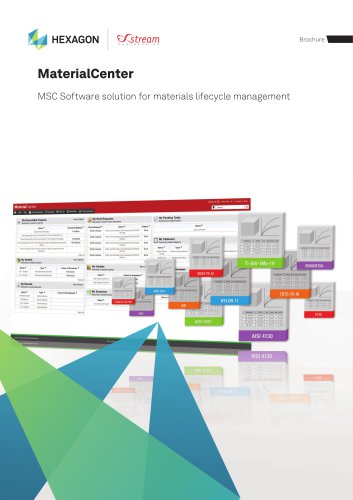 MaterialCenter Brochure
12 Pages
 Actran
12 Pages
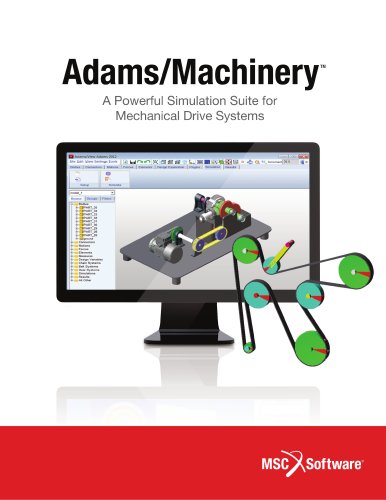 Adams/Machinery
12 Pages





- Automation software solution
- Management software solution
- Analysis software solution
- Process software
- Real-time software
- Computer-aided design software
- Cloud-based software
- Control software
- Design software solution
- Monitoring software solution
- 3D software solution
- Industrial software
- Measurement software
- Interface software
- Visualization software solution
- Quality software
- Simulation software solution
- Automated software
- Development software
- Network software