
- Catalogs
- MOTRIDAL S.p.A.
- Pipe conveyors

Pipe conveyors

Pipe conveyors
Pipe conveyors represent an advancement over traditional belt conveyors. They consist of drive and tail heads and loading zones similar to standard belt conveyors but differ in the central conveying section, which is tubular in shape. This design allows the belt to enclose the material completely, preventing leakage and enabling the conveyor to navigate both horizontal and vertical curves.
Design and Functionality
After the loading point, the belt folds around the material, forming a tube maintained by hexagonal idler stations. This tubular shape is preserved along the entire transport and return paths. Before reaching the drive pulley, the belt opens to discharge the material. The complete enclosure prevents material leakage and protects against external contamination, allowing for clean transport in both directions.
Advantages of Pipe Conveyors
Pipe conveyors can replace multiple traditional conveyors, eliminating the need for transfer points and associated structures. Their smaller cross-section requires less space and lighter support structures. The design allows for long spans between supports, reducing investment costs. The increased friction within the tubular belt permits steeper inclines, potentially replacing the combination of belt conveyors and bucket elevators.
Technical Specifications
The document includes a table with standard dimensions for pipe conveyors, noting that specific applications may require different geometries. The table lists sizes, belt widths, sectional areas, panel pitches, and average capacities.
Applications
Examples of applications include a coke calcining plant in Bahrain, a power station in the Czech Republic, a steel plant in Italy, and a sludge treatment plant in Italy.
Contact Information
For further inquiries, contact Motridal via phone, fax, or email, or visit their website.
Catalog excerpts

pipe conveyors pipe conveyors
Open the catalog to page 1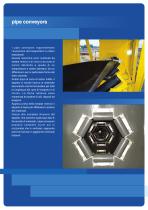
I pipe conveyors rappresentano i’evoluzione dei trasportatori a nastro tradizionali. Queste macchine sono costituite da testate motrici e di rinvio e da zone di carico identiche a quelle di un trasportatore a nastro standard, da cui differiscono per la particolare forma del tratto centrale. Subito dopo la zona di carico infatti, il tappeto si chiude intorno al materiale assumendo una forma tubolare per tutta la lunghezza dei rami di trasporto e di ritorno. La forma tubolare viene mantenuta da sestine di rulli, disposti ad esagono. Appena prima della testata motrice il tappeto si riapre per effettuare...
Open the catalog to page 2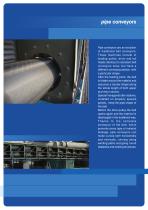
pipe conveyors Pipe conveyors are an evolution of traditional belt conveyors. These machines consist of loading points, drive and tail heads identical to standard belt conveyors ones, but have a different conveying section, with a particular shape. After the loading point, the belt is folded around the material and assumes a tubular shape along the whole length of both upper and return strand. Special hexagonal idler stations, installed on properly spaced panels, keep the pipe shape of the belt. Before the drive pulley the belt opens again and the material is discharged in the traditional way....
Open the catalog to page 3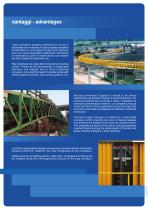
I pipe conveyors possono realizzare curve sia in orizzontale che in verticale. Grazie a questa particolare caratteristica un unico pipe conveyor può sostituire due o più nastri trasportatori tradizionali, eliminando la necessità di punti di trasferimento con relative strutture, sistemi di depolvero, etc. Pipe conveyors can make both horizontal and vertical curves. Thanks to this characteristic, a single pipe conveyor can replace two or more traditional conveyors, removing the need for transfer points with relevant steel structures, dust control systems, etc. Nei pipe conveyors il tappeto si chiude...
Open the catalog to page 4
La sezione del pipe conveyor è più stretta di quella dell’equivalente nastro trasportatore e, oltre ad occupare uno spazio minore, necessita di strutture e carpenterie di sostegno più leggere The section of a pipe conveyor is smaller than the equivalent belt conveyor one, therefore space requirements are minimum and weight of structures and gantries is lower. Le sezioni intermedie dei pipe conveyors possono essere progettate in modo da realizzare ponti con ampie luci tra i supporti. Sono disponibili numerose soluzioni che consentono di minimizzare i costi di investimento delle strutture portanti...
Open the catalog to page 5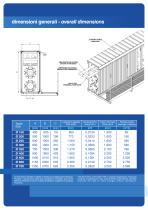
Le dimensioni riportate in tabella si riferiscono ad applicazioni standard. The dimensions of the table refer to standard applications. Particular Prodotti o applicazioni particolari potrebbero richiedere geometrie products or applications may require different geometries. Motridal differenti. Motridal si riserva il diritto di effettuare modifiche in qualsiasi reserves the right to make changes without notification.
Open the catalog to page 6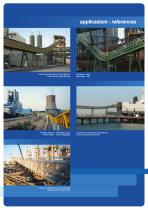
Impianto di calcinazione Coke-Bahrain Coke calcining plant-Bahrain Acciaiena - Italia Steel plant - Italy Centrale elettrica - Repubblica Ceca Impianto di calcinazione Coke-Bahrain Power station - Czech Repubblic Coke calcining plant-Bahrain Impianto di trattamento dei fanghi-Italia Sludge treatment plant -Italy
Open the catalog to page 7
Bulk Handling Equipment & Plants
Open the catalog to page 8All MOTRIDAL S.p.A. catalogs and technical brochures
 bucket elevators
12 Pages
 screw conveyors
8 Pages
 chain conveyors
12 Pages
 belt conveyors
8 Pages
 AUGER MANUFACTURING BROCHURE
9 Pages
