
- Catalogs
- Mors Smitt BV
- Mors Smitt Heavy Duty Relays

Mors Smitt Heavy Duty Relays

Mors Smitt Heavy Duty Relays
Mors Smitt, part of Wabtec Corporation, has been manufacturing relays since 1902, focusing on sectors like power generation, factory automation, and petro-chemical industries. Their products are known for reliability, safety, and environmental consciousness, adhering to ISO 9001:2008 and ISO 14001 standards.
The D-relay concept is designed for demanding applications in the power utility market, offering high DC breaking capacity and inductive load switching. These relays are customizable and widely used globally.
These relays cater to generic automation applications, with details available in a separate catalogue.
Mors Smitt ensures worldwide availability through a network of subsidiaries and distributors. Their relays comply with international standards such as EN 60255, EN 61810, and EN 60947, ensuring reliability and durability.
- D-relays: Designed for both AC and DC networks, capable of switching resistive and inductive loads. Options include instantaneous, latching, and function relays.
- C-relays: Miniature plug-in relays for AC and DC networks, offering instantaneous and safety-critical models.
- A & B-relays: Designed for safety-critical applications with double make/break contacts.
The D-relays feature corrosion resistance, shock and vibration resistance, and integrated snap-locks. They offer high DC breaking capacity, fast switching, and are suitable for hazardous areas.
Relays are available with various contact materials and configurations, offering high breaking capacities and long mechanical life cycles. They operate within a wide range of voltages and temperatures, ensuring adaptability to different environments.
Various options are available to enhance relay performance, such as magnetic arc blow-out for high DC breaking capacity and gold-plated contacts for low-level switching. A range of mounting sockets and accessories are also offered.
The document outlines several contact options, including:
- Option X4: Make before break contacts with 2 Normally Open (N/O) and 2 Normally Closed (N/C) contacts.
- Option X5: Features a higher DC breaking capacity and longer contact life, with a contact gap of 2 mm. Can be combined with options B and Y.
- Option Y: Increases breaking capacity by 50% and extends contact life, featuring double make/double break contacts.
- Option W: Suitable for safety applications according to EN 50205, with various contact configurations.
The document describes coil options that affect relay performance:
- Option D: Includes a back EMF diode for system protection.
- Option H: Provides high burden protection suitable for high-security circuit breaker tripping circuits.
- Option P: Offers protection against reversed polarity with a polarization diode.
- Option V: Provides a wider operating range and ambient temperature tolerance.
These options enhance performance and maintenance without affecting contacts or coils:
- Option A: Trip indicator showing relay energization.
- Option K: Sealed cover for IP50 protection.
- Option L: Integrated LED in coil for indication.
- Option T: Push-to-test button for manual operation.
The document provides technical specifications for various relay models, including:
- Contact material: Silver (Ag)
- Rated continuous current: 10 A
- Breaking capacity: 10 A / 230 V AC, 7 A / 110 V DC
- Max. switching voltage: 350 VDC / 440 VAC
- Mechanical life cycles: Up to 50 million for DC
- Dielectric strength: 2500 VAC (coil-contact), 4000 VAC (contacts)
- Ambient temperature range: -25 °C to +70 °C
The relays comply with several standards, including EN 60255, EN 60947, EN 60947-5-1, and IEC 61810.
The relays are suitable for heavy-duty applications, switching AC and DC voltages, and are designed for resistive and inductive loads. They are also applicable in safety applications and high-security circuit breaker tripping circuits.
Contact material is primarily silver (Ag) with configurations including 2 N/O + 2 N/C, 1 double make/double break, 4 C/O, and 8 C/O. Rated continuous current is 10 A, with breaking capacities of 10 A at 230 V AC1 and varying DC1 capacities. Maximum make current is 16 A, and maximum switching voltage is 350 VDC or 440 VAC. Minimum switched voltage is 12 V, and minimum switched current is 10 mA. Peak inrush current can withstand 200 A.
Nominal voltages range from 12 to 250 VDC and 12 to 380 VAC. Power consumption is 2 VA/W for AC/DC. Operating range is 0.8 to 1.1 Un, with an option for 0.7 to 1.25 Un. Mechanical life cycles are 10 million for AC and up to 50 million for DC. Dielectric strength is 2500 VAC for coil-contact and 4000 VAC for contacts. Isolation class is C 380.
Pull-in time is less than 20 ms for DC and 10 ms for AC, with release times of 18 ms for DC and 5 ms for AC. The ambient temperature range is -25 °C to +55 °C, with humidity tolerance at 95% at 40 °C. Salt mist resistance is 5% NaCl at 35 °C for 4 days. Protection category is IP40.
Complies with EN 60255, EN 60947, EN 60947-5-1, and IEC 61810 standards. Options include LED indicators, cadmium-free contacts, magnetic arc blow-out, and various pin arrangements. Standard AC coil frequency is 50 Hz, with 60 Hz available on request.
Suitable for heavy-duty applications, switching of AC and DC voltages, resistive and inductive loads. Features include plug-in design, flash barriers, and gold-plated contacts for low current switching.
Various models are available with different configurations and specifications, including options for magnetic arc blowout, gold-plated contacts, and different coil voltages. Specific models include D8-ULBX5, D8-ULYBX5, KDN, BD, BD-B, KCD, IOD, and EIOD, each with unique features and configurations.
This document provides detailed specifications and features of various electronic time delay relays used in demanding applications for switching AC and DC voltages, resistive and inductive loads. The relays are designed with Smitt-style pinning and integrated retaining clips, offering adjustable timing with lockable knobs.
- Contact Material: Various models use Ag, AgNi, or AgCdO with gold plating for enhanced conductivity.
- Contact Configuration: Options include 1 C/O, 2 C/O, 3 C/O, and 4 C/O configurations.
- Rated Continuous Current: Ranges from 6 A to 10 A depending on the model.
- Breaking Capacity: AC1 up to 10 A / 230 V and DC1 up to 1 A / 110 V.
- Max Switching Voltage: Up to 250 V AC/DC.
- Insulation: 1 kV, 50 Hz, 1 m between contacts.
- Nominal Voltage: Available in 24, 48, 60, 110, 125, 220, 230, 250 VAC/DC.
- Power Consumption: Varies from 0.5 W to 9 W depending on the model.
- Operating Range: 0.8 to 1.2 Un, with options for 0.7 to 1.25 Un.
- Mechanical Life Cycles: Up to 100 million cycles.
- Dielectric Strength: 2000 VAC between coil and contact.
- Ambient Temperature: -25 °C to +70 °C.
- Humidity: 95% at 40 °C.
- Protection Category: IP40.
The relays comply with EN 60255, EN 60947, EN 60947-5-1, and IEC 61810 standards.
- Adjustable timing with lockable knobs.
- LED indicators for supply and energizing status.
- Cadmium-free contacts for environmental safety.
- Flash barriers and double zener diodes for enhanced protection.
These relays are suitable for applications requiring precise timing control, such as industrial automation, power distribution, and process control systems.
This document provides technical specifications and details for various electronic relays and monitoring devices used in demanding applications for switching AC and DC voltages, resistive and inductive loads. It includes information on different models, their contact and coil specifications, technical data, and standards compliance.
- Contact Specifications: Most devices feature Ag or Ag + Au contact materials, with configurations ranging from 1 C/O + 1 N/O to 4 C/O. Rated continuous currents vary from 6 A to 10 A, with breaking capacities specified for both AC and DC.
- Coil Specifications: Nominal voltages range from 24 V to 250 V for both AC and DC. Power consumption varies, with some models consuming as low as 1.2 W.
- Technical Data: Devices are designed for mechanical life cycles up to 50 million operations, with dielectric strengths up to 4000 VAC. Operating temperature ranges from -40°C to +70°C, with humidity tolerance up to 95% at 40°C.
- Time Functions: Devices offer various timing functions such as pulse, interval, and one-shot operations, with adjustable or fixed time ranges.
- Monitoring Functions: Voltage and current monitoring relays are available, with adjustable pull-in voltages and hysteresis settings.
All devices comply with standards such as EN 60255, EN 60947, EN 60947-5-1, and IEC 61810, ensuring reliability and safety in operation.
For specific applications, users are advised to consult local sales offices for additional types and options. The document also highlights the importance of selecting the appropriate relay based on the application's voltage and current requirements.
Many devices include features like LED indicators, cadmium-free contacts, and Smitt-style pinning for easy installation and maintenance.
This document provides detailed specifications and features of various relay sockets designed for D-relays. It includes information on dimensions, materials, connection types, and mounting options, along with standards compliance and ordering codes.
Each relay socket is designed to accommodate specific connection types such as screw terminals, spring terminals, faston terminals, soldering connections, and crimp terminals. The sockets are made from Polyamide 66 with varying glass content for durability and are suitable for wires up to 2.5 mm². They support a contact rating of 10 A (AC1) as per IEC 60947 standards.
The sockets can be mounted on surfaces, walls, panels, or 35 mm rails, depending on the model. Some models offer features like mechanical keying to prevent incorrect relay placement and touch-proof designs for safety.
Key features include sturdy terminals, no internal soldering for reliability, and easy maintenance. The sockets are designed for long-term availability and low life cycle costs. Specific models offer quick installation, reducing wiring time by up to 75% compared to traditional methods.
All sockets comply with standards such as EN 60255, EN 60947, EN 60947-5-1, and IEC 61810, ensuring reliability and safety in various applications.
Each socket model is associated with a specific ordering code for easy identification and procurement. The document provides detailed diagrams for connection layouts and dimensions for precise installation.
All relay sockets are suitable for KDN & D8 relays with a contact rating of 10 A (AC1) according to IEC 60947. They are designed for surface/wall and 35 mm rail mounting, with a maximum ambient temperature of 80°C. The sockets are made from Polyamide 66 with 30% glass, ensuring durability and reliability. The wire diameter supported is up to 2.5 mm².
The relay sockets comply with standards EN 60255, EN 60947, EN 60947-5-1, and IEC 61810, ensuring high-quality performance and safety.
Each socket type offers unique features such as sturdy screw, faston, or spring terminals, positive mechanical keying, and clear terminal identification. These features contribute to proven reliability, long-term availability, easy maintenance, and low life cycle costs.
Each socket type has a specific ordering code, such as V9 Surface socket (338000900) and V93 Socket (338003900), facilitating easy procurement.
The document provides detailed connection diagrams for various socket configurations, ensuring correct installation and operation.
Accessories like A104 Selection bus and A260 Crimp terminals are available for specific socket types, enhancing functionality and ease of use.
The document outlines various relay options and coil voltages, ranging from 5 VDC to 415 VAC, catering to diverse application needs.
Miniature power C-relays are suitable for both AC and DC networks, capable of switching resistive and inductive loads, depending on the options included.
This document provides detailed specifications and information on various types of relays and sockets used in industrial applications. It includes technical data, standards, and ordering information for different relay models and their compatible sockets.
- Contact Material: Ag + 0.2 μm Au
- Configurations: Available in 1 C/O, 2 C/O, and 1 DM/DB configurations.
- Rated Continuous Current: 6 A to 8 A depending on the model.
- Max Switching Voltage: 300 VDC / 250 VAC.
- Coil Specifications: Nominal voltages range from 6 VDC to 240 VAC.
- Mechanical Life Cycles: Up to 30 million cycles.
- Protection Category: IP40.
All relays comply with EN 60255, EN 60947, EN 60947-5-1, and IEC 61810 standards.
- Types: V10, V11, V12, V13, V17, V17-D, and V14.
- Mounting: Options for surface/wall mounting, 35 mm rail mounting, and PCB soldering.
- Contact Rating: Up to 10 A (AC1) IEC 60947.
- Material: Made from polyester or polyamide with glass reinforcement.
Each relay and socket type has specific ordering codes for easy identification and procurement.
These relays and sockets are designed for heavy-duty industrial applications, offering features like cadmium-free contacts, flash barriers, and magnetic arc blowout functions for enhanced performance and safety.
This document provides detailed specifications and information on various relay components and accessories offered by Mors Smitt, including rail clips, key receptacles, relay retaining clips, and sockets for C-relays. It also includes ordering information, technical specifications, and standards compliance.
The document lists several relay types and their specifications, including coil voltages ranging from 6 VDC to 415 VAC, and different relay types such as wide range AC, high breaking capacity DC, and safety-critical DC. The relays are designed for safety-critical applications with features like double make/break contacts and weld-no-transfer contacts.
Installation and replacement of plug-in relays are designed to be easy and cost-effective, with no maintenance required. The document provides details on mounting options, such as flush/panel and 35 mm rail mounting, and the use of faston and screw terminals.
The relays and sockets comply with standards such as EN 60255, EN 60947, EN 60947-5-1, and IEC 61810, ensuring reliability and safety in industrial applications.
The document highlights the benefits of using Mors Smitt products, including proven reliability, long-term availability, ease of maintenance, and low life cycle costs. It also emphasizes the importance of selecting the appropriate relay type and socket for specific applications.
Detailed technical data is provided for each relay type, including contact material, rated continuous current, maximum switching voltage, mechanical life cycles, dielectric strength, and ambient temperature range. The document also includes dimensions and protection category information.
The document provides contact details for Mors Smitt's sales offices in France, Hong Kong, the Netherlands, the United Kingdom, and the USA, along with their respective phone numbers, fax numbers, and email addresses.
Catalog excerpts

Mors Smitt Industrial Technology Heavy duty relays
Open the catalog to page 1
Mors Smitt Industrial Technology Heavy duty relays
Open the catalog to page 3
By focusing on products exellence for the industrial market, we contribute to a better environment, health and safety of all people involved
Open the catalog to page 4
Mors Smitt - Industrial Technology Mors Smitt has been manufacturing relays since 1902. Our wide relay portfolio is focused on markets sectors like; power generation & distribution, factory automation, petro-chemical and water treatment plants and general industrial requirements. Production is flexible, standards unforgiving. Many units are tailored to specific client requirements. All products go through extensive testing processes with both hardware and production methodology approved to the highest standards. Heavy duty relays The unique D-relay concept is specifically designed to solve demanding...
Open the catalog to page 5
Millions of relays daily used world wide
Open the catalog to page 6
Heavy duty relays The industrial plug-in relays are based on the unique Solve-All design conceptand can be used in both AC and DC voltage networks. The relays are able to switch resistive as well as inductive loads in heavy duty demanding applications, depending on the options included. We offer instantaneous, latching and function relays as well as time, measuring and monitoring The miniature, industrial plug-in C-relays can be used in both AC and DC voltage networks. The relays are able to switch resistive and also inductive loads, depending on the options included. We offer instantaneous and...
Open the catalog to page 7
Standards & approvals Standards & approvals are designed and manufactured with utmost care for reability and durability. The relays are in compliance with the leading international standards. EN 60255 Relay design, specifications and environmental conditions. Electrical relays. EN 61810 Relay design, specifications and environmental conditions. Basic relays. EN 60947 Low voltage switch gear and control gear. EN 60947-4-1 Electromechanical contact and motor starters. EN 60947-5-1 Electromechanical components for control applications. This standard examines both coil and contact specifications...
Open the catalog to page 8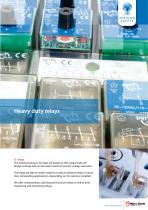
Heavy duty relays D -relays The industrial plug-in D-relays are based on the unique Solve-All design concept and can be used in both AC and DC voltage networks. The relays are able to switch resistive as well as inductive loads in heavy duty demanding applications, depending on the options included. We offer instantaneous, latching and function relays as well as time, measuring and monitoring relays.
Open the catalog to page 9
Power generation and distribution operators across the world rely on the Solve-All relay concept
Open the catalog to page 10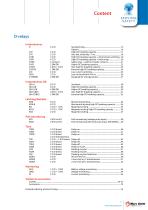
D-relays Instantaneous D 4 C/O D-B 4 C/O D-R 3 C/O D-RB 3 C/O D-BV 4 C/O D-BW 4 contacts D-YB 2 DM/DB D-BX5 2 N/O + 2 N/C D-BYX5 1 DM/DB D-E 4 C/O DGG 2 C/O D-YMBZD 2 DM/DB Puls transducing TDB2 TDB4 TDDB TDE TDE3 TDE4 TDBE FDA FDA4 FDC WDE4 WDDE WDDF 2 C/O timed 4 C/O timed 2 C/O timed 2 C/O instantaneous 2 C/O + 1 N/O timed 3 C/O timed 4 C/O timed 2 C/O timed 2 C/O timed 4 C/O timed 2 C/O timed 4 C/O 4 C/O 4 C/O Sockets & accessories
Open the catalog to page 11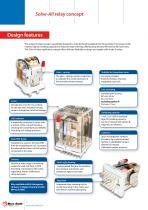
Solve-All relay concept Design features The unique D-relay concept is specifically designed to solve demanding applications (for example in the power utility market); high DC breaking capacity and inductive load switching, offering long electrical life and low life cycle costs. The Solve-All relay application concept offers ultimate flexibility to design and supply tailor made D-relays. Suitable for hazardous areas The joke + springs system is adjusted to calibrate the contact pressure of the normally closed contacts. Corrosion resistant. Shock & vibration resistant. Integrated snap-lock. Fast...
Open the catalog to page 12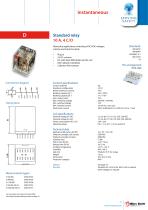
Standard relay 10 A, 4 C/O Standards Heavy duty applications, switching of AC & DC voltages, resistive and inductive loads. • • • • • Plug-in 4 C/O contacts DC (with back EMF diode) and AC coil LED indicator (standard) Cadmium free contacts Contact specifications Contact material Number & configuration Rated continuous current Breaking capacity AC 1 Breaking capacity DC 1 Max. make current Max. switching voltage Min. switched voltage Min. switched current Peak inrush current Coil specifications Nominal voltage (Un DC) Nominal voltage (Un AC) Power consumption (AC / DC) Operating range Technical...
Open the catalog to page 13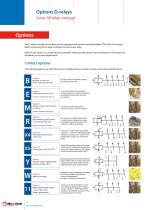
Options D-relays Solve-All relay concept Options The D-relays (and derived models) can be equipped with options mentioned below. This Solve-All concept allows composing the D-relay to solution for almost any relay. Note: Not all options or combinations are possible. Check possible options and combinations with your local distributor or our sales department. Contact options The following options can affect the contact configuration in number contacts and contact specifications: 1(+) Option B Magnetic arc blow-out (for DC and inductive loads) Cannot be combined with option M Fast switching, pull-in...
Open the catalog to page 14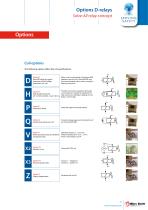
Options D-relays Instantaneous Solve-All relay concept Coil options The following options affect the coil specifications: 1(+) Option D Back EMF diode for system protection, BYW45 philips (standard in DC coil) Provides immunity to capacitive discharge Option H current & power. Suitable for application in High burden protection high security circuitbreaker tripping circuits. DC 110 VDC 220 VDC, 10 µF, 150% Un Relay is 76 mm high. When a coil is switched off, a large back EMF appears across the coil. This back EMF may be several hundred volts in value, enough to destroy a transistor. 2 1(+) Option...
Open the catalog to page 15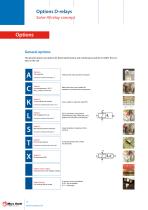
Options D-relays Solve-All relay concept Options General options The general options are options for better performance and maintenance and do not affect the contacts or the coil. Option A Trip indicator Indicates the relay has been energised Cannot be combined with option K Option C Low temperature (-40 °C ) Max. contact current 8 A Option K Cover sealed with sealant Makes the relay more suitable for operation at extreme low temperatures. Cover sealed to make the relay IP50 Cannot be combined with options A & T Option L LED integrated in coil Cannot be combined with option T LED is standard...
Open the catalog to page 16All Mors Smitt BV catalogs and technical brochures
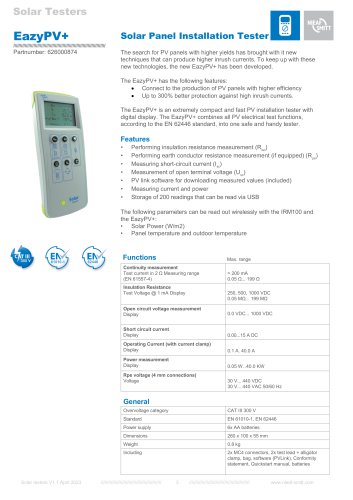 EazyPV+
1 Page
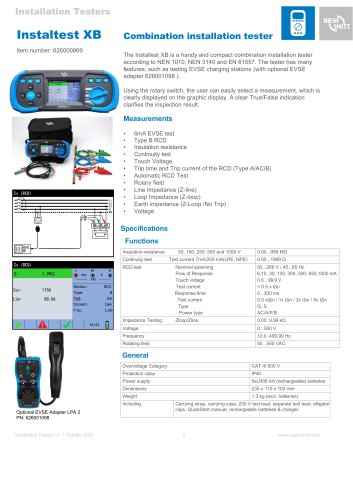 Instaltest XB
1 Page
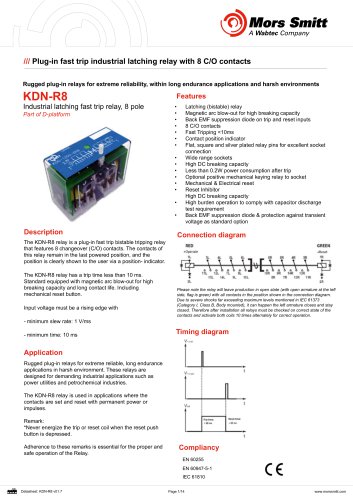 KDN-R8
14 Pages
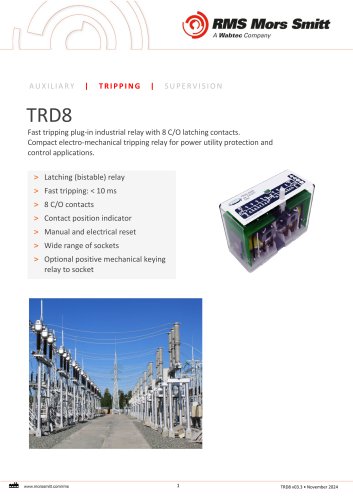 TRD8
TRD812 Pages
 V88 Socket
9 Pages
 V33
V338 Pages
 Universal relays
12 Pages
 Products & services
16 Pages
 Signalling & rail infrastructure
20 Pages
 Activities brochure
12 Pages
 Relay Life Services brochure
8 Pages
 Mors Smitt Group
19 Pages
 Instruments 2
46 Pages
 Instruments 1
74 Pages
 Substation protection & control
12 Pages
 SPD - Surge Protection Devices
60 Pages
 brochure Railway activity
16 Pages
 Protection components
20 Pages
 Railway Technology
11 Pages
 Brochure Mors Smitt Goup
13 Pages
 Signalling relays BR930
11 Pages
 Brochure Door control units
11 Pages
 Brochure Protection components
11 Pages
 Miniature circuit breakers
17 Pages
 Mors Smitt Railway relays brochure
196 Pages
 Engineered solutions
32 Pages
 Mors Smitt Industrial Technology
24 Pages
 Mors Smitt Products & Services
12 Pages






- Switching relay
- Portable tester
- Portable analyzer
- Protection relay
- Digital tester
- Automatic tester
- Industrial tester
- Electromechanical relay
- Voltage testing system
- Time relay
- DC electromechanical relay
- Power quality analyzer
- Installation tester
- Insulation testing system
- Cabling tester
- Compact tester
- Current protection relay
- Digital protection relay