
- Catalogs
- Morris Lubricants (Mfg.)
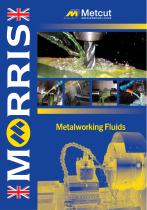
- Metalworking

Metalworking

Metalworking
Coolant Preparation: Always add the product to water in a clean container with agitation. For large-scale operations, mixing units are recommended to achieve the correct dilution ratio. Avoid adding water to oil concentrate.
Concentration Measurement: Regularly check fluid strength using a hand refractometer and adjust as necessary. A correction factor may be required to determine the actual concentration.
Coolant Top-Up and Adjustment: Measure the concentration level in the machine sump before adding fresh cutting fluid to compensate for evaporation or over-dilution.
Contaminant Removal: Maintain fluid cleanliness by removing tramp oils and minimizing metallic swarf using filtration systems.
System Hygiene: Prevent debris from entering the coolant system to avoid bacterial degradation.
System Cleaning: Begin with a clean system using a system cleaner. Regularly monitor concentration and remove metal fines and sludges.
Dos and Don'ts:
- Do read manufacturer instructions and ensure regular condition monitoring.
- Do use protective equipment and train operatives in housekeeping.
- Don't use fluid past its effective life or allow mist to be emitted.
- Don't add water to concentrate or dispose of used fluid directly to the drain.
Troubleshooting Chart: Offers solutions for issues like corrosion, foaming, unstable emulsion, skin irritation, and poor tool life, with likely causes and corrective actions.
Product Range:
- Water Soluble Fluids: Designed for maximum productivity and tool life.
- Grinding Fluids: Provide cooling and lubrication without causing wheel glazing.
- Neat Cutting Oils: High-performance oils for various applications.
- Hand Applied Fluids: Offer tool protection and excellent workpiece finish.
Commitment to Quality: Morris Lubricants combines expertise in metalworking applications with raw material technologies to enhance existing fluids and develop new products. Accredited with BS EN ISO 9001 and ISO 14001, the company is committed to health, safety, and environmental concerns.
Catalog excerpts
A GUIDE TO LOOKING AFTER WATER-MIX METALWORKING FLUIDS COOLANT MAKE UP Coolants should always be prepared by adding the correct quantities of product to water in a suitable clean container with agitation. For the larger user, Morris offers a range of mixing units to enable the correct dilution ratio to be achieved. NEVER ADD WATER TO OIL CONCENTRATE. 3 Do read manufacturers instructions CONCENTRATION MEASUREMENT The recommended fluid strength should be checked regularly using a hand refractometer and adjustments made to bring it back to the recommended strength if necessary. After ascertaining the refractive index, the use of a correction factor may well be necessary in order to identify the actual concentration of the emulsion or solution. COOLANT TOP UP AND CONCENTRATION ADJUSTMENT When additions of fresh cutting fluid are required, it is essential to pre-determine the concentration level in the machine sump in order to compensate for evaporation or over dilution. Topping up with a freshly prepared mix of either a much lower or a much higher concentration, as required, will restore the machine sump to the recommended concentration level. REMOVAL OF CONTAMINANTS The cutting fluid should always be maintained in as clean a condition as possible. To avoid premature bacterial degradation and coolant breakdown, it is essential to remove tramp oils from coolant sumps on a regular basis. Metallic swarf levels should also be kept to a minimum, by use of a suitable filtration system. 3 Do be aware of health problems 3 Do check compatibility of fluids 3 Do store correctly 3 Do ensure regular condition monitoring and keep records of checks 3 Do top up with pre-mixed emulsion 3 Do keep the machine clean and debris free 3 Do keep the reservoir covered 3 Do ensure filtration works 3 Do minimise tramp oil leaks and report all leaks to the supervisor 3 Do clean all pipework, machine and guards, before renewing a fluid 3 Do dry the system if converting to neat oils 3 Do mix the fluids just before use, try not to store pre-mixed fluid 3 Do know the water hardness 3 Do mix in a clean container and not galvanised 3 Do add concentrate to water with constant stirring 3 Do use a refractometer to check concentration 3 Do use protective equipment, i.e. gloves and goggles SYSTEM HYGIENE It is equally important to ensure that debris from the surrounding workplace is prevented from entering the coolant system as this can also result in premature bacterial degradation of the cutting fluid. This is particularly pertinent when food waste, sandwich crusts, etc., and coffee or tea cup dregs are accidentally deposited in sumps. SYSTEM CLEANING Start with a clean coolant system – purged with a good systems cleaner (Superclean KD150 System Cleaner). Charge the sump with fresh coolant at the correct dilution for the operation and regularly monitor the concentration. Periodically remove metal fines and sludges by suction filtration, particularly in mixed metal machining. 3 Do train operatives in housekeeping and practices 3 Do keep all guards, spray covers, etc., in good working order 3 Do ensure correct coolant flow to avoid misting or fuming 3 Do provide local exhaust ventilation if misting occurs 3 Do ensure feeds and speeds are compatible with the tolls and materials used. 7 Don’t use the fluid past its effective working life. Quality, health and safety, and general environment will suffer 7 Don’t allow mist or spray to be emitted 7 Don’t use airlines to blow components clean WATER MIX FLUIDS TROUBLESHOOTING CHART PROBLEM LIKELY CAUSES Concentration pH Contamination High humidity Low Low Bacterial infection present Yes Increase Clean with system cleaner Find source and eliminate Protect in storage Concentration Water hardness Contamination High Soft Present Decrease Use hardener or anti-foam Remove or control Mixing procedure Water hardness Storage Bacterial infection Contamination Incorrect Hard Incorrect High Present Use correct method Use modified product or soften water Store indoors, employ stock rotation Clean with system cleaner Remove or control Concentration pH Bacterial infection Swarf presence Use of solvents or cleaners High High High Yes Yes Decrease Eliminate alkaline contaminants Clean with system cleaner Inspect filtration Use protective clothing Concentration Contamination Incorrect tooling setup Incorrect product Increase Remove or control Reset tooling Change to a more suitable product CORRECTIVE ACTION 7 Don’t allow unnecessary contact with the hands 7 Don’t allow operatives to eat or drink around machine tools 7 Don’t add water to concentrate, it will make an invert emulsion which is useless 7 Don’t dispose of used fluid directly to the drain 7 Don’t wait for problems to arise before taking counter steps. Prevention is better than cure Metalworking Fluids 7 Don’t mix in dirty or galvanised containers 7 Don’t expose fluids to temperature extremes 7 Don’t check it by feel, you will get it wrong UNSTABLE EMULSION SKIN IRRITATION POOR TOOL LIFE 7 Don’t put clean fluids in dirty machines 7 Don’t use a cleaner without checking compatibility with the fluid 7 Don’t allow waste or rubbish to enter the system 7 Don’t allow overheating to occur, ensure fluid level and flow are adequate 7 Don’t allow the fluid to stagnate when not operational 7 Don’t add biocide without guidance from a specialist, and never exceed the recommended dose 7 Don’t allow tramp oil to accumulate 7 Don’t let ‘in-house’ lack of expertise prevent effective fluid maintenance Please refer to the Health and Safety Executive website for the latest information and advice on working with metalworking fluids: www.hse.gov.uk/metalworking/index.htm www.morrislubricants.co.uk Castle Foregate, Shrewsbury, SY1 2EL Tel:+44 (0) 1743 232200 Fax:+44 (0) 1743 353584 All the products are reflective of the latest specifications at the time of going to press and are part of a continuous development programme. The company reserves the right to change formulation and specification, without prior notice to meet the latest trends and developments in lubricant and grease technology. For more detailed information on any product and confirmation of the latest specifications contact our Technical Services Department. Full product data sheets and health and safety information is available on request. Certificate No. EMS 60044 Certificate No. FM 21756
Open the catalog to page 1All Morris Lubricants (Mfg.) catalogs and technical brochures
 Off-Highway
8 Pages
 Automotive Brochure
8 Pages
 Industrial Brochure
6 Pages
 Motorcycle
8 Pages
 Golden Film
2 Pages
 Groundforce Horticultural
2 Pages
 Bulk Delivery
2 Pages
 Fleet
Fleet4 Pages
 Steam Lubricants
4 Pages
 Aerosol and Janitorial
2 Pages
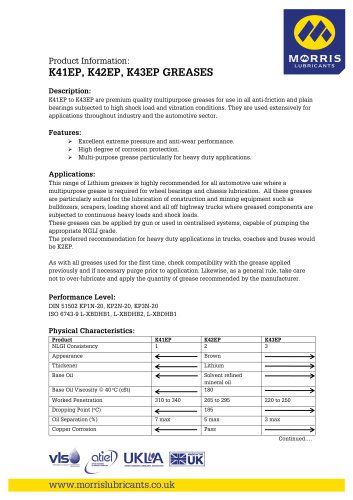 K41EP, K42EP, K43EP GREASES
2 Pages


- Synthetic lubricant
- Synthetic oil
- Mineral lubricant
- Anti-corrosion lubricant
- Bearing lubricant
- High-temperature lubricant
- Industrial oil
- Gear lubricant
- Mineral oil
- Bearing grease
- Anti-corrosion oil
- Long-life lubricant
- Universal lubricant
- High-temperature oil
- Low-temperature lubricant
- High load capacity lubricant
- High-temperature grease
- Metal spray
- Gear oil
- Chain lubricant