
- Catalogs
- MonTech Werkstoffprüfmaschinen GmbH
- Moving Die Rheometer

Moving Die Rheometer
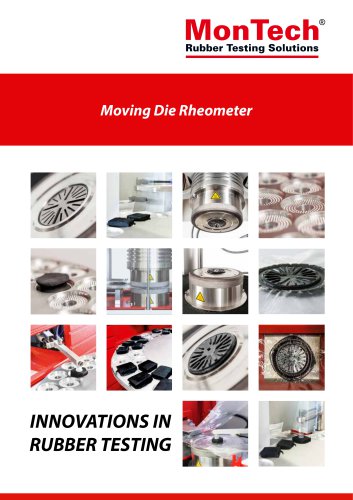
Moving Die Rheometer
MonTech Werkstoffprüfmaschinen GmbH is a prominent manufacturer of rubber testing instruments, recognized for high-quality standards, customer focus, and ongoing research and development. Their products serve industries such as automotive, aerospace, and pharmaceuticals, and are certified under ISO 9001:2015 and ISO/IEC 17025:2018.
The Moving Die Rheometer is crucial for rubber curing characterization in quality control and R&D. It features a closed, sealed biconical die system compliant with ISO, ASTM, and DIN standards, offering excellent temperature control and customizable automation solutions.
MonTech Rheometers are constructed with aerospace-grade aluminum and stainless steel for durability and stability. The design includes thick baseplates and crossheads for improved repeatability and reduced signal-to-noise ratio, with the frame acting as a heatsink to prevent corrosion.
The biconical die assembly ensures accurate temperature measurement and control. Made from hardened stainless steel, the dies are durable and resistant to abrasive compounds. The pneumatic die closing system provides reliable sealing, with optional features for variable closing force and cavity pressure.
MonTech instruments feature internal diagnostics and condition monitoring, with precision calibration tools for easy verification. A detailed PDF report is generated post-verification, ensuring traceability to reference standards.
Programmable Logic Controllers ensure system reliability, with real-time data analysis using advanced electronics. The system supports high-speed data sampling and provides true measured data without filtering.
MonTech Rheometers use advanced digital drive technology for precise deformation application. The patented direct torque drive system ensures accurate rheological measurements, with ceramic and magnetic bearings enhancing durability.
MonTech Rheometers support various testing scenarios, including isothermal and non-isothermal cure tests, and advanced cure kinetics modeling, providing detailed data for quality control and material analysis.
MonTech Rheometers provide comprehensive testing solutions for analyzing and optimizing the rheological properties of rubber and polymer compounds, enhancing material processing and performance.
Includes compliance with international standards, biconical die configuration, sample volume, drive system options, oscillation frequency, torque range, temperature control, and data interface options.
Automation options, direct drive system, temperature check system, and extensive data points for each test.
Suitable for quality control and production monitoring, providing advanced information on processability, cure characteristics, and compound behavior.
The MonTech MDR 3000 series offers a range of rheometers tailored to different testing needs, making it a versatile tool for material analysis in various industrial applications.
Highlights the machine's capabilities in assessing processability, cure characteristics, and behavior of compounds before, during, and after curing.
Features a biconical, closed die system, advanced wearless servo drive system, wide range of oscillation frequencies, and precision temperature control.
Supports various dynamic test sequences and offers extensive automation options to enhance productivity.
Describes pneumatic and advanced cooling systems for precise temperature control during testing.
Includes axial force transducer system, cavity pressure controller system, and high-speed data acquisition system.
Designed for precise torque signal and motor position analysis, suitable for FT-Rheology and detailed material response analysis.
Includes simultaneous sampling and processing, real-time data calculation, and MonLAOS software for FT-Rheology analysis.
Integrated industrial computer systems, remote operation, RS232 Logic Interface, and additional programmable outputs.
Enhanced instrument protection, movable instrument carts, forced air aspiration system, and 5” Color Touchscreen.
Reference compounds for Rheometer cure and dynamic testing, advanced torque calibration standards, and traceable calibration standards.
The document outlines the capabilities and options available for MonTech Rheometers, emphasizing precision, flexibility, and adaptability to various testing environments and requirements.
Catalog excerpts
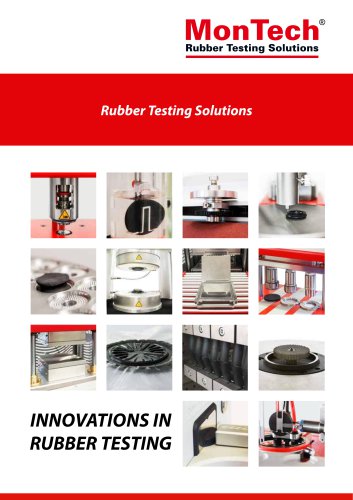
Rubber Testing Solutions INNOVATIONS IN RUBBER TESTING
Open the catalog to page 1
MonTech Werkstoffprüfmaschinen GmbH Carl - Benz - Straße 11 D - 74722 Buchen / Germany I n n o vat i v e t evat s t iinvg Inno e s o lu ng s t et s itoi n m atdi o e ni n s o lu s G emra mdaeniyn! Germany! MonTech Werkstoffprüfmaschinen GmbH is the world‘s leading premium manufacturer of rubber testing instruments. Since 1998, we have been developing, producing, distributing and servicing high quality testing machines and their components as well as related software solutions for materials and component testing. Trust in MonTech’s products and services are reflected in their long-term customer...
Open the catalog to page 2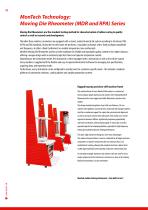
MonTech Technology: Moving Die Rheometer (MDR and RPA) Series Moving Die Rheometers are the standard testing method for characterisation of rubber curing in quality control as well as research and development. Therefore these rotorless curemeters are equipped with a closed, sealed, biconical die system according to all relevant ISO, ASTM and DIN standards. During the test the lower die performs a sinusoidal oscillation with a fixed oscillation amplitude and frequency, at either a fixed (isothermal) or variable temperature (non-isothermal). MonTech Moving Die Rheometer systems are the backbone...
Open the catalog to page 3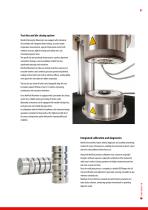
Test dies and die closing system MonTech Moving Die Rheometers are equipped with a biconical die assembly with integrated direct heating, accurate sample temperature measurement, superior temperature control with unbeaten accuracy, highest heating and cooling rates, and minimized response times. The specific die and crosshead design ensures a perfect alignment and uniform closing as well as parallelism of both test dies, significantly reducing result variations. MonTech Rheometer test dies are entirely made from superior, lottraceable stainless steel, hardened, precision ground and polished,...
Open the catalog to page 4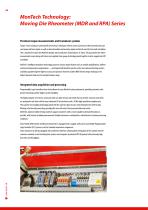
MonTech Technology: Moving Die Rheometer (MDR and RPA) Series Precision torque measurements and transducer systems Torque / force transducers and loadcells are the most critical part when it comes to precision of the instrument because raw torque and force signals, as well as derived modulus and viscosity signals are directly used for test result calculation. This is exactly the reason why MonTech designs and manufactures all transducers in-house. This guarantees the widest measurement ranges along with clean-room applied strain gauge technology paired together in ultra-rugged and stiff assemblies....
Open the catalog to page 5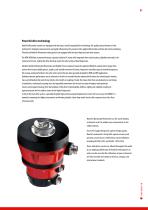
Powerful drive technology MonTech Rheometer systems are equipped with the latest, closed-loop digital drive technology. The quality and performance of the instruments‘ rheological measurements are highly influenced by the precision of the applied deformation and thus the motor positioning. Therefore all MonTech Rheometer testing systems are equipped with the latest high-precision drive systems: The MDR 3000 Basic instrument features a geared, brushless DC motor with integrated drive control systems, digitally connected to the instrument PLC unit, making this drive the ideal system for static...
Open the catalog to page 6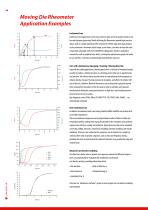
Moving Die Rheometer Application Examples 14 Isothermal Cure Isothermal cure experiments are the most common type of test for quality control in rubber and elastomer processing. MonTech Moving Die Rheometers provide high precision data as well as a simple operation of the instruments. All the important characteristics, such as minimum / maximum elastic torque, scorch times, cure times and reaction rates are precisely calculated, with over 3500 different datapoints. All data is available in numerical as well as graphical form; limits, control gates and tolerance graphs can easily be set, and Pass...
Open the catalog to page 7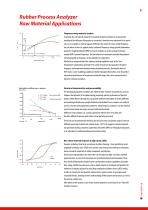
Rubber Process Analyzer Raw Material Applications Frequency sweep material analysis In general, the mechanical properties of materials depend on frequency. A good understanding of the influence of frequency on a material is therefore very important for its practical use. For example, a material appears stiff under the action of a force at high frequency, but soft when the force is applied slowly. Isothermal frequency sweeps provide information about the weight distribution MWD (crossover modulus) as well as average molecular weight AWM (crossover frequency). But the behavior of viscoelastic materials...
Open the catalog to page 8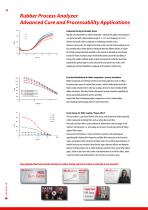
Rubber Process Analyzer Advanced Cure and Processability Applications 20.0 Isothermal Curing at Variable Strain Typically, cure experiments on rubber compounds - especially for quality control purposes - are performed with a fixed oscillation angle of +/- 0.5° and a frequency of 1.67 Hz. However, for specific rubber compounds or challenging materials such as silicones or epoxy resins, this might not be ideal as either reaction torque readings are too low, providing only a limited ability to distinguish between different batches, or might be too high causing high result variability as the material...
Open the catalog to page 9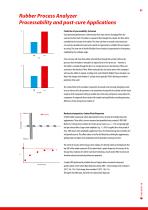
Rubber Process Analyzer Processability and post-cure Applications Prediction of processability: Extrusion Good processing performance is influenced by three main criteria: throughput flow, die swell and surface finish. The rubber is required to flow through the extruder. The flow will be controlled by the viscosity of the rubber. The shear rate from an extruder and extrusion die can easily be calculated and used as the specific test parameters in a Rubber Process Analyzer test setup. The shear rate in MonTech Rubber Process Analyzer is proportional to the frequency multiplied by the oscillation...
Open the catalog to page 10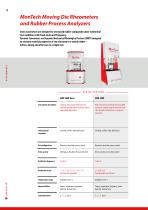
RHEOMETER PERFORMANCE STATIC TESTING Instrument description Oscillation frequency MonTech Moving Die Rheometers and Rubber Process AnalyzersStatic Curemeters are designed to test mixed rubber compounds under isothermal test conditions with fixed strain and frequency.Dynamic Curemeters are Dynamic Mechanical Rheological Testers (DMRT) designed to measure material properties of raw elastomers or mixed rubber -before, during and after cure in a single test. International Drive system Oscillation strain Temperature range Measured Data Calculated Data
Open the catalog to page 11All MonTech Werkstoffprüfmaschinen GmbH catalogs and technical brochures
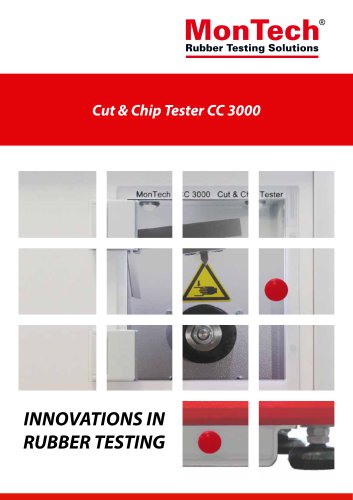 Cut & Chip Tester CC 3000
4 Pages
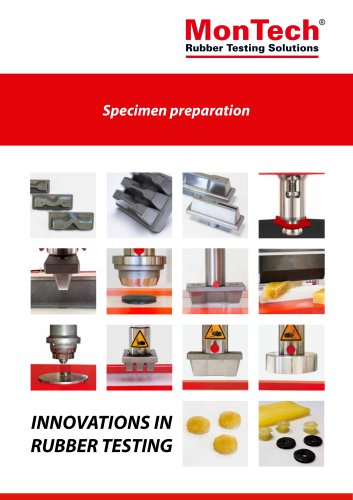 Specimen preparation
14 Pages
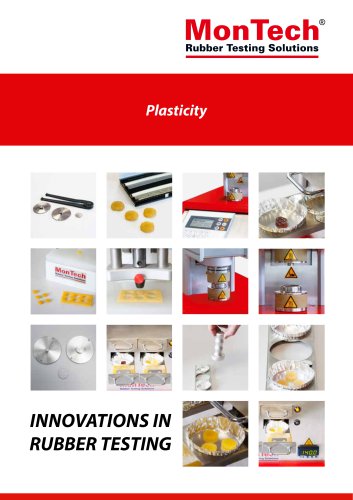 Plasticity
6 Pages
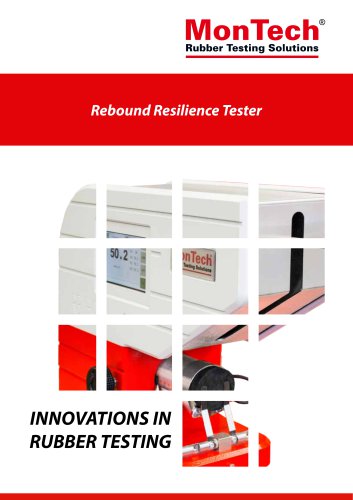 Rebound Resilience Tester
4 Pages
 Online Testing Cell Systems
24 Pages
 Compression Set and Ageing
6 Pages
 Hardness testing
7 Pages
 Fatigue Testing
4 Pages
 Density
3 Pages
 Dispersion
10 Pages
 Bale cutting
6 Pages
 Mooney Viscometer
13 Pages
 Specimen and Die cutting
138 Pages
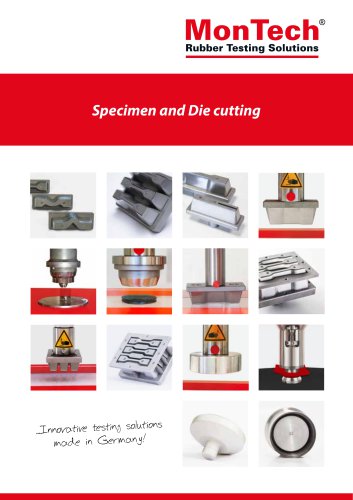 Specimen and Die cutting
18 Pages
- Cutting system
- Industrial press
- Kiln
- Chamber kiln
- Hydraulic press
- Test cabinet
- Automatic cut-off machine
- Knife cutting system
- High-speed cut-off machine
- Indentation hardness tester
- Plastic cutting machine
- Automatic press
- Digital tester
- Table-mounted hardness tester
- Automatic tester
- Industrial tester
- Sheet cutting machine
- Digital display hardness tester
- Thickness gauge
- Compact cut-off machine