
- Catalogs
- Montanstahl AG
- Duplex

Duplex

Duplex
Stainless steels, particularly Duplex stainless steels, are valued for their corrosion resistance and mechanical strength, making them suitable for various industries such as offshore oil & gas, chemical processing, and construction. Duplex steels offer up to twice the mechanical strength of conventional stainless steels and are considered as substitutes for types like 304L, 316L, 904L, or 254SMO depending on environmental conditions.
Available Structural Sections
The document lists various structural sections available in laser-hybrid welded execution, including equal and unequal leg angle bars, tee-sections, UPN, UPA, UPE channels, IPE, HEA, HEB beams, and SHS/RHS sharp-edged sections. These sections conform to specific European norms for size and tolerances.
Welding Techniques
Duplex stainless steels can be welded using various methods, but laser-hybrid welding is highlighted for its effectiveness. This method combines laser and arc welding, achieving a balanced microstructure without the need for solution-annealing, thus maintaining corrosion resistance equivalent to the parent material. The welding process is standardized under EN ISO 15609-6 and EN 15614-14.
Corrosion Resistance
Duplex steels exhibit excellent resistance to localized corrosion, such as pitting and crevice attack. The pitting resistance equivalent number (PREN) is used to compare stainless steels. Testing standards like ASTM G48 and ASTM A 923 are referenced for evaluating corrosion resistance, with laser-hybrid welding showing superior results compared to other methods.
Mechanical Properties
Laser-hybrid welded sections have a monolithic structure with controlled heat input, resulting in superior mechanical properties. These sections demonstrate high wear resistance and fatigue strength, crucial for structures subjected to dynamic loads. The mechanical properties of the weld and heat-affected zones do not limit industrial applications.
Cost Saving Potential
Duplex steels offer significant cost savings in structural applications due to their higher yield strength. They allow for lighter sections without compromising structural performance. Charts illustrate the improved buckling load and weight savings of Duplex sections compared to standard austenitic stainless steels, highlighting a potential material saving of about 40% under similar load conditions.
Conclusion
Duplex stainless steels, particularly when welded using laser-hybrid techniques, provide enhanced mechanical and corrosion resistance properties, making them a cost-effective choice for structural applications. The document emphasizes the advantages of using Duplex over traditional austenitic stainless steels in terms of performance and cost efficiency.
Catalog excerpts
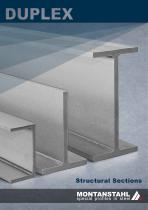
Structural Sections
Open the catalog to page 1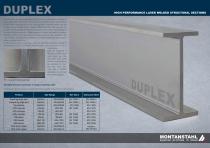
Stainless steels are used predominantly for their corrosion resistance in moderate to highly aggressive environments. For construction purposes, carbon steel normally is the common choice due to low cost, long experience, applicable design rules and a large variety of strength classes. However, different stainless steel types can also provide a very wide range of mechanical properties and they have the advantage of no need for surface protection. Some examples of industry end uses are structural supports for offshore oil & gas industry, chemical process industry, desalination and water treatment,...
Open the catalog to page 2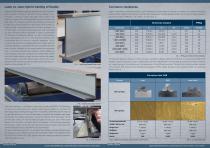
Laser vs. laser-hybrid welding of Duplex Corrosion resistance Welding of Duplex stainless steels can be carried out with all commonly used processes, including arc and beam welding. However, several studies on welding of Duplex warn about rapid cooling as this leads to a freezing of the ferritic structure (up to 90% ferrite in the weld zone). This happens especially with methods characterized by high-energy density welding like laser beams. The resulting unbalanced ferrite content leads to a loss of corrosion resistance. On the other hand, an excessively slow cooling rate, that might result e.g....
Open the catalog to page 3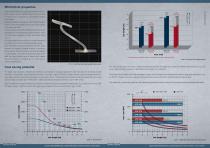
Mechanical properties Laser-hybrid welded structural sections have a monolithic structure with a controlled area of heat input and a reduced seam compared to conventional welding technologies. Extensive destructive testing has shown that the fracture points in laser-hybrid welded sections are never located in the weld area itself. External stresses and loads applied to the sections are transmitted to the neighbouring parent material, which only fails when exceeding its own mechanical limits (Pic. 6). All Duplex grades feature significantly better mechanical properties than common austenitic stainless...
Open the catalog to page 4
Disclaimer All the information contained in this documentation are given to the best of our knowledge and ability. However, we decline all responsibility for the use made of there suggestions and data. We reserve the right to effect technical modifications without prior warning. Current version available at www.montanstahl.com MONTANSTAHL 2016 Each reproduction - also partial - of the images included in this brochure is strictly forbidden. All rights reserved MONTANSTAHL AG Via Gerrette 4 CH-6855 Stabio Switzerland MONTANSTAHL Aspecial profiles in steel^r
Open the catalog to page 5All Montanstahl AG catalogs and technical brochures
 SOLUTIONS IN STEEL
11 Pages