
- Catalogs
- MITSUBISHI Automation
- Q/L-Family MELSEC Modular PLC


Q/L-Family MELSEC Modular PLC

Q/L-Family MELSEC Modular PLC
The document provides a comprehensive overview of Mitsubishi Electric's MELSEC Modular PLC systems, emphasizing their flexibility, scalability, and global applicability. These systems integrate various engineering disciplines, including PLCs, motion control, and process-based control, to enhance productivity and reduce ownership costs.
Mitsubishi Electric's Himeji Works is ISO14001 certified, emphasizing environmental management. The company's vision, "Changes for the better," aims for a sustainable future.
The MELSEC L series and MELSEC System Q offer modular automation solutions suitable for a wide range of applications. These systems are designed to be scalable, allowing for growth and adaptation to specific needs.
Mitsubishi's modular PLCs are globally recognized for their reliability and compliance with international standards. They offer multiple CPU configurations, including PLC, Motion, PC, and Process CPUs, and support single or redundant power supplies. The systems are designed for easy maintenance and feature built-in functions like data logging.
The modular PLCs are characterized by their flexibility and extensibility, supported by software tools that comply with international standards like IEC 61131-3. This flexibility reduces development time and simplifies system maintenance.
The MELSEC System Q supports multiple CPUs, allowing for complex task management and improved production quality. The system's modular design supports a wide range of control philosophies and programming languages.
The MELSEC L series is designed for high reliability and user-friendliness, featuring built-in functions typically found in compact PLCs. It supports up to 40 extension modules and includes built-in Ethernet and USB interfaces.
The document discusses the capabilities of motion controllers, which are expected to handle a broad range of applications. The Q17nDSCPU motion controller and QD77MS Simple Motion module offer compatibility with conventional servo amplifiers and ensure compliance with international safety standards.
Mitsubishi Electric's modular PLC systems are designed to meet future market requirements, offering safe investment through reliable technology and extensive system compatibility. The systems are supported by a global network, ensuring availability and support worldwide.
Mitsubishi Electric's MELSEC System Q offers a comprehensive automation platform with a focus on motion control, process control, and safety solutions. The system supports a wide range of applications with its modular PLCs, motion controllers, and process CPUs. The MELSEC L series provides various positioning options, including high-speed counter modules and multi-axis positioning modules for servo or stepper drives.
The system includes SSCNETIII/H, a dedicated motion controller network that supports fast, secure communication between up to 96 servo systems. This network uses fiber-optic cabling to ensure reliability and flexibility, eliminating concerns about electrical noise.
MELSEC System Q's process CPUs offer high functionality with features like loop controls and high-speed PID control. The system supports high availability through redundant CPUs and network configurations, ensuring seamless operation even in case of failures.
The system integrates IT solutions with its C controller, allowing for flexible control and monitoring. It supports various networking and communication modules, including Ethernet and CC-Link, and offers a dedicated webserver module for easy information sharing.
MELSEC System Q provides a fully integrated safety solution certified by relevant safety organizations. It offers flexible implementation options, including safety relay modules and safety I/O modules, to meet diverse system design needs.
Mitsubishi Electric's MELSOFT software solutions facilitate programming and visualization, offering tools to enhance productivity and simplify interface design. The software supports standard Mitsubishi Electric format, IEC 61131-3 compliance, and process control applications.
Mitsubishi Electric offers programming solutions that facilitate code reuse and feature intuitive interfaces, enhancing productivity and ease of use. The MELSOFT communication packages integrate Mitsubishi products with other software using plug-ins or drivers, ensuring reliability and compatibility with tools like Microsoft Excel and OPC.
Mitsubishi provides SCADA and PC-based HMI solutions for data analysis and maintenance. Their range of HMI technologies includes simple text screens to high-resolution touch screens and industrial PCs, complementing the MELSEC System Q's modular PLCs.
The e-F@ctory solution by Mitsubishi Electric addresses plant-wide management challenges using the MELSEC System Q platform. It supports over 50 communication forms, simplifying the interface between MES and production environments by embedding PCs directly on the backplane.
Mitsubishi's modular PLCs offer compact, flexible, and easy-to-program solutions for machine control, accommodating various I/O requirements and environmental conditions. They support a wide range of modules for temperature, positioning, and communication needs.
Mitsubishi Electric products are used across diverse sectors, including agriculture, building management, construction, food and drink, leisure, medical, pharmaceutical, plastics, automotive, printing, textiles, transportation, and utilities. Their solutions include SCADA, networking, telemetry, and industrial modems for remote management.
The document provides an overview of the MELSEC System Q and L series, detailing system descriptions, digital modules, special function modules, accessories, and dimensions. It emphasizes the importance of consulting product manuals for detailed configuration and installation guidance.
The MELSEC System Q by Mitsubishi Electric is a compact and powerful modular PLC designed for medium to high-performance automation tasks. It features multiprocessor technology, allowing for up to 4096 local and 8192 remote I/O points, making it suitable for various automation challenges. The system supports multiple network communications, including MELSECNET, CC-Link, Ethernet, and Profibus DP/Profinet, enhancing its flexibility and scalability.
- Up to 4096 local I/Os and 8192 remote I/Os.
- Interchangeable intelligence with 45 different CPU types across 9 families.
- Wide range of communication facilities.
- Easy installation and a single system platform for all configurations.
- Expandable memory up to 32 MB and integrated buffer battery for data protection.
The document lists various CPU types categorized into Basic PLC CPUs, High-performance CPUs, Universal PLC CPUs, Process CPUs, Redundant PLC CPUs, Motion CPUs, PC CPUs, and Special Purpose CPUs. Each type varies in program capacity and I/O points, catering to different application needs.
The modular design allows for flexible usage with various modules available, including digital and analog modules, pulse catch and interrupt modules, positioning modules, and communication modules. The system supports task management with multiple PLC CPUs, enabling distributed control and data processing.
The MELSEC System Q supports integration of Motion CPUs and Personal Computer CPUs, optimizing data exchange and reducing system costs. It allows for load distribution across multiple CPUs, improving system performance and stability.
The iQ Platform is a consolidated automation platform that integrates various controllers such as sequence controllers, process controllers, CNC controllers, robot controllers, and HMIs. It is designed to optimize productivity and reduce total cost of ownership (TCO) across diverse application areas.
The MELSEC QS Safety Programmable Controller is designed to prioritize worker safety in manufacturing environments. It connects to safety devices like Emergency Stop switches and light curtains, ensuring machinery is safely shut down in hazardous situations. It complies with international safety standards and is certified by TÜV Rheinland.
The system is designed with redundancy to prevent sudden faults, ensuring continuous operation even if a failure occurs. The Q Series products support this redundancy without requiring changes to existing modules, except for some specific cases.
The system's structure includes a base unit with an internal bus for communication between modules and CPUs. It supports extensions for additional modules and power supply configurations to enhance availability.
The platform supports TCP/IP Ethernet for global connectivity and MELSECNET/10/H for cost-effective, redundant cabling. CC-Link and CC-Link IE networks provide real-time processing and distributed intelligence, integrating third-party modules.
The system operates within a temperature range of 0 to +55°C and is protected against dust and corrosive gases. It meets various international certifications, ensuring reliability and safety in diverse environments.
The document outlines the network structure of the MELSEC System Q, which includes various levels such as the manufacturing, motion, and safety levels. The future goal is to have a uniform network structure across all levels. Key network technologies include MELSEC FX Peer-to-Peer for up to 8 FX2N controllers using standard twisted-pair cables, and SSCNETIII/H for high-speed servo and motion applications using optical fiber.
The command level utilizes TCP/IP Ethernet, while the control level includes CC-Link/CC-Link IE, CC-Link Safety, and MELSECNET/10/H. The production level features networks like CC-Link, CC-Link IE Field, and MELSEC FX-PPN. Open networks such as Modbus/TCP, Profibus/DP, Profinet, DeviceNet, AS-Interface, and CANopen are also supported.
Main base units hold and connect CPUs, power supply units, and various modules. They feature automatic module addressing and can be mounted using screws or a profiled rail. Extension base units expand the system to a maximum of 7 units with up to 64 I/O modules. They provide slots for power supply modules and increase system availability with redundant power supplies.
These modules supply necessary voltages for operation and feature LED indicators for readiness. They support a wide input range and can be replaced during operation without interrupting control. Specifications vary across models, with different input voltages, frequencies, and output currents.
The document details specifications for various CPU modules, including single and multi-processor types. Features include CPU self-diagnostic functions, battery buffers, and memory types. High-performance CPUs offer fast processing speeds, expandability, and advanced functions like floating point arithmetic and PID control loop processing.
- Modules like Q64RD, Q64TD, and Q68RD3-G support various temperature sensors (Pt100, JPt100, Ni100Ω, thermocouples) with specific temperature ranges and resolutions.
- Features include error compensation, alarm outputs, and potential isolation.
- Specifications cover input channels, temperature scaling values, resolution, accuracy, and conversion time.
- Modules such as Q64TCRT utilize PID algorithms for temperature control without burdening the PLC CPU.
- Features include auto-tuning, transistor output for actuator control, and removable terminal blocks.
- Specifications detail control output types, supported sensors, sampling cycles, and PID settings.
- The Q61LD module connects load cells directly to the MELSEC Q series, eliminating the need for external converters.
- Features include zero offset, two-point calibration, and error detection.
- Specifications include input points, voltage, resolution, accuracy, and conversion speed.
- The Q68CT module connects up to eight current transformers directly, supporting a range of AC currents.
- Features include high accuracy, scaling functions, and peak current detection.
- Specifications cover input points, resolution, accuracy, and response time.
- The Q62HLC module offers fast response control with continuous proportional PID control.
- Features include support for various sensor types and cascade control capabilities.
- Specifications include input channels, conversion speed, and PID settings.
- Modules like QD62E and QD60P8-G detect high-frequency signals for tasks like positioning and frequency measurement.
- Features include automatic rotation direction detection and preset count functions.
- Specifications detail counter inputs, signal levels, and additional functionalities.
- Specifications: These modules support a maximum counting frequency of up to 500 kHz and a counting range of 32 bits with a sign, allowing for a range from -2,147,483,648 to +2,147,483,647. They feature UP/DOWN preset counters and ring counter functions.
- External Connections: They utilize 40-pin connectors and support wire sizes of 0.3 mm². The modules have a nominal voltage of 5/12/24 V DC with varying current requirements.
- QD70 Series: These modules control up to 8 axes and support various positioning methods, including PTP and speed/locus positioning. They offer easy parameter setup via GX Configurator PT software.
- QD72P3C3 and QD73A1: Designed for space-efficient applications, these modules support 3 and 1 axis control respectively, with integrated counter inputs and D/A converters for servo amplifier control.
- QD74MH Series: These modules support up to 16 axes with SSCNETIII for high-speed motion control, featuring linear interpolation and rapid operation cycles.
- QD75 Series: These modules offer long-distance positioning capabilities with differential outputs and SSCNET compatibility, supporting up to 4 axes with linear and circular interpolation.
- QJ71C24N Series: These modules provide RS232 and RS422/485 interfaces for communication with peripheral devices. They support full duplex/half duplex modes and asynchronous communications, with integrated flash ROM for data logging.
- All modules are designed with a standard dimension of 27.4x98x90 mm and vary slightly in weight and power consumption.
- They are equipped with features like automatic acceleration/deceleration processing, rapid stop capabilities, and extensive data storage options.
- QG60 Protection: Designed to protect unused slots from dust, with selectable I/O points ranging from 0 to 1024. It is lightweight and compact.
- Conversion Adapters: Enable easy replacement of MELSEC AnS series PLCs with System Q PLCs without altering wiring, saving time and reducing errors.
- Connection Cables: Various cables are available for connecting base units, CPUs, and extension units, with specific lengths and order numbers provided.
- Programming Cables: Used for connecting PCs to MELSEC System Q PLCs via RS232 or USB interfaces, facilitating programming and data transfer.
- Connector Disconnection Prevention: A holder to secure RS232 connectors, preventing accidental disconnection.
- Memory Cards: Expandable memory options for MELSEC System Q CPUs, including SRAM and Flash types with varying capacities.
- Wireless LAN Adapter: Allows wireless network connectivity for PLC systems, supporting IEEE 802.11 standards.
- DIN Rail Mounting Adapter: Facilitates easy mounting of MELSEC System Q on DIN rails.
- Terminal Blocks: Options for screw-less wiring, enhancing ease of use and installation speed.
- Design: Compact, modular controller with built-in features, promoting flexibility and efficient use of space.
- Features: Includes high-speed counters, positioning capabilities, Ethernet communication, and data logging.
- Modules: Supports a variety of digital, analog, positioning, communication, and network modules, allowing for extensive customization.
- Power Supply and CPUs: Offers standard and high-performance CPUs with built-in communication interfaces and memory slots.
The document provides a comprehensive description of the MELSEC L Series, focusing on its components, functionalities, and specifications. It covers various modules, including power supply, CPU, digital input/output, and special function modules.
- Power Supply Module: Operates at 100-240VAC, 50/60Hz, with models L61P and L63P offering different input options and built-in protections.
- CPU Modules: Central to the system, offering high-speed processing, large memory capacity, and integrated data logging. Models vary in processing speed and program capacity, with built-in connectivity options like USB and Ethernet.
- Digital Input/Output Modules: Available in various configurations, these modules convert digital signals and control external processes. They feature LED status indicators and support both sink and source types.
- Special Function Modules: Include analog I/O, motion control, high-speed counting, and communication modules for specialized applications.
Each CPU includes 24 built-in I/O points, reducing the need for additional modules and lowering system costs. These I/Os support functions like positioning control, high-speed counting, and pulse catch inputs.
- Positioning Control: Supports up to two axes with a maximum speed of 200 kpulse/s and S-curve acceleration/deceleration.
- High-Speed Counter: Two channels with a maximum counting speed of 200 kpulse/s, supporting high accuracy measurements.
- Pulse Width Modulation (PWM): High precision control up to 200 kHz, suitable for applications like lighting dimmer control and motor drives.
The built-in data logging function allows for detailed operational analysis and troubleshooting. It synchronizes with the sequence program scan to capture every available value.
- Power Supply: L61P and L63P models with specific voltage and current ratings, built-in protections, and efficiency over 70%.
- CPU Modules: Various models with different processing speeds, memory capacities, and connectivity options. The L26CPU series offers the highest program capacity and CC-Link connectivity.
- Digital Modules: Input and output modules with varying points, voltage levels, and response times, designed for flexibility and reliability in signal processing.
The MELSEC L Series is designed for flexibility and efficiency in industrial automation, offering a range of modules and features to meet diverse application needs.
- Connection to PLCs using standard cables without special bus cables or communication settings.
- Master module supports up to six IO-Link devices, configurable as digital inputs or outputs.
- Features include data masking, parameter storage, and device configuration checks.
- Convert analog signals to digital values for processing by the CPU.
- High accuracy and resolution with isolated channels.
- Specifications include input points, voltage/current ranges, and conversion speed.
- Convert digital values to analog signals, suitable for fast and accurate control applications.
- Features high-speed conversion, accuracy, and integrated scaling functions.
- Independent temperature control with PID algorithm, relieving CPU load.
- Supports thermocouples and Pt100 sensors with auto-tuning for optimal control.
- Detect high-frequency signals with features like periodic pulse counting and ring counter functions.
- Specifications include counting frequency, range, and input/output points.
- Enable communication with peripheral devices via standard serial interfaces.
- Support for RS232 and RS422/485 interfaces with high transmission speeds.
- Control high-resolution drives with features like interpolation and speed positioning.
- Support for multiple axes and high output pulse rates.
- Provide advanced control functions like speed, torque, and synchronous control.
- Realized through simple parameter adjustments and PLC programming.
- LD77MH Module: Compatible with QD75MH, supports up to 600 positions per axis, and includes features like electronic cam control and high-speed digital inputs. It offers linear and circular interpolation functions and is compatible with SSCNETIII for communication with servo amplifiers.
- LJ61BT11 Module: Functions as a master/slave module for CC-Link networks, supporting up to 64 connected stations and a maximum transmission speed of 10 Mbps. It allows for easy integration with a wide range of CC-Link compatible devices.
- CC-Link IE Field Modules: These modules support high-speed Ethernet communication with a maximum speed of 1 Gbps. They offer flexible network configurations and are designed for easy parameterization and diagnostics.
- RS232 Interface Adapter (L6ADP-R2): Provides serial communication capabilities for the L series PLCs with a maximum transfer rate of 115.2 kbit/s.
- End Cover (L6EC-ET): Includes a relay output for error notification, providing an alternative to the standard end cover.
- Display Module: Allows for system status checks and setting changes directly from the display. It supports English and Japanese languages.
- SD Memory Card: Available in 2 GB and 4 GB capacities for CPU program backup and data logging.
- Backup Battery: Options available for different capacities to support the L series CPU.
- Extension Cables and Modules: Facilitate the connection and expansion of the MELSEC L series PLCs.
- MELSOFT Software Family: Includes GX Developer, GX Works2, and other tools for programming, visualization, and network configuration. GX Works2 is highlighted for its comprehensive support of MELSEC PLCs and its advanced features for programming and diagnostics.
- iQ Works: Provides a unified engineering environment for system design, programming, testing, and maintenance, integrating various MELSOFT programs for efficient system management.
- GX IEC Developer: This software supports programming standards IEC 1131.3 and is compatible with MS Windows XP and Vista. It is designed for MELSEC A series and MELSEC System Q PLCs. The software does not include a programming cable, which must be ordered separately.
- MX OPC Server: A standardized software interface for communication between Mitsubishi Electric PLCs and Microsoft Windows applications. It uses OPC standards for high-performance data exchange and is compatible with MS Windows XP and Vista.
- MX Components: Provides Active-X elements for communication between Windows applications and processes. It supports integration with MS Office applications and is compatible with MS Windows XP and Vista.
- GX Configurator DP: A configuration tool for Profibus DP networks, supporting various Mitsubishi Electric modules. It allows easy parameter setting for third-party devices and runs on MS Windows XP and Vista.
- GX Configurator PN: Used for configuring Profinet I/O modules, offering various capabilities for parameter data transfer. It supports MS Windows XP, Vista, and Windows 7.
- MELSEC L Series and System Q: The document lists various modules and accessories for these series, including CPU modules, power supply modules, digital modules, and special function modules.
Catalog excerpts
many solutions PLC Control / Motion / PC / Process / Multi CPU solutions / Redundancy / IEC 61131 -3 / Networking / Scalable / Machine control / Plant management / Safety /
Open the catalog to page 1
Global Standards Global Standards Manufactured to the highest standards Mitsubishi Electric automation products enjoy a global reputation for outstanding quali y and reliability. The process starts at t the design stage, where quality is designed into even the smallest components. Our systematic pursuit of “best practice” means that Mitsubishi Electric products readily comply with shipping approvals, product directives and standards. Through Mitsubishi Electric’s vision, “Changes for the better” are possible for a brighter future The 2004 Worldwide PLC Survey conducted by the respected American...
Open the catalog to page 2
Range overview Motion control Process control Plant solutions Machine solutions Section 2: Technical Informations
Open the catalog to page 3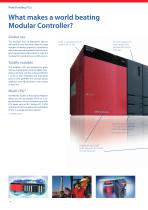
World leading PLCs What makes a world beating Modular Controller? Global use The modular PLCs of Mitsubishi Electric will work all over the world. With the large number of marine approvals, compliance with international standards and the stringent requirements of the industry, make the modular PLC a product you can fully trust in. Single or redundant power supplies (AC or DC) All CPU’s support the same range of I/O and special function modules Totally scalable The modular PLCs are designed to grow with your application, from the Q00UJ standalone solution and the compact MELSEC L series to the...
Open the catalog to page 4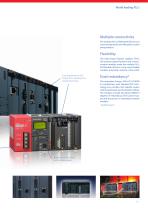
World leading PLCs Multiple connectivity The modular PLCs of Mitsubishi Electric can communicate easily with Mitsubishi or third party products. Flexibility The wide range of power supplies, CPU’s, I/O modules, special function and communication modules make the modular PLCs of Mitsubishi Electric to the most flexible modular automation systems in the world. Easy maintenance with bright LEDs indicating the operational status Dual redundancy* The redundant Process CPUs Q12/25PRH in combination with standard PLC technology can, provide a hot standby system with the automatic synchronization of...
Open the catalog to page 5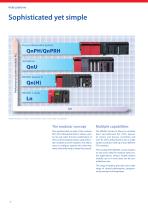
Multi platform Performance System modular PLC Process/Redundant System Mitsubishi Electric’s modular control solutions span a wide range of capabilities. Multiple capabilities This sophisticated concept of the modular PLCs from Mitsubishi Electric allows users to mix and select the best combination of CPUs, communication devices, special function modules and I/O modules. This allows users to configure systems into what they need, when they need it, where they need it. The MELSEC System Q allows to combine basic and advanced PLC CPUs, specialist motion and process controllers and even PC CPUs...
Open the catalog to page 6
Multi platform Flexible and scalable An automation platform for the future Flexibility and scalability are the key design features that enable the modular PLCs to be a truly powerful automation platform. Users can apply simple control to an individual machine or integrated plant wide management all from the same hardware base. The modular PLC is supported by several software tools which enable easy and comprehensive integration using Mitsubishi Electric’s EZSocket middleware. In addition, Mitsubishi Electric also offer software tools that comply with international standards such as IEC 61131-3,...
Open the catalog to page 7
Multi platform MELSEC System Q The CPUs of the MELSEC System Q Universal PLC CPUs These universal PLC CPUs are the latest generation of modular CPUs for the MELSEC System Q controller platform and they are the foundation of the iQ Platform system. They can be combined with the motion, robot and NC CPUs to configure scalable and highly flexible modular automation systems. Scalable With the exception of the embedded Q00J CPU, all MELSEC System Q PLC processors are interchangeable, which means processing power can be increased as applications grow, protecting your investment in infrastructure and...
Open the catalog to page 8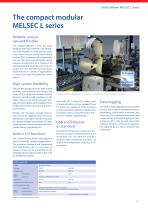
Multi platform MELSEC L series The compact modular MELSEC L series Reliable, ease to use and flexible The modular MELSEC L series has been designed with high reliability, user friendliness and flexibility in mind and has builtin functions that are usually found only in compact PLCs. Engineers and programmers can use their time more efficiently, saving valuable development time. Thanks to its sophisticated approach, the L series can be used at low costs and with minimum space requirements in a variety of applications. A system that easily fits perfectly in every respect. High system flexibility...
Open the catalog to page 9
Motion control The challenge of Motion Control Reliable safety monitoring Safety in production is an absolute must as all machines and equipment must comply with the international safety standards. The Q17nDSCPU is equipped as standard with safety functions which are certified to EN ISO 13849-1 Category 3, PL d. User-friendly development environment Powerful functions which have been optimised for efficiency are provided via a userfriendly development environment. These simplify system design, commissioning and fault finding, increase data security and lead to shorter downtimes. Mitsubishi Electric...
Open the catalog to page 10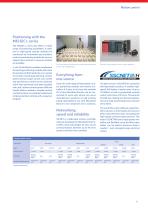
Motion control Positioning with the MELSEC L series The MELSEC L series also offers a whole range of positioning possibilities. In addition to high-speed counter modules for connection of incremental axes encoders, multi-axis positioning modules for servo or stepper drives with up to 4 axes per module are available. 4- and 16-axis Motion modules complement the existing positioning modules and round the product portfolio perfectly out. A variety of controls including positioning control, speed control, torque control, cam control and synchronous control can be achieved, which have previously only...
Open the catalog to page 11
Process control MELSEC System Q MELSEC System Q process control you can count on Reliable system operation is essential in the process industry. A platform to build on The strength of MELSEC System Q’s automation platform really comes into its own in traditional specialist industries. The unique flexibility of proven off-the-shelf control components such as I/O and communication devices, teamed with dedicated special devices like process CPUs, assures high functionality, ease of use and targeted control – all within budget. Two worlds meet Our dedicated MELSEC System Q process CPUs build on the...
Open the catalog to page 12All MITSUBISHI Automation catalogs and technical brochures
 MELSEC iQ-R Series
120 Pages
 MR-FAMILY
117 Pages
 FR-A741
4 Pages

Archived catalogs
 MR-J4
MR-J44 Pages
 the automation book
188 Pages
 MELSEC System Q
84 Pages
 MR-J3-BSafety
4 Pages
 FX3UC
FX3UC4 Pages
 HMI E1000
4 Pages
 ST series
4 Pages
 SPAC
SPAC2 Pages
 Material Handling
28 Pages
 SUPER AE-SW
4 Pages
 203684
52 Pages
 Data 2009
8 Pages
 Data Redundant System Q Series
27 Pages
 219952
28 Pages
 Data CC-Link/LT Safety
136 Pages
 LVS Family
116 Pages
 MR Family
90 Pages
 HMI Family
58 Pages
 MELSEC STlite
4 Pages
 L series
4 Pages
 FX Family
90 Pages
 Micro controller ALPHA 2
4 Pages
 Mitsubishi Magasine
20 Pages
 Automotive
20 Pages
 MELSEC Process Control Catalog
13 Pages
 MELSEC iQ-R series/System Q/L series
166 Pages


- Mitsubishi Electric electric motor
- Panel PC
- Industrial panel PC
- Panel PC with touch screen
- Fanless panel PC
- Industrial robot
- Mitsubishi Electric AC motor
- LCD panel PC
- Management software solution
- Mitsubishi Electric automation software
- Intel® Core™ PC
- Fanless PC
- Intel® Core™ panel PC
- Box PC
- Analysis software solution
- Windows PC
- Electromotor for industrial applications
- Process software
- Windows 10 panel PC