
- Catalogs
- MITSUBISHI Automation
- MELSEC System Q


MELSEC System Q

MELSEC System Q
Mitsubishi Electric's System Q is a versatile automation platform integrating control features from various engineering disciplines, including PLCs, motion, and process-based control. It aims to boost productivity, reduce ownership costs, and enhance return on investment.
System Q is manufactured to high standards, ensuring compliance with global shipping approvals and product directives. Mitsubishi Electric is recognized as a leading PLC producer, as confirmed by the 2004 Worldwide PLC Survey.
- Scalability: System Q can expand from standalone solutions to networked and redundant systems.
- Multi CPU Solutions: Supports multiple CPUs on a single backplane, including PLC, Motion, PC, and Process CPUs.
- Redundancy: Offers dual redundancy with automatic data synchronization and hot standby systems.
- Networking: Supports multi-network connectivity, including Ethernet and SQL database connections.
- Basic PLCs: Suitable for small systems requiring compact designs and high-speed operation.
- Advanced PLCs: Designed for complex machine designs and manufacturing cells, offering expandable memory and support for complex programs.
- Universal PLC CPUs: The latest generation of modular CPUs, forming the foundation of the iQ Platform system.
- Motion Control: Offers high-speed, reliable control with solutions ranging from individual motion cards to advanced motion CPUs.
System Q's process CPUs combine standard PLC control with dedicated process functions, offering high functionality and ease of use. The platform supports high system availability through redundant CPUs and network configurations.
System Q is a flexible and scalable automation platform that supports a wide range of applications, ensuring high performance, reliability, and cost-effectiveness.
The document outlines specifications of various Process CPUs and Redundant CPUs, including models Q02PHCPU, Q06PHCPU, Q12PHCPU, Q25PHCPU, Q12PRHCPU, and Q25PRHCPU. Key features include a total input/output capacity of 4096/8192, memory capacity of 32 MB, and program memory ranging from 28 k steps to 252 k steps. The CPUs support multi-CPU capability with a maximum of four CPUs per system.
System Q integrates a Windows® PC into its industrial design, allowing users to write control programs and directly actuate I/O control. It can serve as an embedded monitoring point for SCADA installations or user-created VB applications. The fanless design and optional silicon hard drive enhance reliability in industrial environments.
System Q supports over 50 types of networking and communication modules, including Ethernet, Profibus/DP, and Modbus TCP. The QJ71WS96 webserver module facilitates information sharing with on-board webpages and Java scripting. Telemetry solutions include basic and intelligent modems available in triband GSM or PSTN formats.
The QJ71MES96 module allows direct connection with commercial databases like Oracle and MS SQL Server, supporting bi-directional data transfer and reducing network load. This simplifies system complexity and cost by eliminating the need for gateways.
Mitsubishi Electric offers a comprehensive safety solution certified by EN954-1 Category 4, ISO13849-1 PL e, and IEC61508 SIL 3. The safety functions can be mounted on the rack, decentralized I/O, or on the CC-Link Safety network. The MELSEC WS Safety Controller and MELSEC QS Safety PLC provide scalable safety solutions for different system sizes.
Mitsubishi’s MELSOFT software solutions streamline programming and visualization, offering packages in standard Mitsubishi format, IEC1131.3 compliance, and dedicated process control solutions. The software supports integration with other tools like Microsoft Excel and OPC, enhancing productivity and ease of use.
System Q’s modular design facilitates plant-wide control and communication, supporting over 50 communication forms. The e-F@ctory solution simplifies the interface between MES and production environments. For machine solutions, System Q offers compact, flexible control systems with a wide range of modules and easy programming tools.
The document details the technical specifications of the MELSEC System Q, highlighting its multiprocessor technology, compact design, and extensive communication capabilities. It supports up to 4096 local and 8192 remote I/O points, making it suitable for medium to high-performance automation tasks.
The MELSEC System Q includes various modules such as base units, power supply modules, CPU modules, digital input/output modules, analog modules, temperature control modules, and network modules. These components are designed for easy installation and flexibility in configuration.
Key features include interchangeable intelligence, a wide range of communication facilities, and innovative technology for future applications. The system supports multiple CPU types, including PLC, process, redundancy, PC/C, and motion CPUs.
The system's performance can be enhanced by adding or replacing CPUs, with support for up to four CPUs sharing control and communication tasks. Memory can be expanded up to 32 MB, and flash ROM cards are available for permanent storage.
The document mentions programming systems such as MELSOFT software, visualization software, and Profibus software, which facilitate system configuration and management.
Mitsubishi Electric's MELSEC System Q offers a robust and flexible automation platform suitable for a wide range of industrial applications, with a focus on expandability, performance, and ease of use.
The safety main base unit connects the Safety CPU with CC-Link Safety Master Modules and Ethernet modules. It features automatic module addressing and can be mounted using screws or a profiled rail. Specifications vary by model, with different slots for I/O and power supply modules.
These units expand the Q system to a maximum of 7 extension units with up to 64 I/O modules. They include slots for power supply modules and support redundant systems. Specifications detail the number of slots, installation requirements, and dimensions.
These modules provide necessary voltages for operation, with features like LED indicators and support for a wide input range. Redundant power supplies can be replaced without interrupting operations. Specifications include input voltage, frequency, inrush current, and output current.
The MELSEC System Q offers single and multi-processor CPUs, with features like RS232C interfaces, integrated Flash ROMs, and various memory capacities. Specifications cover I/O points, memory type, program cycle period, and more.
These CPUs offer high processing speed and expandability, with features like USB interfaces, floating point arithmetic, and hot-swap module replacement. Specifications include memory capacity, program cycle period, and the number of connectable extensions.
The latest generation of modular CPUs for the MELSEC System Q, these CPUs feature integrated USB and Ethernet interfaces and fast bit processing. Specifications detail memory capacity, program cycle period, and dimensions.
These modules support multiprocessor mode and include features like CPU self-diagnostic functions and battery buffers. Specifications cover memory capacity, program cycle period, and I/O points.
The safety CPU conforms to EN954-1 Category 4, ISO13849-1 PL e, and IEC61508 SIL 3 standards, certified by TÜV Rheinland. It includes automatic checking of safety inputs and outputs, reducing wiring requirements, and comprehensive diagnostics functions.
The CPU supports up to 4096/8192 I/O points, uses cyclic program execution, and supports relay symbol language and function block programming. It has a processing speed of 0.10–0.35 µs, a program capacity of 14 k steps, and a memory capacity of 128 kB.
These modules convert digital process signals into levels required by the PLC. They feature potential isolation via optocouplers, LED status indicators, and removable terminal blocks. Various models support different input points and voltage levels.
Output modules are available with relay, transistor, or triac switches, featuring potential isolation and removable terminal blocks. They support different output types and voltage levels, with specific models offering short-circuit protection.
These modules convert analog signals into digital values for processing by the Q CPU. They offer up to 8 channels per module, with a resolution of 0.83 mV and conversion time of 80 µs/channel. Potential isolation is provided via optocouplers.
Each module type has detailed specifications regarding input/output points, voltage ranges, current ratings, response times, and physical dimensions. The document also includes order information and available accessories for each module.
The analog input modules are designed to convert analog process signals into digital values with high accuracy. Most channels are isolated from each other and the external power supply, except for the ME1AD8HAI-Q, which supports HART communication with up to eight devices. Key features include potential isolation, high resolution (16/32 bit), high accuracy (±0.05%), integrated short circuit protection, and signal conditioning functions. The modules support various input types and resolutions, with specifications varying across models like Q62AD-DGH, Q64AD-GH, Q66AD-DG, Q68AD-G, and ME1AD8HAI-Q.
These modules convert digital values from the CPU into analog signals to control devices like frequency inverters and valves. They offer up to 8 channels per module, with a resolution of 0.333 mV and 0.83 μA, and a conversion time of 80 μs/channel. Features include potential isolation, disconnection detection, and removable terminal blocks. Specifications vary across models such as Q62DAN, Q62DA-FG, Q64DAN, Q66DA-G, Q68DAVN, and Q68DAIN.
These modules convert input values from temperature sensors into digital temperature measurements. They support various sensor types and standards, with features like disconnection detection, error compensation, and alarm outputs. Models include Q64RD, Q64RD-G, Q64TD, Q64TDV-GH, Q68RD3-G, and Q68TD-G-H01/H02, each with specific sensor compatibility and measurement ranges.
Designed for PID algorithm temperature control, these modules operate independently of the PLC CPU. They feature four input channels, auto-tuning for PID control, and transistor outputs for actuator control. Models like Q64TCRT, Q64TCRTBW, Q64TCTT, and Q64TCTTBW support various temperature sensors and offer settings for PID constants and control output cycles.
The document discusses various special function modules for Mitsubishi Electric's programmable controllers. The QI60 interrupt module is highlighted for its quick response capabilities, allowing each input to be assigned to a subroutine pointer. It features galvanic isolation and can only be installed once per PLC system. High-speed input modules offer adjustable response times and can be configured as interrupt or input modules.
The document provides detailed specifications for several modules, including input points, rated input voltage, operating voltage range, input resistance, and response times. All modules feature photocoupler isolation and have specific dimensions and weight.
Various accessories are described, such as dummy modules for slot protection, connection cables for redundant CPUs, programming cables for USB and RS232 interfaces, and connector disconnection prevention holders. The document also covers memory cards and adapters, including specifications for different types and capacities.
Dimensions for base units, CPUs, power supply modules, and I/O modules are provided, with detailed measurements for each type.
The MELSOFT software family is introduced, offering programming and documentation tools for Mitsubishi Electric systems. It includes packages like GX Developer and GX IEC Developer, which support structured programming and conform to IEC 1131 standards.
Catalog excerpts

FACTORY AUTOMATION PROGRAMMABLE LOGIC CONTROLLERS many solutions PLC Control /// Motion /// PC /// Process /// Multi CPU solutions /// Redundancy /// IEC 61131-3 /// Networking /// Scalable /// Machine control /// Plant management ///
Open the catalog to page 1
Global leader /// Global leader /// Global leader /// Global leader /// Global Global Standards Through Mitsubishi Electric's vision, "Changes for the better" are possible for a brighter future Mitsubishi Electric Corporation Nagoya Works is a factor ycertif ied far ISO14001 (standards for environmental management systems) and I SO9001 (standards far quality assurance management systems) System Q provides total global solutions for a vast range of applications. Pioneered by Mitsubishi, System Q is a single automation platform that brings together modular control features from a variety of different...
Open the catalog to page 2
/// Contents /// Contents /// Contents /// Contents /// Contents /// Contents Contents Range overview 4 PLC control 6 Motion control 8 Process control 10 PC control 12 Safety for all systems 14 Programming 15 Plant solutions 16 Machine solutions 17 Applications 18 Section 2: Technical Informations 3
Open the catalog to page 3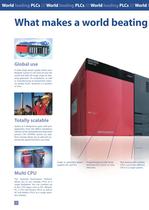
World leading PLCs /// World leading PLCs /// World leading PLCs /// World l What makes a world beating Global use A wide range power supply means your Modular System Q will work all over the world and with the huge range of shipping approvals, CE compliance, as well as manufacturing to Automotive industry quality levels, SystemQ is a product to trust. Totally scalable System Q is designed to grow with your application, from the Q00UJ standalone solution to the networked and redundant process CPU Q25PRH. System Q's platform concept allows you to add and customize the special functions you need....
Open the catalog to page 4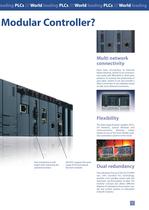
eading PLCs /// World leading PLCs /// World leading PLCs /// World leading Modular Controller? Multi network connectivity From basic AS-Interface to Ethernet based networks, System Q can communicate easily with Mitsubishi or third party products. To increase the productivity in your plant, System Q can also provide a direct connection to any database based on SQL via an Ethernet connection. Flexibility The wide range of power supplies, CPU’s, I/O Modules, Special Modules and Communication Modules makes System Q one of the most flexible modular automation systems in the world. Easy maintenance...
Open the catalog to page 5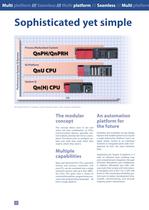
Multi platform /// Seamless /// Multi platform /// Seamless /// Multi platform Sophisticated yet simple Performance System Q Servers Process/Redundant System iQ Platform System Q I/O Mitsubishi Electric's modular control solutions span a wide range of capabilities. The modular concept This concept allows users to mix and select the best combination of CPUs, communication devices, specialist control modules and discreet I/O on a backplane. This allows users to configure systems into what they need, when they need it, where they need it. Multiple capabilities Basic and advanced PLC CPUs, specialist...
Open the catalog to page 6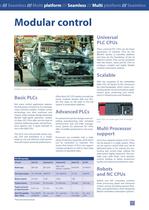
m /// Seamless /// Multi platform /// Seamless /// Multi platform /// Seamless Modular control Universal PLC CPUs These universal PLC CPUs are the latest generation of modular CPUs for the MELSEC System Q controller platform and they are the foundation of the iQ Platform system. They can be combined with the motion, robot and NC CPUs to configure scalable and highly flexible modular automation systems. Scalable Reliable control when you need it most. Basic PLCs Not every control application requires the full power of System Q. For example, many machine builders embed control technology into their...
Open the catalog to page 7
Motion control /// Motion control /// Motion control /// Motion control /// Power in motion To control these servo systems as well as those made by other manufacturers, System Q offers solutions ranging from individual motion/positioning cards to advanced motion CPUs capable of synchronised operation across many axes. In control System Q’s unique design allows users to select and use different combinations of CPUs from the same platform. For example, motion CPUs can be employed independently or in tandem with PLC, PC or process CPUs. Thanks to the dedicated motion control network SSCNET III,...
Open the catalog to page 8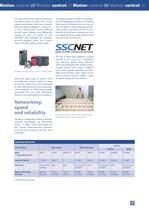
Motion control /// Motion control /// Motion control /// Motion control /// For users who do not need a full motion controller, System Q offers over 12 individual control cards. Each type of special function card is available in a range of 1, 2, 4 or 8 control axes; control methods include open collector and differential output, as well, of course, as the SSCNetIII. Also available are standard, general purpose, pulse train output cards, and high-speed counter cards. The latest version is SSCNET III, a powerful third-generation product. It enables high-speed, full duplex, transfer rates of up...
Open the catalog to page 9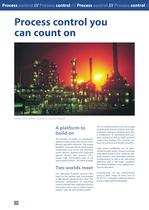
Process control /// Process control /// Process control /// Process control // Process control you can count on Reliable system operation is essential in the process industry. A platform to build on The strength of System Q’s automation platform really comes into its own in traditional specialist industries. The unique flexibility of proven off-the-shelf control components such as I/O and communication devices, teamed with dedicated special devices like process CPUs, assures high functionality, ease of use and targeted control – all within budget. Two worlds meet Our dedicated SystemQ process...
Open the catalog to page 10
// Process control /// Process control /// Process control /// Process control Process CPUs System Q’s Process CPUs bring the benefits of standard System Q technology into the process environment, reducing both implementation and long-term running costs. These powerful processors combine standard PLC control with 52 dedicated process control functions, including loop controls with two degrees of freedom (DOF) and highspeed PID control. The high availability of the dual redundant System Q can be applied to a wide range of industries from Food and Utilities to Process, and Chemical. High reliability...
Open the catalog to page 11All MITSUBISHI Automation catalogs and technical brochures
 MELSEC iQ-R Series
120 Pages
 MR-FAMILY
117 Pages
 FR-A741
4 Pages

Archived catalogs
 MR-J4
MR-J44 Pages
 the automation book
188 Pages
 Q/L-Family MELSEC Modular PLC
114 Pages
 MR-J3-BSafety
4 Pages
 FX3UC
FX3UC4 Pages
 HMI E1000
4 Pages
 ST series
4 Pages
 SPAC
SPAC2 Pages
 Material Handling
28 Pages
 SUPER AE-SW
4 Pages
 203684
52 Pages
 Data 2009
8 Pages
 Data Redundant System Q Series
27 Pages
 219952
28 Pages
 Data CC-Link/LT Safety
136 Pages
 LVS Family
116 Pages
 MR Family
90 Pages
 HMI Family
58 Pages
 MELSEC STlite
4 Pages
 L series
4 Pages
 FX Family
90 Pages
 Micro controller ALPHA 2
4 Pages
 Mitsubishi Magasine
20 Pages
 Automotive
20 Pages
 MELSEC Process Control Catalog
13 Pages
 MELSEC iQ-R series/System Q/L series
166 Pages


- Mitsubishi Electric electric motor
- Panel PC
- Industrial panel PC
- Panel PC with touch screen
- Industrial robot
- Fanless panel PC
- Mitsubishi Electric AC motor
- LCD panel PC
- Mitsubishi Electric automation software
- Management software solution
- Intel® Core™ PC
- Industrial computer
- Fanless PC
- Intel® Core™ panel PC
- Box PC
- Analysis software solution
- Windows PC
- Electromotor for industrial applications
- Process software
- Windows 10 panel PC