
- Catalogs
- miller graphics
- Atom DAM Digital Asset Management Brochure

- Company
- Products
- Catalogs
- News & Trends
- Exhibitions
Atom DAM Digital Asset Management Brochure
1 / 3 PagesView full catalog
Atom DAM Digital Asset Management Brochure
Product catalog summary
Overview of Digital Asset Management (DAM):
Digital Asset Management (DAM) is a comprehensive system designed to manage, organize, and distribute digital assets such as photos, videos, audio files, presentations, and documents from a single source. It is a powerful web-based tool that simplifies the handling of digital assets, ensuring brand consistency and security.
Digital Asset Management (DAM) is a comprehensive system designed to manage, organize, and distribute digital assets such as photos, videos, audio files, presentations, and documents from a single source. It is a powerful web-based tool that simplifies the handling of digital assets, ensuring brand consistency and security.
Key Features and Benefits:
- Brand Consistency: Ensures the use of the same asset across all channels, maintaining brand integrity.
- Global Management: Centralizes assets, providing control over images used across various locations and departments.
- Improved Workflows: Simplifies file management, preventing versioning issues and file loss.
- Fast Access: Allows quick retrieval of digital assets, accessible directly from the DAM platform or through API connections.
- Streamlined Approvals: Centralizes workflow, speeding up asset production and reducing reliance on emails.
- Asset Security: Ensures only the latest versions of images are used, with options to set expiration dates and hide invalid assets.
- Brand Protection: Guarantees the use of original images, preventing counterfeit usage.
- Multi-format Exports: Supports exports in various formats.
- Integration with PIM: Covers all asset and product information needs.
- Connectivity: Integrates with online artwork applications, CREATOR, PIM, and millnet for comprehensive control over market material output and workflow.
Usage and Integration:
DAM can be used as a simple archive or an advanced media sharing and production management system. It integrates seamlessly with other modules and external systems, providing a single point of storage for assets across multiple platforms and applications. It is particularly beneficial for omnichannel retailers requiring diverse data types.
DAM can be used as a simple archive or an advanced media sharing and production management system. It integrates seamlessly with other modules and external systems, providing a single point of storage for assets across multiple platforms and applications. It is particularly beneficial for omnichannel retailers requiring diverse data types.
Additional Capabilities:
- Remote Access: Access content from anywhere at any time.
- File Sharing: Share large files via links, eliminating the need for large attachments.
- Distribution: Streamlines distribution to multiple stakeholders across platforms.
- Permissions: Controls access and usage of assets.
- Cost Efficiency: Reduces costs related to lost or misplaced files.
- Customization: Solutions are tailored to specific needs, with scalability options.
- eCommerce Synchronization: Ensures the latest product images and marketing materials are online, maintaining brand integrity.
See more
Catalog excerpts
CONNECTING YOUR BRAND
Open the catalog to page 1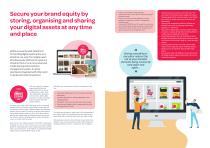
Secure your brand equity by storing, organising and sharing your digital assets at any time and place • Exports can be made in multiple formats • Combine with PIM to cover all your assets and product information needs • Connect with online artwork application to easily populate and create your artwork for packaging or marketing needs • Connect with CREATOR and PIM to get full control over your market material output securing your brand equity • Connect with millnet to take control of workflow and approval cycles for your packaging process DAM is a powerful web-based tool for handling digital...
Open the catalog to page 2
CONNECTING YOUR BRAND © 2021 Miller Graphics Group. All rights reserved.
Open the catalog to page 3All Miller graphics catalogs and technical brochures

Related Searches
- Automation software solution
- Management software solution
- Computer-aided design software
- Cloud-based software
- Design software solution
- Industrial software
- Automated software
- Creation software
- Optimization software
- Web-based software solution
- Centralized software
- Production software
- Graphic software
- Editing software
- Printing software
- Web browser software
- Collaborative software
- Commercial software
- Custom-made software
- SaaS software
*Prices are pre-tax. They exclude delivery charges and customs duties and do not include additional charges for installation or activation options. Prices are indicative only and may vary by country, with changes to the cost of raw materials and exchange rates.
About DirectIndustry
DirectIndustry is a marketplace that offers B2B players a complete experience, from product sourcing to purchase. DirectIndustry is an entity of VirtualExpo Group.
Are you a buyer?
Are you a supplier?