
- Catalogs
- Miki Pulley Europe AG
- Precision Springs catalog


Precision Springs catalog
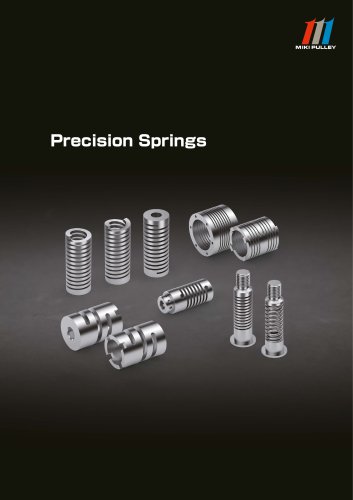
Precision Springs catalog
Precision springs are engineered components known for their ability to absorb compressive, tensile, torsional forces, and bending stresses. Unlike standard coiled springs, precision springs are machined from a single piece of material, offering high accuracy and operational reliability. They provide precise and constant spring rates with minimal internal stresses, resulting in a linear spring characteristic curve and high fatigue strength.
Materials and Design Features
Precision springs can be made from a wide range of materials, including aluminum, plastics, and titanium, allowing for lightweight, electrically insulating, and corrosion-resistant applications. They offer versatile mounting options and can integrate additional functions, enhancing strength and service life.
Comparison: Standard Springs vs. Precision Springs
Precision springs offer several advantages over standard springs, including the ability to integrate custom fasteners, achieve high dimensional accuracy, and maintain consistent spring rates. They are available in single, double, or triple-coil designs and can be manufactured from a variety of materials, providing high reliability and reduced material stresses.
Application Example: Custom Compression Spring
A custom compression spring solution demonstrates the benefits of precision springs, such as higher accuracy, reduced procurement costs, and inventory minimization. The new solution replaces a multi-component system with a single precision spring component.
Use of the Finite Element Method (FEM)
The Finite Element Method is employed to design and optimize precision springs, allowing for accurate predictions of strength, load-bearing capacity, and service life.
Extending Service Life
Design measures such as stress-relief holes, material reinforcements, and surface coatings can extend the service life of precision springs by increasing load cycles and improving fatigue strength.
Optimized Fastening for Precision Springs
Precision springs allow for integrated fasteners, reducing installation space, production costs, and assembly time while increasing service life and operational reliability.
Catalog excerpts
Precision Springs
Open the catalog to page 1
Precision Springs
Open the catalog to page 2
07 Materials and Design Features 10 Comparison: Standard Springs vs. Precision Springs
Open the catalog to page 3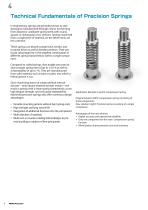
In engineering, springs are generally known as standard parts manufactured through cold or hot forming from alloyed or unalloyed spring steels with round, square, or rectangular cross-sections. Springs machined from a single piece of material, on the other hand, are less common. These springs can absorb compressive, tensile, and torsional forces as well as bending stresses. Their particular advantage lies in the targeted combination of different spring characteristics within a single component. Compared to coiled springs, they enable very precise and constant spring rates of up to ±0.1% as well...
Open the catalog to page 4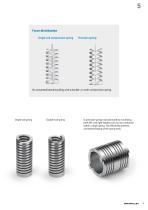
Force distribution Single-coil compression spring Precision spring No unwanted lateral buckling with a double- or multi-coil precision spring. Single-coil spring Double-coil spring In precision springs manufactured by machining, both left- and right-handed coils can be combined within a single spring. This effectively prevents unwanted twisting of the spring ends.
Open the catalog to page 5
6 Maximum Accuracy in Precision Springs The machining process used to manufacture precision springs does not generate any additional internal stresses that must be overcome when the spring is loaded. Furthermore, due to the high manufacturing accuracy, all coil windings are active. As a result, the spring deforms uniformly under load and returns to its original shape once the load is removed. The result is a linear and precise spring characteristic curve. For conventionally wound springs, the spring rate typically falls within a tolerance range of approximately ±10%. Machined precision springs,...
Open the catalog to page 6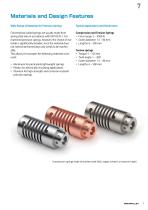
Wide Range of Materials for Precision Springs Conventional coiled springs are usually made from spring steel wire in accordance with EN 10270-1. For machined precision springs, however, the choice of materials is significantly broader, since the material does not need to be formed but only needs to be machinable. This allows, for example, the following materials to be used: • Aluminum for particularly lightweight springs • Plastics for electrically insulating applications • Titanium for high-strength and corrosion-resistant precision springs Typical Applications and Dimensions Compression and...
Open the catalog to page 7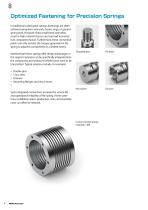
Optimized Fastening for Precision In traditional coiled spiral springs, fastenings are often achieved using bent wire ends, hooks, rings, or ground spring ends. However, these small bend radii often result in high material stresses and can lead to premature component failure. Furthermore, these connection points can only transfer the torques generated in the spring to adjacent components to a limited extent. Machined precision springs offer design advantages in this regard. Fasteners can be specifically integrated into the component and reinforced where forces need to be transmitted. Typical...
Open the catalog to page 8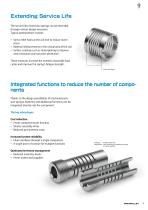
9 Extending Service Life The service life of precision springs can be extended through various design measures. Typical optimizations include: • Stress-relief holes at the coil end to reduce notch stress • Material reinforcements in the critical area of the coil • Surface coatings such as nickel plating to improve wear resistance and corrosion protection These measures increase the number of possible load cycles and improve the spring’s fatigue strength. Stress relief bores Integrated functions to reduce the number of components Thanks to the design possibilities of machined precision springs,...
Open the catalog to page 9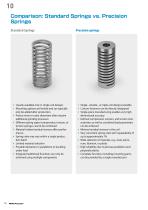
Precision springs Standard Springs • Usually available only in single-coil designs • Mounting options are limited and can typically only be added after production • Precise inner or outer diameters often require additional grinding processes • Different spring types (compression, tension, or torsion springs) cannot be combined • Material-related residual stresses affect performance • Spring rates may vary within a single production batch • Limited material selection • Possible deviations in parallelism or buckling under load • Integrated additional functions can only be achieved using multiple...
Open the catalog to page 10All Miki Pulley Europe AG catalogs and technical brochures
 MHS Datasheet
2 Pages
 MHL Datasheet
2 Pages
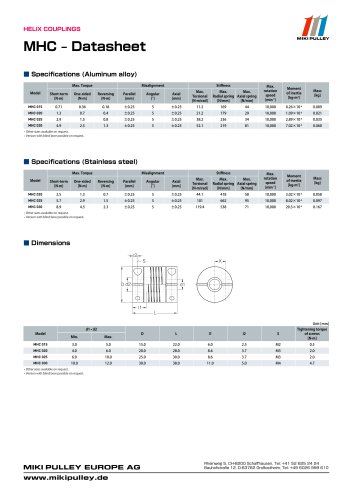 MHC Datasheet
2 Pages
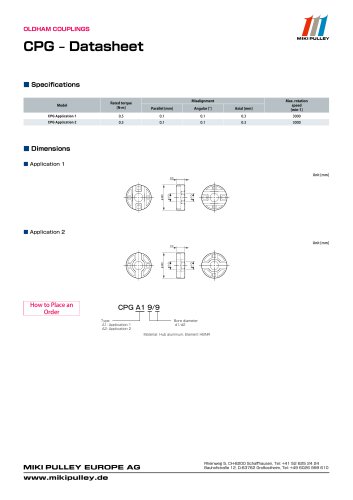 CPG Datasheet
1 Page
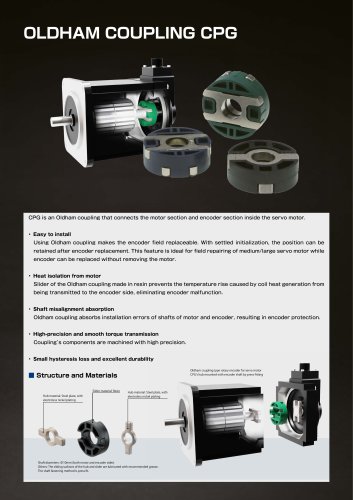 CPG catalog
2 Pages
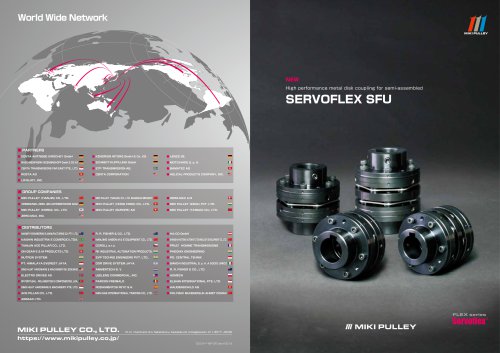 Servoflex SFU Catalog
6 Pages
 PSL - D Model
2 Pages
 Starflex ALS AN
12 Pages
 STK Model datasheet
1 Page
 Servoflex SFR Catalog
12 Pages
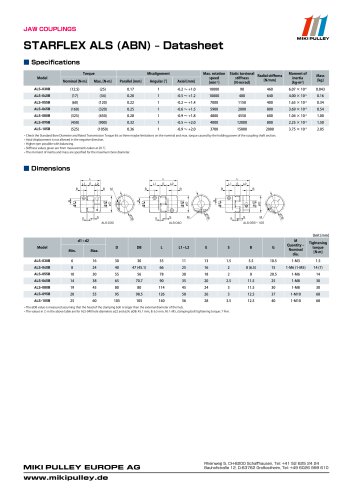 Starflex ALS AN datasheets
9 Pages
 BXR Model datasheet
2 Pages
 BXR-LE Model datasheet
2 Pages
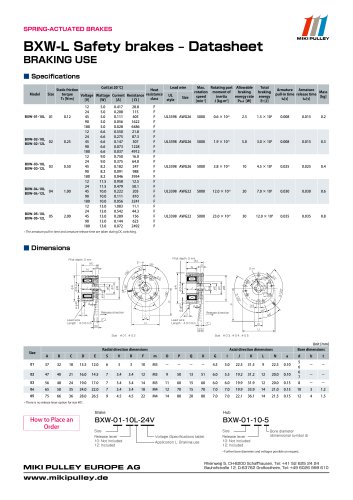 BXW Model datasheets
4 Pages
 SFM Model datasheets
2 Pages
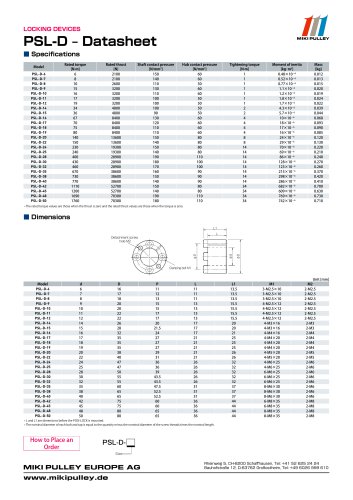 PSL-D series datasheet
2 Pages
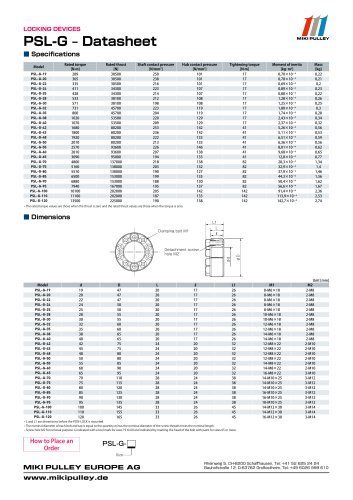 PSL-G series datasheet
2 Pages
 SFC Model Datasheet
10 Pages
 TT(01) Model datasheet
3 Pages
 KSK Model
2 Pages
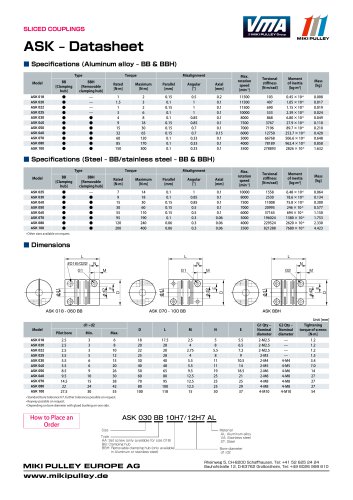 ASK Model datasheet
1 Page
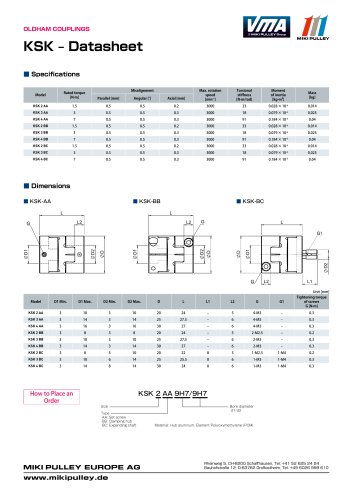 KSK Model datasheet
1 Page
 ASK Model
2 Pages
 STK Catalog
2 Pages
 TT(03) Model datasheet
3 Pages
 BXL-N datasheet
1 Page
 BXL Model datasheet
2 Pages
 BXH Model datasheet
2 Pages
 TT Torque Tender
10 Pages
 SFM Model
8 Pages
 SFS Model
14 Pages
 SFC Model
12 Pages
 PSL - G Model
2 Pages
 Sprflex / Jaw Type
3 Pages
 Paraflex Pin Bush
4 Pages
 Posi Lock / Klemmelemente
18 Pages
 Spring-Actuated Brakes
34 Pages
 Power Supplies Brakes
26 Pages
 Electromagnetic clutch and brake
14 Pages
 Clutch and Brake Units
50 Pages
 SFF Model
14 Pages
 SFH Model
8 Pages
 DC Motors
12 Pages
 Speed change Pulley
20 Pages
 Baumannflex Models
8 Pages
 Starflex ALS Model
16 Pages
 BXR-LE Model
2 Pages
 BXR Model
4 Pages
 BXW Model
4 Pages
 BXH Model
4 Pages
 BXL Model
4 Pages
 BXL-N Model
2 Pages
 SFF Model datasheets
9 Pages
 SFH Model datasheets
6 Pages
 SFS Model datasheets
21 Pages
 Paraflex CPE, CPU
2 Pages
 CHP Model datasheet
1 Page
 102, 112, CYT datasheets
8 Pages
 121, 122, 125 datasheets
3 Pages
 DMB Model datasheet
1 Page
 SRG Model datasheet
1 Page
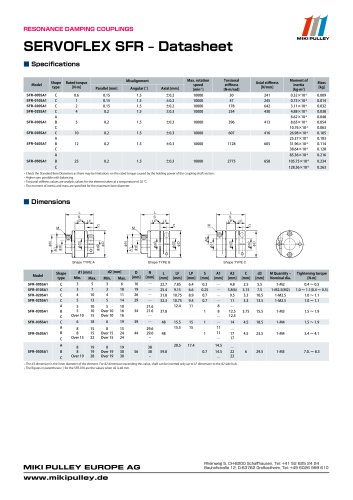
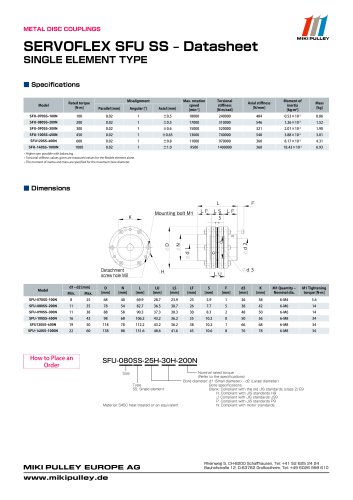


- Clamping device
- MIKI PULLEY flexible coupling
- MIKI PULLEY shaft coupling
- MIKI PULLEY friction brake
- Flange coupling
- Clamping device
- MIKI PULLEY torque coupling
- Rigid coupling
- Spring brake
- MIKI PULLEY zero-backlash coupling
- MIKI PULLEY transmission coupling
- Electromagnetic brake
- Sleeve coupling
- MIKI PULLEY compact coupling
- MIKI PULLEY misalignment correction coupling
- MIKI PULLEY motor coupling
- Overload clutch
- MIKI PULLEY high-torque coupling