


- Products
- Catalogs
- News & Trends
- Exhibitions
BELCAT II
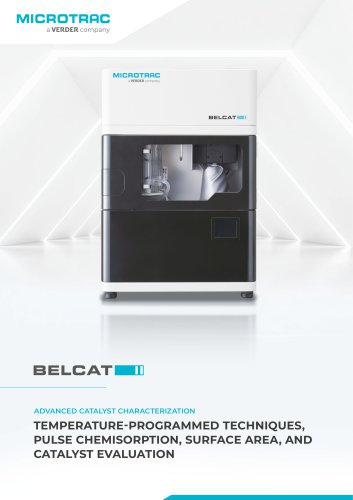
BELCAT II
- Compact design with minimized dead volume.
- Triple sample cell design for efficient gas preheating.
- Multi-purpose gas dosing system for simultaneous connection to multiple gases.
- High-resolution thermal conductivity detector for precise measurements.
- Advanced safety measures including overheat protection.
- TPD: Analyzes chemical adsorption characteristics.
- TPO/TPR: Measures surface reaction characteristics.
- Pulse Chemisorption: Determines metal dispersion rates.
- BET Surface Area: Measures specific surface area using nitrogen adsorption.
- User-friendly software with real-time monitoring.
- Sequential measurement mode for systematic analysis.
- Waveform analysis software for peak separation.
- Optional BELMASS link software for mass spectrometer integration.
- Vapor dosing unit for precise vapor injection.
- External gas mixing unit for complex gas mixtures.
- Low temperature electric furnace for controlled cooling.
- On-line gas analyzer for high accuracy gas measurement.
- AIRGUARD system for measuring sensitive materials without air exposure.
- Catalyst Analyzer/BELCAT II: Dynamic flow method with a semi-diffusion type 4-element thermal conductivity detector, supporting various gases and a maximum temperature of 1200 °C.
- On-line Gas Analyzer/BELMASS II: Mass range of 1-200 amu with a Faraday cup/SEM detector, minimum detection limit of less than 1 ppm.
Catalog excerpts
ADVANCED CATALYST CHARACTERIZATION TEMPERATURE-PROGRAMMED TECHNIQUES, PULSE CHEMISORPTION, SURFACE AREA, AND CATALYST EVALUATION
Open the catalog to page 1
The reactivity of solid catalysts is generally influenced by the specific surface properties. Optimizing catalyst performance requires careful consideration of the nature and distribution of active sites. In addition to acidity and basicity, intrinsic properties such as redox behavior, electronic structure, and surface morphology are all critical factors that impact catalytic activity and selectivity. Metal dispersion rates, metal surface areas, and average particle size of supported precious metal catalysts are analyzed to enhance performance and reduce costs. Furthermore, specific surface areas...
Open the catalog to page 2
I Compact Design The BELCAT II features a compact housing with an attractive design, offering a small footprint and various functionalities. I Optimized Gas Flow Path The gas flow path volume has been minimized by an integrated manifold valve block. The gas flow volume is controlled by high-precision mass flow controllers to enable stable and precise measurements. I High-Resolution TCD Detector A highly sensitive 4-element thermal conductivity detector (TCD) and an enhanced circuit board enable the measurement of a smoother spectrum. I Triple Sample Tube The cylindrical triple sample tube facilitates...
Open the catalog to page 3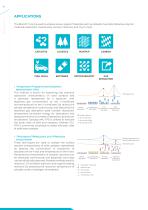
APPLICATIONS The BELCAT II can be used to analyze various types of materials such as catalysts, fuel cells, batteries, polymer materials, separation membranes, cement, ceramics, and much more. FUEL CELLS BATTERIES PETROCHEMISTRY GASSEPARATION I Temperature-Programmed Desorption Measurement (TPD) This method is known for examining the chemical adsorption characteristics on solid surfaces and is generally represented by a spectrum with desorbed gas concentration as the Y-coordinate and temperature as the X-coordinate. By raising the sample temperature continuously and detecting the desorbed gas,...
Open the catalog to page 4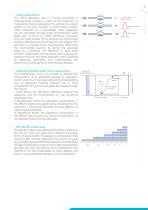
5 I Pulse measurement The metal dispersion rate is a critical parameter in heterogeneous catalysis. It refers to the proportion of metal atoms that are exposed on the surface of a catalyst relative to the total number of metal atoms present (often expressed as a percentage). Metal dispersion can be calculated through pulse chemisorption using gases such as CO or H2, which selectively chemisorb onto the metal surface. This is achieved by continuously pulsing a specified amount of gas into the sample until saturation is reached. Pulse measurement determines the chemisorbed quantity by taking the...
Open the catalog to page 5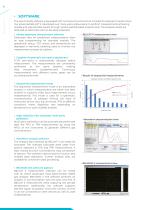
• SOFTWARE The user-friendly software is equipped with numerous functions that increase the operator's productivity. Our advanced BELCAT II, developed over many years, allows easily to perform measurements achieving reliable and reproducible results through various sophisticated analysis tools. The analysis results are obtained as ASCII files and can be easily exported. I Capable of automatic zero-point adjustment TCD’s zero-point is automatically adjusted before measurement. The measurements are consistently performed at the same baseline, making data comparison straightforward. Continuous measurements...
Open the catalog to page 6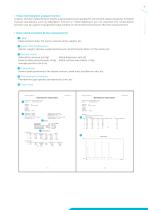
A report of pulse measurement results is generated automatically for convenient data processing. Complex manual calculations such as adsorption amount or metal dispersion are not required. The recalculation function can be used to change the metal content or the stoichiometry factor after the measurement. Measurement date, file name, sample name, weight, etc. [2) Supported metal species Atomic weight, density, supported amount, stoichiometric factor of the metal, etc. Adsorption amount (cm3/g) Metal dispersion rate (%) Metal surface area (Sample, m2/g) Metal surface area (Metal, m2/g) Average...
Open the catalog to page 7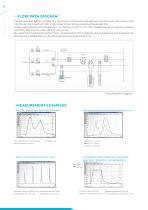
• FLOW PATH DIAGRAM The gas injection system consists of a carrier line, a pretreatment/pulse gas line and a mix line. Gases in the mix line can be mixed with either the carrier line or the pre-treatment/pulse gas line. Various applications are possible, such as mixing H2 with Ar for TPR measurements or injection amount control by diluting the pulse gas and many more. By implementing the pretreatment line, contamination of the detector due to degassing of the sample can be prevented. Stable data can be obtained over a long period of time. (Option) Bubbler Furnace * Simplified flow diagram • MEASUREMENT...
Open the catalog to page 8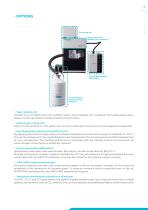
Gas mixing unit Vapor dosing unit (Bubbler and condenser) On-line gas analyzer/ BELMASS II Low temperature electric furnace/ CATCryo II I Vapor dosing unit Consists of an air thermostat unit, bubbler, heater and condenser. The condenser eliminates excess vapor. Vapors can be injected accurately at stable concentrations. I External gas mixing unit Allows mixing of three or more gases. One unit can install up to three lines. Corrosive gases are supported. I Low temperature electric furnace/CATCryo II By applying the liquid nitrogen spray, the sample temperature can be continuously controlled from...
Open the catalog to page 9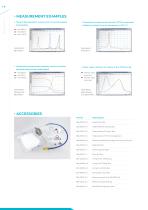
• MEASUREMENT EXAMPLESI Thermal decomposition measurement of calciumoxalate monohydrate — Mz=18(H2O) Used option: BELMASS II Used option: CATCRYO II I Temperature-programmed oxidation reaction of carbonmonoxide using precious metal catalyst - m/z=28(CO) Used option: MIX gas unit, BELMASS II Without vapor treatment Without vapor treatment Used option: Vapor dosing unit, BELMASS II Sample cell holder Triple sample cell 3 (Outer), 3pcs Triple sample cell 2 (Inner), 3pcs Triple sample cell 1 (Thermocouple), 3pcs Sample cell (trap/outer for large volume inner cell), 1pcs Bubbling bottle Thermocouple...
Open the catalog to page 10
• SPECIFICATIONS I Catalyst analyzer/BELCAT II Measurement principle Dynamic flow method Semi-diffusion type 4-element thermal conductivity detector (TCD) Measurement/ pretreatment port Mass flow Controller Electric furnace Regular temperature: 1100 °C Maximum temperature: 1200 °C Quick cooling: 30min (400→50 °C) CATCryo II (option) -120 °C supported Vapor injection (option) Utility Measurement gas: 0.1 MPa(G), Valve driving: 0.45-0.55 MPa(G) Joint: 1/8” Swagelok connection I On-line gas analyzer/BELMASS II Mass range Scan speed Sniffer probe Max. temperature of heat hose Vent connection Measurement...
Open the catalog to page 11All MICROTRAC catalogs and technical brochures
 MICROTRAC PRODUCT OVERVIEW
16 Pages
 BELPORE SERIES
8 Pages
 BELPYCNO L
4 Pages
 BELSORP MAX X
12 Pages
 BELSORP MINI X
12 Pages
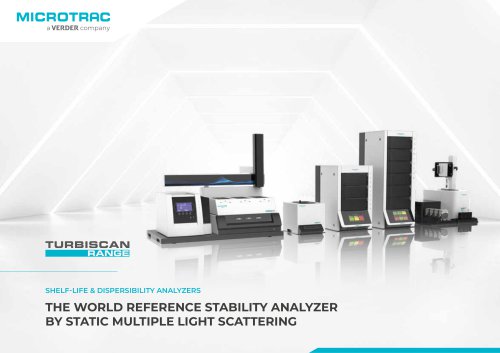 TURBISCAN RANGE
24 Pages
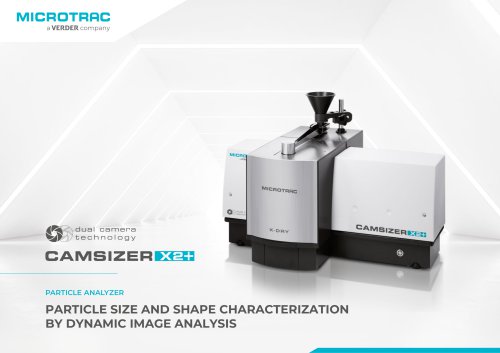 CAMSIZER X2+
24 Pages
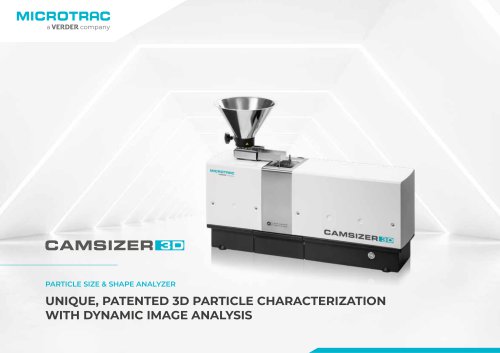 CAMSIZER 3D
20 Pages
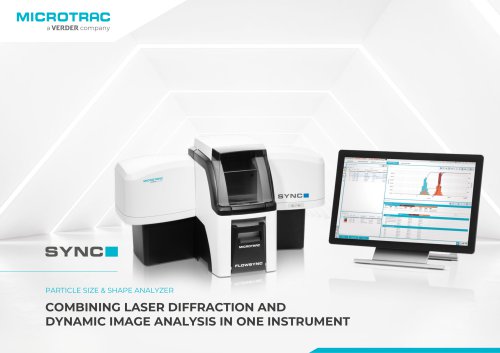 SYNC
SYNC20 Pages
- Monitoring analyzer
- Liquids analyzer
- Benchtop analyser
- Process analyzer
- Laboratory analyzer
- Compact analyzer
- Analyzer for the food industry
- Quality control analyzer
- Simultaneous analyzer
- Particle size measuring instrument
- Food analyzer
- Analyzer for the chemical industry
- Pharmaceutical product analyzer
- Laser diffraction particle size analyzer
- Laboratory particle size analyzer
- Research particle size analyzer
- Temperature control analyzer
- Stability analyzer