Microdrop Microdispenser System MD-E

Microdrop Microdispenser System MD-E
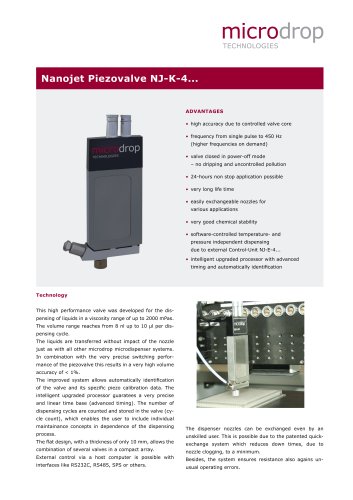
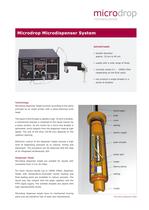
The microdrop dispenser heads operate similarly to inkjet printers using piezo-electrical print heads. They dispense liquid through a capillary tube, where a piezo ceramic generates a mechanical impulse to emit a micro-fine droplet at high speed. The droplet size ranges from 35 to 90 μm, depending on the capillary opening. Electronic controls ensure precision in volume, timing, and placement, with an integrated stroboscopic LED for observation.
Microdrop dispenser heads are suitable for liquids with viscosities between 0.4 to 20 mPas. For higher viscosities up to 10000 mPas, temperature-controlled nozzle heating is available. The liquid contacts only the glass capillary and PTFE supply, ensuring high reproducibility. The heads have no mechanical moving parts, eliminating wear and maintenance.
- Droplet diameter: 35 μm to 90 μm
- Usable with a wide range of fluids
- Viscosity range: 0.4 to 10000 mPas
- Capable of producing single or multiple droplets
- Permissible liquid viscosity: 0.4 to 20 mPas (standard), 10 to 10000 mPas (with heating)
- Inner nozzle diameter: 30 to 100 µm
- Dispensed volume: 20 to 380 pl per droplet
- Maximum liquid throughput: 1 μl/s
- Drop rate: 1 to 2000 Hz
- Drop velocity: < 2.5 m/s
- Environmental temperature: 10 to 80°C
- Dimensions: Ø 10 mm, height 38 mm
- Life time: > 1010 cycles
The control unit allows manual or external control via a TTL-interface. It supports various operating modes, including single droplet emission and adjustable droplet series. It features displays for power, dosing, droplet rate, and stroboscope delay, with optional nozzle heating controls. Connections include mains, dispenser head, external trigger, and stroboscope-LED.
- MD-K-... micro dispenser head
- MD-E-201-H drive electronic
- MD-H-7... vertical holder
- MD-V-... storage bin with PEEK top
Microdrop Technologies GmbH, Mühlenweg 143, 22844 Norderstedt, Germany. Phone: +49 (0)40 53 53 83-0, Fax: +49 (0)40 53 53 83-24, Email: [email protected], Website: www.microdrop.de
Catalog excerpts
ADVANTAGES droplet diameter: approx. 35 Վm to 90 m ܕ usable with a wide range of fluids viscosity range 0.4 ... 10000 mPas (depending on the fluid used) Օ can produce a single droplet or a series of droplets Technology Microdrop dispenser heads function according to the same principle as an inkjet printer with a piezo-electrical print head.The liquid is fed through a capillary tube. To emit a droplet, a mechanical impulse is imparted to the liquid column by a piezo ceramic. At the nozzle tip a micro fine droplet is generated, which departs from the dispenser head at high speed. The size of the drop (35-90 μm) depends on the capillary opening. Electronic control of the dispenser heads ensures a high level of dispensing precision as to volume, timing and placement. The procedure can be observed with the help of an integrated stroboscopic LED. Dispenser Head Microdrop dispenser heads are suitable for liquids with viscosities from 0.4 to 20 mPas. For more viscous liquids (up to 10000 mPas), dispenser heads with temperature-controlled nozzle heating and fluid leading parts are available to reduce viscosity. The liquid only has contact with the glass capillary and the PTFE liquid supply. The emitted droplets are placed with high reproducibility levels. Microdrop dispenser heads have no mechanical moving parts and are therefore free of wear and maintenance. > Microdrop dispenser head size="-1">
Open the catalog to page 1All Microdrop catalogs and technical brochures
 Miniature Camera system MD-O
2 Pages