
- Catalogs
- Microchip Technology Inc.
- 16-bit Tools & Solutions Brochure


- Products
- Catalogs
- News & Trends
- Exhibitions
16-bit Tools & Solutions Brochure

16-bit Tools & Solutions Brochure
Microchip provides a comprehensive suite of tools and solutions for 16-bit embedded control product families, specifically targeting the PIC24 Microcontrollers (MCUs) and dsPIC Digital Signal Controllers (DSCs). This document outlines the development tools, reference designs, development boards, and training materials available to support these products.
- MPLAB IDE: An integrated development environment for programming and debugging.
- Compilers and Assemblers: Includes MPLAB C30 C Compiler, MPASM Assembler, MPLINK Linker, and MPLIB Librarian.
- Debugging Tools: MPLAB ICD 2 In-Circuit Debugger/Programmer and MPLAB REAL ICE In-Circuit Emulation System.
- Software Libraries: Various libraries for modem, speech recognition, noise suppression, encryption, and more.
- Development Boards: A range of boards including the Explorer 16 Development Board and various dsPICDEM boards for different applications.
- Reference Designs: Supported by application notes and online resources.
- Documentation: Data sheets and reference manuals available in multiple formats.
- Training Support: Includes seminars, guides, and online resources.
- Explorer 16 Development Board: Supports PIC24F, PIC24H, dsPIC33F, and PIC32 families, featuring an LCD display and expansion connectors.
- 16-bit, 28-pin Starter Development Board: A prototyping tool for 28-pin PIC24 and dsPIC devices.
- dsPICDEM 80-pin Starter Development Board: Economical evaluation for dsPIC DSC families with various plug-in modules.
- Includes libraries for modem, speech recognition, noise suppression, echo cancellation, encryption, and more, tailored for dsPIC DSCs.
- Tools for data analysis, digital filter design, and specific application solutions like motor control and power factor correction.
Microchip offers a robust set of tools and resources to support the development of 16-bit embedded control applications, ensuring efficient product evaluation and development processes.
- Purpose: A cost-effective tool for familiarizing with dsPIC30F and dsPIC33F 16-bit architecture.
- Features: Includes a demonstration program for temperature and voltage measurements, digital filter selections, and DTMF tone generation. Supports MPLAB IDE for project creation and debugging.
- Components: dsPIC30F6014A PIM, serial communication interfaces, Si3000 codec, prototyping area, LCD, and various sensors and regulators.
- Purpose: Development and evaluation tool for embedded applications using dsPIC DSCs.
- Features: Supports multiple dsPIC30F devices, includes sample applications, and provides interfaces like RS-232 and CAN.
- Components: Prototyping hardware, temperature sensor, LCD, and access to all device socket pins.
- Purpose: Platform for developing connectivity and non-connectivity based applications.
- Features: Includes PSTN and Ethernet interfaces, serial communication channels, and external memory.
- Components: dsPIC30F6014A PIM, dual channel digital potentiometer, and LCD display.
- Purpose: Prototyping and validating motor control applications with dsPIC30F DSC family.
- Features: Supports various motor control applications with optional power modules for different voltage requirements.
- Components: dsPIC30F6010A MCU, connectors for sensors, and a breadboard area.
- Purpose: Prototyping motor control applications with dsPIC33F DSC family.
- Features: Includes Explorer 16 board and Motor Control Interface PICtail for connecting to power stages.
- Components: dsPIC33FJ256MC710-based PIM, power modules, and various feedback signal options.
- Purpose: BLDC motor control platform using dsPIC30F and PIC microcontrollers.
- Features: Supports sensor and sensorless control, includes a 3-phase inverter, and protection circuits.
- Components: dsPIC30F2010, dsPIC30F3010, dsPIC30F4012, and PIC18F2431/2331.
- Purpose: Reference design for DC-DC SMPS applications.
- Features: Dual Buck converters, dynamic output load, and user potentiometers for application simulation.
- Components: dsPIC30F2020 DSC, RS-232 channel, and MPLAB ICD 2 support.
- The libraries support various 16-bit devices, including dsPIC30F, dsPIC33F, PIC24H, and PIC24F.
- Libraries cover functionalities such as soft modem, speech recognition, noise suppression, acoustic echo cancellation, encryption, and more.
- Many libraries are available for free or at a low cost for evaluation and development purposes.
- Composed of ITU-T compliant algorithms for various modem standards like V.21, V.22bis, V.32bis, etc.
- Supports small transaction-oriented applications such as POS terminals and internet-enabled devices.
- Includes a comprehensive set of APIs and is optimized for performance.
- Provides voice control for embedded applications with speaker-independent word recognition.
- Optimized for dsPIC30F processors and supports US English.
- Includes a PC-based utility for creating custom word libraries.
- Designed to suppress noise in microphone-based applications.
- Utilizes frequency domain algorithms and is optimized for dsPIC DSC DSP instruction set.
- Supports a sampling rate of 8 kHz with conversion functions for higher rates.
- Eliminates echo in applications where speakers and microphones are in close proximity.
- Compliant with the G.167 standard for acoustic echo cancellation.
- Uses adaptive filtering techniques to model and cancel the echo path.
- Libraries are written in assembly language for optimal performance.
- Comprehensive documentation and user guides are provided for implementation support.
- Evaluation versions are available for free or at minimal cost, facilitating development and testing.
- The library supports full-duplex communication and uses a Non-Linear Processor (NLP) algorithm to eliminate residual echo.
- Operates at an 8 kHz sampling rate with a conversion function for higher rates (9.6 kHz, 11.025 kHz, 12 kHz).
- Echo tail lengths of 16, 32, or 64 ms are configurable, with varying computational requirements.
- Features include compatibility with C and Assembly, optimized assembly code, and compliance with G.167 specifications.
- Devices supported include various dsPIC models.
- Targets elimination of far-end and near-end echoes in telephony and digital network applications.
- Uses an adaptive FIR filter with NLMS algorithm and optional Double Talk Detection (DTD) and NLP features.
- Configurable echo tail lengths and processing intervals, with compliance to ITU-T G.168 specifications.
- Devices supported include various dsPIC models.
- Provides symmetric key encryption/decryption functions like AES and Triple-DES.
- Optimized for speed, code size, and RAM usage, with adherence to standards like FIPS and IETF.
- Applications include secure web transactions, mobile devices, and VPNs.
- Devices supported include PIC24 and dsPIC DSCs.
- Implements public key functions like RSA and Diffie-Hellman, with signing and verification capabilities.
- Optimized for speed and RAM usage, with extensive testing for standards compliance.
- Applications include secure banking, web transactions, and smart card readers.
- Execution times for various cryptographic functions are provided for a 1024-bit modulus.
- Asymmetric Key Embedded Encryption Library: Supports RSA, Diffie-Hellman, and DSA algorithms with varying security strengths and code sizes. It requires setup of input/output buffers and has specific device support limitations.
- Symmetric Key Embedded Encryption Library: Additional support available for symmetric encryption needs.
- Speex Library: Provides toll-quality voice compression using CELP with a 16:1 compression ratio. Suitable for various applications like answering machines and intercoms. Requires specific computational power and memory resources.
- G.711 Library: Implements ITU-T G.711 standard with A-law or μ-law companding, offering a 2:1 compression ratio. Best for full-duplex systems without storage needs.
- G.726A Library: Uses ADPCM for configurable compression ratios, suitable for both half and full-duplex systems. Supports a wide range of applications.
- Offers 49 functions optimized for speed, including vector, matrix, filtering, and transform operations. Compatible with all dsPIC DSC variants and provides significant performance improvements over C-coded equivalents.
- Includes advanced floating-point arithmetic and trigonometric functions, compliant with IEEE-754 standards. Optimized for small code size and high accuracy.
- All libraries are designed to integrate easily with applications using well-defined APIs.
- Resource requirements vary by library, with specific needs for computational power, program flash memory, and RAM.
- Libraries are royalty-free with a one-time license fee, ensuring cost-effective deployment.
- AC Induction Motor Control: Utilizes vector control with indirect flux control method. Requires dsPIC30F/33F devices and offers a ready-to-use solution with optimized C code. Key features include a 50 μsec control loop period and optional diagnostic mode.
- BLDC Motor Control: Solutions for both sensored and sensorless control using dsPIC30F2010. The software supports open-loop and closed-loop control algorithms, with a focus on ease of understanding and modification.
- PMSM Motor Control: Provides sinusoidal control with Space-Vector Modulation (SVM) and four-quadrant control. The solution is optimized for energy-efficient applications.
- MC1 Motor Control Development Board and MC1H 3-phase High-Voltage Power Module for ACIM.
- PICDEM™ MC LV Development Board and Explorer 16 Development Board for BLDC and PMSM motors.
- Motor Control Interface PICtail Plus Daughter Card for enhanced interfacing capabilities.
- Application notes (e.g., AN901, AN908, AN957) provide working examples and source code for integrating hardware and software.
- Motor Control Getting Started Guide and extensive design support material available on Microchip’s website.
- MPLAB® ICD 2 In-Circuit Debugger and Device Programmer for debugging and programming support.
- Software solutions are optimized for performance and ease of modification, with detailed annotations.
- Support for various control algorithms, including vector control, open-loop, closed-loop, and sensorless control.
- Memory requirements and program code sizes are specified for each solution, ensuring compatibility with targeted dsPIC devices.
- Memory Disk Drive File System Library supports removable Flash-based media cards up to 2 GB, with features like directory manipulation and file search.
- IrDA Standard Stack provides wireless communication capabilities, supporting various protocols and devices.
- CPU Usage: 11 MIPS with control loops at 8 kHz, and 21 MIPS with 20 kHz control loops.
- Available MIPS: 30 MIPS on dsPIC30F, and 40 MIPS on dsPIC33F.
- Power Stage: MC1H 3-phase High-Voltage Power Module, MC1L 3-phase Low-Voltage Power Module, 3-Phase 24V BLDC Low Voltage Motor.
- Control Boards: MC1 Motor Control Development Board, dsPIC30F6010A Plug-In Module, Explorer 16 Development Board, Motor Control Interface PICtail, dsPIC33FJ12MC202 Plug-In Module.
- Graphics Display Solution: Utilizes Explorer 16, Graphics PICtail Plus Daughter Board, and a free Graphics Library for GUI implementation.
- Sensorless BLDC Control: Describes a sensorless BLDC motor control algorithm using dsPIC DSC with back EMF filtering.
- Power Factor Correction: Based on Average Current Mode Control using a DSC for stable DC power source with reduced input current harmonic content.
- MPLAB IDE: Integrated development system with tools for project development.
- MPLAB C30 C Compiler: ANSI-compliant compiler for PIC24 and dsPIC DSC architectures.
- MPLAB REAL ICE: In-circuit emulation system for debugging and application development.
- Application notes and source code available for download from the Microchip website.
- MPLAB IDE includes Visual Device Initializer and Data Monitor and Control Interface for project management and debugging.
The document provides contact details for various Microchip offices across China, India, Japan, Korea, Malaysia, Philippines, Singapore, Taiwan, and Thailand. Each entry includes the city and corresponding telephone number.
Purchase Information:
MicrochipDIRECT is an online purchasing platform offering 24/7 access to Microchip devices and tools. It provides features such as pricing, ordering, inventory, and support, with the option to purchase on a Microchip line of credit.
Support Services:
Microchip offers extensive support to its customers through a global network of field applications engineers and technical support. Key online resources include:
- Support Link: Fast answers to questions at support.microchip.com
- Sample Link: Free evaluation samples available at sample.microchip.com
- Training Link: Access to webinars, seminars, and MASTERs events information at microchip.com/training
- Forum Link: Knowledge base and peer help at forum.microchip.com
Sales Office Listing:
The document includes a listing of sales offices, directing users to microchipdirect.com for further information.
Catalog excerpts
16-bit Embedded ControlDevelopers Resource February 2008 > A comprehensive overview of libraries, boardsand software development tools for MicrochipҒs 16-bit embedded control product families. >
Open the catalog to page 1
It has always been MicrochipҒs goal to provide great silicon solutions to our customers. However, silicon is only part of the story. Support tools, such as programmers, compilers, reference designs, libraries, application notes, evaluation boards and the like are required to make your evaluation and product development process as effi cient as possible. Microchip considers a product released when the silicon and its appropriate support tools are ready for production. This document describes Microchips rapidly evolving solutions to support the ongoing enhancements to the 16-bit PIC24 Microcontrollers...
Open the catalog to page 2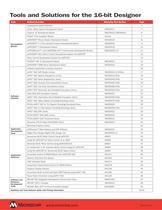
MPLAB IDE (Integrated Development Environment) ToolsSW00700247MPLABή C30 C Compiler SW00601248 MPLAB REAL ICEΙ In-Circuit Emulation SystemDV24400549 Software and Hardware Development Tools Solutions and Tools Selector Guide with Pricing Information 50-54 dsPICworks Data Analysis and DSP Software SW30002333Digital Filter Design/Digital Filter Design Lite SW300001/LT34 Application Development Tools Sensorless BLDC Motor Control Using dsPIC30FAN90135Using the dsPIC30F for Vector Control of an ACIMAN90836 Sensored BLDC Motor Control Using dsPIC30F2010AN95737 An Introduction to AC Induction Motor...
Open the catalog to page 3
The low-cost, 16-bit, 28-pin Starter Development Board allows the user to easily evaluate 28-pin, PIC24 microcontroller or dsPIC Digital Signal Controller (DSC) devices. This board is an ideal prototyping tool to help you validate key design requirements. > Key features of the 16-bit, 28-pin Starter Development Board include: Prototyping tool for all 28-pin SDIP PIC24, dsPIC30F and dsPIC33F devices Includes a 28-pin PIC24FJ64GA002 and dsPIC33FJ12GP202 On-board regulators for 3.3V or 5V operation Power input from 9V power supply or USB power source Single UART communication channel via USB bridge...
Open the catalog to page 5
Plug-In Modules (DM240001/DM240002)*Part #ControllerPin AdaptationNotes MA240011 PIC24FJ128GA010100 pin to 100 pinincluded in DM240001 MA240012 PIC24HJ256GP610100 pin to 100 pinPurchase separately MA240013 PIC24FJ64GA004 44 pin to 100 pinincluded in DM240002 MA330011 dsPIC33FJ256GP710100 pin to 100 pinincluded in DM240001 MA330013 dsPIC33FJ256MC710100 pin to 100 pinPurchase separately MA330014 dsPIC33FJ12MC20228 pin to 100 pinPurchase separately MA330015 dsPIC33FJ12GP20228 pin to 100 pinPurchase separately MA330016 dsPIC33FJ32GP20444 pin to 100 pinPurchase separately MA330017 dsPIC33FJ32MC20444...
Open the catalog to page 6
Motor Control Interface PICtail Plus Daughter Card (AC164128) This PICtail MC board interfaces with Explorer 16 (DM240001/2) and the HV/LV Power Module (DM300021 and DM300022). It has hardware support for sensor and sensorless applications such as Hall sensors, optical encoder, back EMF and current sensing. Included is a dsPIC33FJ256MC70 Motor Control Plug-in Module for use with the Explorer 16 development board. This board connects horizontally to the male edge connection on the Explorer 16 development board. The Graphics PICtailٙ Plus Daughter Board is a demonstration board for evaluating Microchips...
Open the catalog to page 7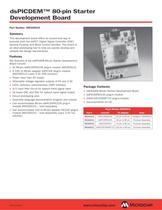
This development board offers an economical way to evaluate both the dsPICٮ Digital Signal Controller (DSC) General Purpose and Motor Control families. This board is an ideal prototyping tool to help you quickly develop and validate key design requirements. > Key features of the dsPICDEM 80-pin Starter Development Board include: An 80-pin dsPIC30F6014A plug-in module (MA300014) A 100- to 80-pin adapter dsPIC33F plug-in module (MA330012) (uses 3.3V VDD solution) Power input from 9V supply Selectable voltage regulator outputs of 5V and 3.3V LEDs, switches, potentiometer, UART interface A/D input...
Open the catalog to page 8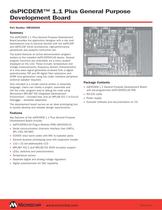
The dsPICDEM 1.1 Plus General Purpose Development Board provides the application designer with a low cost development tool to become familiar with the dsPIC30F and dsPIC33F 16-bit architecture, high-performance peripherals and powerful instruction set. The board features an active demonstration program loaded on the installed dsPIC30F6014A device. Several program functions are selectable via a menu system displayed on the LCD. These include: temperature and voltage measurements, frequency domain characteristics of a sine wave signal generated on-board from a digital potentiometer, FIR and IIR...
Open the catalog to page 9
dsPIC30F DeviceSupported Packages Motor Control Family > dsPIC30F4011 dsPIC30F2011 40-pin PDIP 18-pin PDIP Sensor Family dsPIC30F3012 18-pin PDIP > General Purpose Family dsPIC30F4013 40-pin PDIP >
Open the catalog to page 10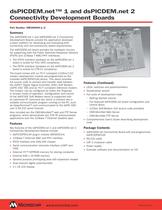
The dsPICDEM.net 1 and dsPICDEM.net 2 Connectivity Development Boards provide the application developer a basic platform for developing and evaluating both connectivity and non-connectivity based requirements. The dsPICDEM.net board provides the hardware circuitry for supporting both the Public Switched Telephone Network (PSTN) and 10-Base T MAC/PHY interfaces. The PSTN interface hardware on the dsPICDEM.net 1 board is suited for FCC/JATE compliancy The PSTN interface hardware on the dsPICDEM.net 2 board is suited for CTR-21 compliancyThe board comes with an ITU-T compliant V.22bis/V.22 modem...
Open the catalog to page 11
For maximum flexibility in quickly prototyping or validating BLDC, PMAC and ACIM applications with the dsPIC30F DSC family, the dsPICDEM MC1 controller board coupled with either a high voltage or low voltage power module is recommended. > Part #Description TM DM300020 dsPICDEM MC1 Motor Control Development Board DM300022 Motor Control Development Board > ordsPICDEM MC1L 3-Phase Low-Voltage Power Module (50V 400W) DM300021 dsPICDEM MC1L 3-Phase High-Voltage Power Module (400V 1 kW) dsPICDEM MC1 Motor Control Development Board with pre-programmed dsPIC30F6010A plug-in module (MA300015) Power Modules...
Open the catalog to page 12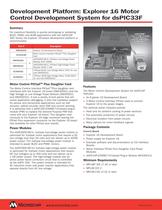
For maximum flexibility in quickly prototyping or validating BLDC, PMAC and ACIM applications with the dsPIC33F DSC family, the Explorer 16-based development platform is recommended. > Part #Description DM240001 Explorer 16 Development Board TM AC164128 Motor Control Interface PICtail Plus Daughter Card DM300022 ordsPICDEM MC1L 3-Phase Low-Voltage Power Module (50V 400W) DM300021 dsPICDEM MC1L 3-Phase High-Voltage Power Module (400V 1 kW) AC300020 or3-Phase BLDC Low Voltage Motor (24V) for use with DM300022 AC300021 3-Phase ACIM High Voltage Motor (208/460V) for use with DM300021 The Motor Control...
Open the catalog to page 13All Microchip Technology Inc. catalogs and technical brochures
 MicroSolutions
8 Pages
 DSA1001/3/4
22 Pages
 Embedded Computing Solutions
4 Pages
 ATmegaET128
469 Pages
 RE46C140
13 Pages
 ATmega4809
74 Pages
 16-bit MCUs and DSCs
20 Pages
 MPLAB® Harmony
12 Pages
 32-bit Microcontroller Family
20 Pages
 32-bit MPU
8 Pages
 UCS100X Family Sell Sheet
2 Pages
 PIC32 Graphics Sell Sheet
2 Pages
 PIC32 Audio Sell Sheet
2 Pages
 PIC1XF150X/155X Sell Sheet
2 Pages
 MRF24WG0MA/MB Sell Sheet
2 Pages
 MCP19111 Sell Sheet
2 Pages
 LAN9730(i) Sell Sheet
2 Pages
 Connectivity Brochure
16 Pages
 bit Embedded Control Solutions
20 Pages


Archived catalogs
 Serial Memory Products
16 Pages
 LIN J2602 Transceiver
32 Pages
 Infrared Encoder/Decoder
36 Pages
 MCP794XX I2C™ RTCC Brochure
2 Pages
 MCP1640/B/C/D
32 Pages
 Motor Control Solutions Brochure
12 Pages
 Power Management MCP1525/41
20 Pages
 PIC32 Overview Brochure
6 Pages
 8-bit PIC® Microcontrollers
16 Pages


- Signal amplifying integrated circuit
- Microchip power amplifier
- Wireless module
- Compact converter
- Industrial converter
- Serial converter
- Manual potentiometer
- Crystal oscillator
- Measuring amplifier
- Microchip voltage amplifier
- DC amplifier
- Low-noise amplifier
- Power converter
- Precision potentiometer
- Digital converter
- Microchip current amplifier
- Analog amplifier
- Audio amplifying integrated circuit