
- Catalogs
- MICRO-EPSILON
- True Color Measuring Systems // colorSENSOR


- Company
- Products
- Catalogs
- News & Trends
- Exhibitions
True Color Measuring Systems // colorSENSOR
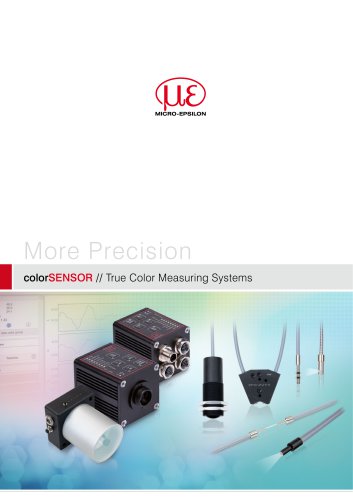
True Color Measuring Systems // colorSENSOR
The colorSENSOR series by MICRO-EPSILON ELTROTEC offers True Color sensors for measuring color values and intensities on various surfaces. These systems are crucial in manufacturing, automation, and quality assurance, enhancing productivity and cost efficiency.
- High accuracy True Color controllers.
- Color sensors suitable for large distances.
- Robust fiber optic sensors for diverse applications.
- Easy configuration via a web interface.
The systems use a sensor and controller setup where the sensor illuminates the surface, and the reflected light is evaluated by the controller. They are ideal for high-speed processes and small object detection, with modern interfaces for industrial integration.
- Sensors: Models like CFS1 for high-gloss surfaces, CFS2 for structured surfaces, CFS3 for transparent surfaces, and CFS4 for reflex detection.
- Controllers: Options include CFO100 for universal applications and CFO200 for high precision, each with features like color memory and repeatability.
- Color matching for car parts like parking sensors and front spoilers.
- Inspection of kitchen fronts and aluminum can coatings.
- Distinction of shiny nuts and detection of protective films.
- Sorting of plastic components based on color.
Detailed specifications for different sensor models include measurement geometry, working distances, and spot diameters. The CFO series controllers offer high measuring rates, multiple interfaces, and extensive color memory capabilities.
Various sensor models are outlined with specific measurement geometries, target sizes, and sensitivity parameters. Sensors are designed for different applications, including color measurement on flat and curved surfaces, with varying permissible ambient light levels and tilt angles.
Sensors operate by emitting light at specific angles to the surface of the object being tested. The diffuse back reflection or transmitted light is detected and transmitted to a controller, allowing precise color measurement with repeatability of ΔE ≤ 0.3.
Sensors adhere to protection class IP54 or IP64, depending on the model, and are compatible with CFO controllers. They operate within specified temperature and humidity ranges.
These sensors are recommended for applications requiring precise color differentiation, such as quality control in manufacturing processes involving metals, plastics, and other materials. They are suitable for environments with varying ambient light and temperature conditions.
Sensors offer homogeneous illumination, ideal for structured or shiny surfaces. They are compatible with previous controller series and can be adapted for specific customer needs. The document highlights the advantages of using circular, transmission, and reflex sensors for different applications, emphasizing their precision and versatility.
Specifications for various sensor models include working distances, measurement spot diameters, light spot diameters, and repeatability in rotation. Sensitivity to distance, tilt angle, and ambient light is detailed, with permissible ambient light levels and maximum tilt angles specified.
The document describes the use of colorSENSOR CFO100 and CFO200 controllers for precise color recognition in industrial tasks. These controllers use modulated high-power white light LEDs to project light onto surfaces, with back-scattered light analyzed for color values.
Protection classes are specified according to DIN EN 60529, with IP ratings provided for different models. Shock and vibration resistance are detailed according to DIN EN 60068-2-27 and DIN EN 60068-2-6 standards.
The CFO controllers are recommended for applications such as marking detection on cosmetics bottles and anti-reflection coating inspection on lenses. They are suitable for integration in modern environments with various interface options, including Ethernet, Modbus, RS232, and USB.
Both CFO100 and CFO200 controllers feature high color accuracy, state-of-the-art interfaces, and intuitive operation. They support multi-teach functions, automatic adjustment of illumination brightness, and measurement signal amplification.
Tables provide detailed specifications for sensor models, including part numbers, sensor types, working distances, and measurement geometries. Diagrams with dimensions for various models are included.
The document provides detailed technical specifications and features of the OT3 series True Color sensors, designed for color measurement tasks requiring large distances from the measuring object.
The OT3 series sensors have a maximum switching frequency of 35 kHz and support interfaces like RS232 and USB. They can store up to 31 colors per teach-in and measure distances up to 900 mm.
Various models such as OT-3-LD-200 and OT-3-LD-500 are detailed with specific working distances and measurement spot diameters.
The sensors operate within a spectral range of 400 to 680 nm and utilize ultra-bright white light LEDs. They offer synchronization capabilities, are protected against overload, and have a temperature stability of less than 0.01% FSO/K.
The sensors can operate in temperatures ranging from -20 to +55 °C and have a protection class of IP67 for optics and IP64 for the controller.
Possibilities for customer-specific adaptations include special types for various sensors, optical fiber sheaths, and mountable lenses. Available accessories include connection cables and power supply units.
The document explains the use of standard color spaces like CIE 1931 and CIELAB76 for color measurement, detailing how colors are perceived and measured.
The sensors are suitable for various industrial applications, including color control of LEDs and other self-luminous objects.
Catalog excerpts
| colorSENSOR // True Color Measuring Systems
Open the catalog to page 1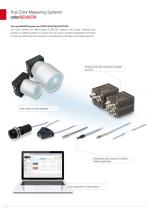
True Color Measuring Systems colorSENSOR The colorSENSOR series from MICRO-EPSILON ELTROTEC True Color sensors from Micro-Epsilon ELTROTEC measure color values, intensities and functions on different surfaces. As a result, they are used in a variety of applications and stand for high productivity and cost reduction in manufacturing, automation and quality assurance. Powerful True Color controllers for highest accuracy Color sensors for large distances Robust fiber optic sensors for versatile fields of application Easy configuration via web interface
Open the catalog to page 2
General information Measuring principle & fields of application Selection criteria Circular sensor Transmission sensor Reflex sensor (standard) High precision True Color sensor controller Color sensor for high offset distances Connection cables & Accessories Basics and selection criteria
Open the catalog to page 3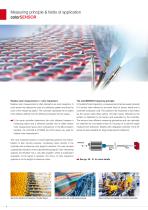
Measuring principle & fields of application colorSENSOR Relative color measurement (= color inspection): The colorSENSOR measuring principle Relative color measurement is often referred to as color inspection. A In the field of color inspection, a measurement channel usually consists color sensor first detects the color of a reference pattern and then the of a sensor (also referred to as probe head or sensor head) and a color of the measuring object. The controller calculates the so-called controller (evaluation unit). The surface to be measured is illuminated color distance (ΔErel) from the...
Open the catalog to page 4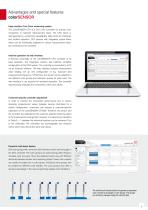
Advantages and special features colorSENSOR High precision True Color measuring system The colorSENSOR CFO is a True Color controller for precise color recognition in industrial measurement tasks. The CFO series is distinguished by unmatched repeatability, state-of-the-art interfaces and intuitive operation. CFS sensors with integrated optical fibers which can be individually adapted for various measurement tasks, are connected to the controller. Intuitive operation via web interface A decisive advantage of the colorSENSOR CFO controller is its easy operation. The integrated, intuitive web interface...
Open the catalog to page 5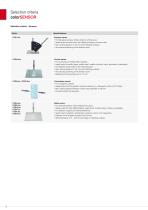
SeriesCFS1-Vxx Special features Standard sensor ■ For high-gloss surfaces, diffuse reflection without gloss ■ Ideally suited for solid colors, anti-reflective coating or chrome colors ■ Max. working distance of 125 mm (with reflecting surfaces) ■ Very precise positioning of the detection point CFS2-Mxx CFS3-Axx / CFS3-Cxx Circular sensor ■ For structured and metallic-effect surfaces ■ Ideally suited for textile, paper, metallic paint, metallic nail polish, sand, granulate or masterbatch ■ Homogeneous illumination of the measuring point ■ Max. working distance of 100 mm (with reflecting surfaces)...
Open the catalog to page 6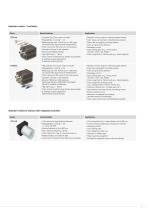
Special features ■ Universal True Color sensor controller ■ Measuring rate max. 10 kHz (up to 2,500 parts per second with asynchronous measurement) ■ Color memory for 256 colors in 6 color groups ■ Operation via keys or web interface ■ High light output > 130 lm ■ Color control of self-luminous objects also possible ■ 3 switching outputs (digital I/O); 8 switching outputs (binary) ■ High precision True Color sensor controller ■ Measuring rate max. 30 kHz (up to 7,500 parts per second with asynchronous measurement) ■ Color memory for 320 colors in 254 color groups ■ Operation via keys or web interface...
Open the catalog to page 7
Applications colorSENSOR Painted car body components Comparing colors of parking sensor and car body Color inspection on front spoilers Car attachments such as parking sensors are painted separately. Before installing front aprons, Micro-Epsilon color sensors check if However, the colors of the parts must be identical during assembly. the color of the attachment matches the body color. Different color For color assignment, the colorSENSOR CFO sensors are used groups can be defined to cover all coatings. which ensure a direct color comparison between the parking sensor and the rear bumper. Recommended...
Open the catalog to page 8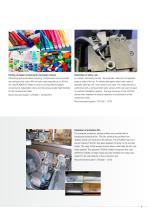
Sorting of plastic components (connector colors) Distinction of shiny nuts Particularly with automated mounting, components must be sorted In modern machining centers, the automatic distinction of supplied according to their color. With its high measuring rate up to 30 kHz, parts is state of the art. To reliably distinguish shiny nuts made of the colorSENSOR CFO200 is used for sorting different plastic stainless steel and tin, color sensors are used. The measurement is components. Adjustable colors and tolerances enable high flexibility performed with a compact fiber optic sensor which can also...
Open the catalog to page 9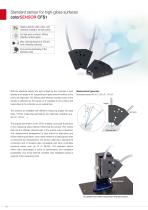
■ Standard sensor for high-gloss surfaces With the standard sensor, the light emitted by the controller is sent laterally at an angle of 45° (depending on type) onto the surface of the part to be inspected. The diffuse back reflection (surface color) of the sample is detected by the sensor at 0° (parallel) to the surface and transmitted to the controller via an optical fiber. The sensors are available with different measuring angles and spot sizes. Further measuring geometries are optionally available (e.g., 40°x:0°; 18°x:0°; ...) The angular illumination of the CFS1 enables a punctual illumination...
Open the catalog to page 10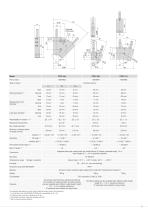
The specified data apply to a white, diffuse reflecting surface (zenith white reference) 11 In combination with colorSENSOR CFO200 and a repeatability of AE <0.3 2) On titanium pearl mica from a distance of 30 mm 3) With potted connection cable also available with IP67 4) Valid for optimal working distance
Open the catalog to page 11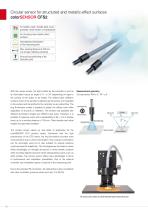
Circular sensor for structured and metallic-effect surfaces colorSENSOR CFS2 For textiles, paper, metallic paint, sand, granulate, wood veneers or masterbatch For structured and metallic-effect surfaces Homogeneous illumination of the measuring point Max. working distance of 100 mm (on strongly reflecting surfaces) Very precise positioning of the detection point With the circular sensor, the light emitted by the controller is sent as Measurement geometry an illuminated ring at an angle of 11° or 34° (depending on type) to the surface of the object to be tested. The diffuse back reflection (surface...
Open the catalog to page 12All MICRO-EPSILON catalogs and technical brochures
 OEM series applications
20 Pages
 Vacuum
24 Pages
 Metallic Flat & Long Products
20 Pages
 Tracks & Rail Traffic
20 Pages
 Welding Automation
12 Pages
 Watches & Precision Mechanics
12 Pages
 Battery Production
16 Pages
 Medical Technology & Production
28 Pages
 Test Rigs and Road Tests
4 Pages
 Ophthalmic lens metrology
12 Pages
 Automotive Production
24 Pages
 Electronics Production
24 Pages
 Glass Industry
12 Pages
 Machine Tools
16 Pages
 Optics & Laser
8 Pages
 Semiconductor Industry
20 Pages
 Telescopic Supports & Booms
8 Pages
 Wind Turbines
8 Pages
 Surface Finishing
8 Pages
 Plastics Industry
16 Pages
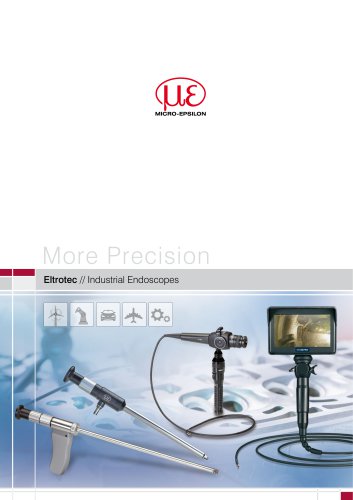 Industrial Endoscopes
32 Pages






Archived catalogs
 Metal Industry
8 Pages

- Measuring device
- Digital pyrometer
- Inspection system
- Industrial thermometer
- °C thermometer
- IR pyrometer
- MICRO-EPSILON thickness gauge
- MICRO-EPSILON displacement sensor
- Waterproof thermometer
- Stainless steel thermometer
- MICRO-EPSILON linear displacement sensor
- Automatic inspection system
- Portable thickness gauge
- Micrometer
- Industrial measuring module
- Automatic measurement system
- Inspection machine
- Optical measurement system
- Distance sensor