
- Catalogs
- MICRO-EPSILON
- Magneto-inductive displacement sensors // mainSENSOR


- Company
- Products
- Catalogs
- News & Trends
- Exhibitions
Magneto-inductive displacement sensors // mainSENSOR
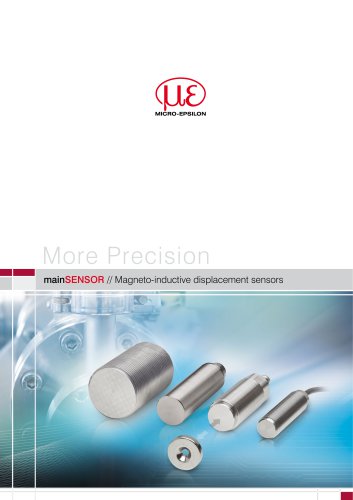
Magneto-inductive displacement sensors // mainSENSOR
The mainSENSOR by Micro-Epsilon is a magneto-inductive displacement sensor that merges the advantages of inductive and magnetic sensors. It is tailored for precise displacement and distance measurement, applicable in industries such as automation, machine building, and OEM applications.
Measuring Principle
The sensor functions by detecting variations in magnetic flow due to the movement of a magnet attached to the measurement object. This results in a linear output signal proportional to the magnet's distance, enabling self-linearization and removing the need for calibration.
Flexibility and Design
Available in various housings like M12, M18, and M30 stainless steel or flat plastic, the sensors are adaptable for different applications. They offer high sensitivity, temperature stability, and are non-contact and wear-free.
Applications
- Medical Technology: Detects foreign bodies in blister machines.
- Food Industry: Measures valve lift during drink carton filling.
- Washing Machines: Detects imbalance and load.
- Marine Diesel Engines: Measures rotational speed of gear wheels.
Installation Options
The sensors can be installed in non-ferromagnetic materials with versatile mounting options, including axial and side-shifted measurements.
Advantages
- High sensitivity and protection class.
- Suitable for measurements on conductive and non-magnetic materials.
- Ideal alternative to switches and proximity sensors.
- Extended measuring range and linear output signal.
Technical Specifications
The MDS-45 series is robustly designed with stainless steel housing, suitable for harsh environments. It offers a measuring range of up to 45 mm, with various output options and high temperature stability.
Conclusion
The mainSENSOR series offers a cost-effective, flexible solution for precise displacement and rotational speed measurements across various industrial applications.
Catalog excerpts
More Precision mainSENSOR // Magneto-inductive displacement sensors
Open the catalog to page 1
- Selectable measuring ranges up to 55 mm - Linear output signal - High basic sensitivity and temperature stability - High dynamics The mainSENSOR is based on an innovative measuring principle, which has been developed by Micro-Epsilon in order to combine the advantages of both inductive and magnetic sensors. A magnet is fixed to the measurement object. The movement of the magnet induces a change in the magnetic flow in the sensor element, which is detected by the sensor coil. A linear relationship between output signal and magnet distance (self-linearization technology) is produced due to counteracting...
Open the catalog to page 2
Automation, machine building and OEM applications Magneto-inductive sensors from Micro-Epsilon offer versatile fields of applications which include conventional machine building to measurements in automated processes and cost-sensitive large-scale production. Source: Uhlmann Pac-Systeme GmbH & Co. KG Source: SIG Combibloc Group AG Foreign body detection in medical technology In this application, the MDS sensor recognizes foreign bodies in blister machines during the tablet packaging process. Via the movement of overhead touching rollers, foreign bodies between the blister packaging and covering...
Open the catalog to page 3
Unlike inductive sensors, Micro-Epsilon’s magneto-inductive sensors offer versatile installation possibilities. The sensor can be immersed in nonferromagnetic objects, flush mounted or protruding without influencing the measurement accuracy. The magnet is mounted to the measurement object using a stainless steel screw, which is supplied with the sensor. Measuring through non-ferromagnetic materials Unlike conventional measuring procedures, the magneto-inductive sensor also measures through non-ferromagnetic materials such as aluminum and steel. A clear benefit is provided here as the sensor and...
Open the catalog to page 4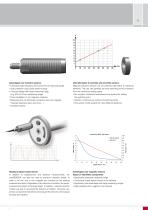
Advantages over inductive sensors ■ Constantly high sensitivity, even at the end of measuring range ■ High protection class (solid metal housing) ■ Compact design with large measuring range (e.g. M12 at 55 mm measuring range) ■ Flush installation in non-magnetic materials ■ Measurements on electrically conductive and non-magnetic materials (stainless steel, aluminum...) Magneto-inductive sensors are the preferred alternative to switching elements. The user can generate as many switching points as desired from the continuous analog signal. ■ No complex, mechanical adjustments are required for...
Open the catalog to page 5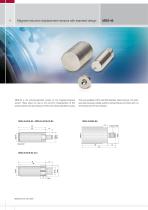
Magneto-inductive displacement sensors with standard design MDS-45 is the industry-standard version of the magneto-inductive sensor. These stand out due to the common characteristics of this product series and also because of their very robust standard housing. They are available in M18 and M30 stainless steel housings. The stainless steel housing is ideally suited to demanding environments (dirt, oil, chemicals) and the food industry.
Open the catalog to page 6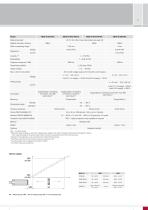
FSO = Full Scale Output 11 Measuring range changes by using other magnets (see catalog p.18); external magnetic fields and/or ferromagnetic material in the measuring range of the sensor system affect the sensor characteristic line and the technical data. 2) Deviation to the regression curve according to the method of least squares 3) Peak-Peak; external first-order low pass; frequency response 5 kHz 4) For plug versions only in plugged and screwed condition 5) Connection cable see accessories MR = Measuring range, SMR = Start of measuring range, EMR = End of measuring range
Open the catalog to page 7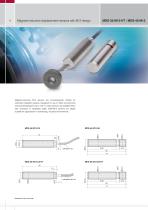
Magneto-inductive displacement sensors with M12 design Magneto-inductive M12 sensors are industrial-grade models for restricted installation spaces. Designed for use in harsh environments and high temperatures up to 120 °C, these sensors are available either with connector or integrated cable. MDS-M12 sensors are ideally suitable for applications in demanding, industrial environments.
Open the catalog to page 8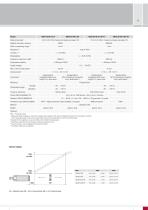
FSO = Full Scale Output 11 Measuring range changes by using other magnets (see catalog p.18); external magnetic fields and/or ferromagnetic material in the measuring range of the sensor system affect the sensor characteristic line and the technical data. 2) Deviation to the regression curve according to the method of least squares 3) Peak-Peak; external first-order low pass; frequency response 5 kHz 4) For plug versions only in plugged and screwed condition 5) Connection cable see accessories MR = Measuring range, SMR = Start of measuring range, EMR = End of measuring range
Open the catalog to page 9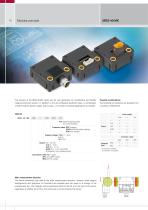
Connector / cable FIX: Optimal retaining plate for curved surfaces Protection class: IP67 (casting) IP20V (IP20 with partial casting) IP20 (not molded) F (frequency: time measurement) • Combination possible - Combination not possible Main measurement direction The above-mentioned data refer to the main measurement direction; however, other magnet arrangements and directions of movement are possible and can result in a change of the characteristic line. The magnets can be positioned either to the left or to the right of the sensor regardless of whether the north or the south pole is turned towards...
Open the catalog to page 10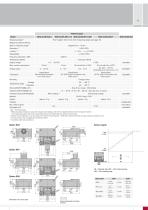
FSO = Full Scale Output 11 Measuring range changes by using other magnets (see catalog p.18); external magnetic fields and/or ferromagnetic material in the measuring range of the sensor system affect the sensor characteristic line and the technical data. 2) Deviation to the regression curve according to the method of least squares; 3) Peak-Peak; external first-order low pass; frequency response 5 kHz 4) For plug versions only in plugged and screwed condition 5) Connection cable see accessories Sensor signal MR = Measuring range, SMR = Start of measuring range, EMR = End of measuring range
Open the catalog to page 11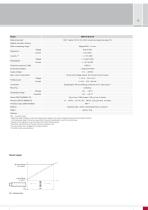
FSO = Full Scale Output 11 Measuring range changes by using other magnets (see catalog p.18); external magnetic fields and/or ferromagnetic material in the measuring range of the sensor system affect the sensor characteristic line and the technical data. 2) Deviation to the regression curve according to the method of least squares 3) Peak-Peak; external first-order low pass; frequency response 5 kHz 4) For plug versions only in plugged and screwed condition 5) Connection cable see accessories
Open the catalog to page 13All MICRO-EPSILON catalogs and technical brochures
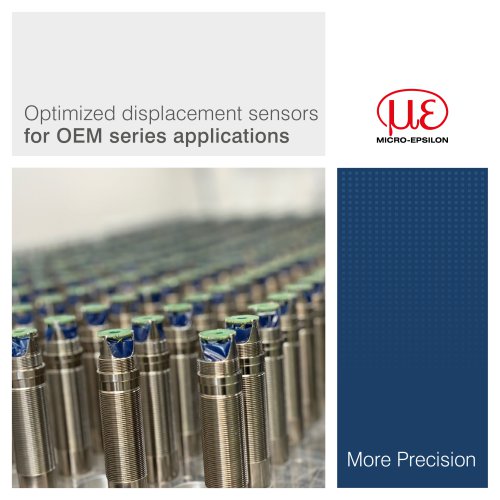 OEM series applications
20 Pages
 Vacuum
24 Pages
 Metallic Flat & Long Products
20 Pages
 Tracks & Rail Traffic
20 Pages
 Welding Automation
12 Pages
 Watches & Precision Mechanics
12 Pages
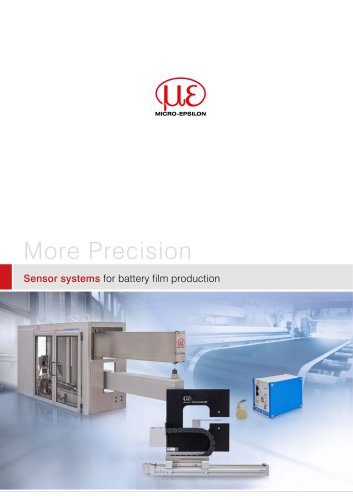 Battery Production
16 Pages
 Medical Technology & Production
28 Pages
 Test Rigs and Road Tests
4 Pages
 Ophthalmic lens metrology
12 Pages
 Automotive Production
24 Pages
 Electronics Production
24 Pages
 Glass Industry
12 Pages
 Machine Tools
16 Pages
 Optics & Laser
8 Pages
 Semiconductor Industry
20 Pages
 Telescopic Supports & Booms
8 Pages
 Wind Turbines
8 Pages
 Surface Finishing
8 Pages
 Plastics Industry
16 Pages
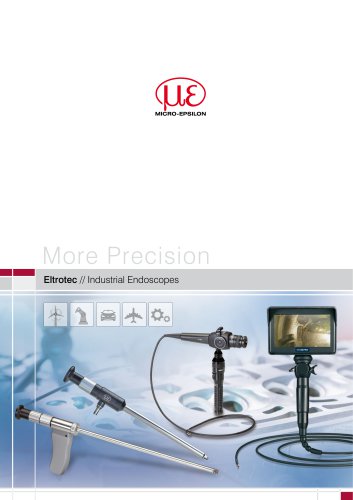 Industrial Endoscopes
32 Pages


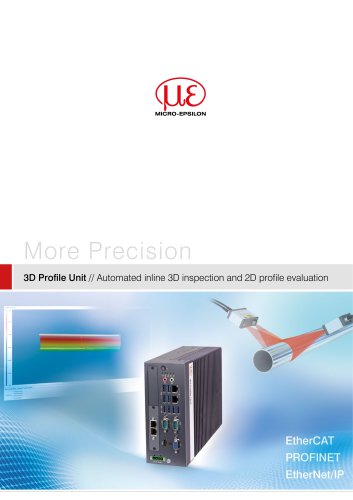






Archived catalogs
 Metal Industry
8 Pages

- Measuring device
- Measuring machine
- Digital pyrometer
- Inspection system
- Industrial thermometer
- °C thermometer
- IR pyrometer
- MICRO-EPSILON thickness gauge
- Waterproof thermometer
- Stainless steel thermometer
- MICRO-EPSILON linear displacement sensor
- Automatic inspection system
- Portable thickness gauge
- Micrometer
- Industrial measuring module
- Automatic measurement system
- Inspection machine
- Optical measurement system
- Distance sensor