
- Catalogs
- MICRO-EPSILON
- Inductive sensors based on eddy currents // eddyNCDT


- Company
- Products
- Catalogs
- News & Trends
- Exhibitions
Inductive sensors based on eddy currents // eddyNCDT
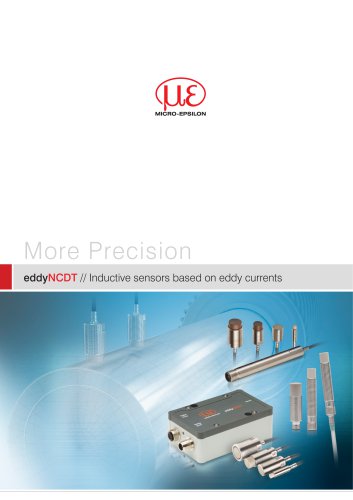
Inductive sensors based on eddy currents // eddyNCDT
Eddy current sensors are inductive displacement sensors used for non-contact measurement of displacements, distances, positions, oscillations, and vibrations. They are known for their high precision, robustness, and suitability for industrial environments.
The sensors operate by inducing eddy currents in a conductive object within a magnetic field created by an alternating current in a coil. Changes in the coil's impedance are detected for precise measurement.
- Wear-free and non-contact measurement
- High precision and resolution
- Temperature stability
- Applicable to both ferromagnetic and non-ferromagnetic materials
- Suitable for harsh industrial environments
- Fast measurements up to 20 kHz
- eddyNCDT 3001: Compact sensor with integrated controller, measuring ranges 2-8 mm, resolution ≥ 3 µm, measuring rate 75 kSa/s.
- eddyNCDT 3005: Compact system for fast, high precision measurements, measuring ranges 1-6 mm, resolution ≥ 0.5 µm.
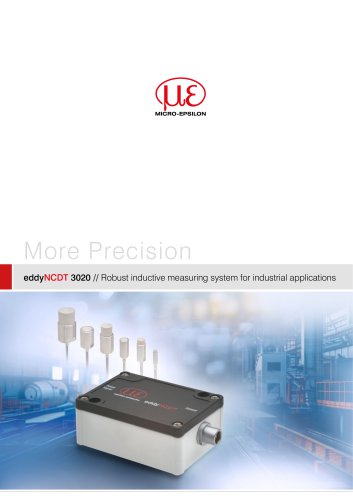
- eddyNCDT 3020: Robust system for industrial applications, measuring ranges 1-80 mm, resolution ≥ 0.04 µm.
- eddyNCDT 3060: Powerful system with measuring ranges 1-80 mm, resolution ≥ 0.02 µm, measuring rate 200 kSa/s.
- eddyNCDT 3070: High precision system for small ranges, measuring ranges < 1 mm, resolution ≥ 0.02 µm.
- turboSPEED DZ140: Sensor for turbocharger rotation speed, measuring ranges 0.5-1 mm, speed range 200-400,000 rpm.
- eddyNCDT SGS4701: Spindle growth measuring system, measuring ranges 250-500 µm, resolution ≥ 0.5 µm.
Sensors are factory-calibrated for specific materials like steel and aluminum, with options for custom calibration. They offer high temperature stability and are resistant to harsh conditions such as dirt, pressure, and extreme temperatures.
Standard installation conditions are provided, with options for field linearization and special tuning to maintain accuracy. Sensors are available in shielded and unshielded versions, affecting their compactness and sensitivity to surrounding metals.
Eddy current sensors are used in various industrial applications requiring high precision in challenging environments. They are suitable for OEM applications and can be customized for specific requirements.
- Measurement Range: 1 to 80 mm with high resolution and linearity.
- Temperature Resistance: Sensors operate up to 200°C, controllers up to 105°C.
- Interfaces: Digital (RS485, USB, Ethernet, EtherCAT, PROFINET, EtherNet/IP) and analog outputs (4-20 mA, 0-10 V).
- Protection Class: IP67 for DT3020 and IP68 for sensors.
- Material: Aluminum die-cast for controllers and stainless steel for sensors.
- High Precision: High resolution and frequency response up to 20 kHz.
- Temperature Compensation: Active compensation for accuracy across varying temperatures.
- Configuration: Easy setup via sensorTOOL software and web interface.
- Robust Design: High shock and vibration resistance.
Ideal for flatness measurement in steel rolling, distance measurement in galvanizing processes, and integration into welding and die casting systems.
Capable of measuring ranges smaller than 1 mm with high temperature stability and resolution. Supports both ferromagnetic and non-ferromagnetic materials. Includes a compact controller, sensor, and integrated cable, with factory calibration for specific materials.
Designed to operate in temperatures up to 200 °C and pressures up to 700 bar. Protection class is IP67 when plugged.
Supports Ethernet, PROFINET, EtherNet/IP, and EtherCAT. Configuration via web interface or sensorTOOL.
High resolution and linearity, frequency response of 20 kHz, active temperature compensation, frequency separation, and scalable measuring ranges.
Includes standard and miniature versions with specific measuring ranges, temperature stability, and pressure resistance. Special sensors for high-pressure applications.
Sensors can be mounted using screw connections, with various cable lengths and configurations available.
Suitable for integration into industrial machinery and plant environments, offering robust performance even in fluctuating temperatures and high-pressure conditions.
Includes dimensions with tolerances, e.g., ES-U3 model has a dimension of 10 mm with a tolerance of ±0.2 mm.
Proper installation is crucial for accurate measurement signals. Shielded sensors require a target size at least twice the sensor diameter, unshielded sensors four times. Field linearization is recommended for smaller targets.
Stable measurements depend on target material and thickness, with recommended minimum thicknesses for various materials.
Accuracy is affected by tilt angle; angles greater than 6° require factory calibration.
Frequency separation for multi-channel operation without interference. Field linearization recommended for non-standard installation conditions.
Micro-Epsilon's systems are actively temperature-compensated, ensuring stable measurement signals even with temperature fluctuations.
Precise measurement values in the micrometer range require high resolution and temperature stability. Micro-Epsilon systems provide active temperature compensation, ensuring reliable measurements even with daily temperature fluctuations.
Catalog excerpts
More Precision eddyNCDT // Inductive sensors based on eddy currents
Open the catalog to page 1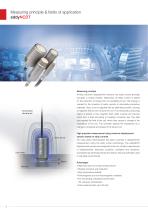
■ Measuring principle & fields of application alternating field Sensor with coil Eddy currents Metal plate Measuring principle Among inductive displacement sensors, the eddy current principle occupies a unique position. Measuring via eddy current is based on the extraction of energy from an oscillating circuit. This energy is needed for the induction of eddy currents in electrically-conductive materials. Here, a coil is supplied with an alternating current, causing a magnetic field to form around the coil. If an electrically conducting object is placed in this magnetic field, eddy currents are...
Open the catalog to page 2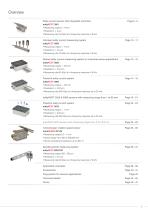
Eddy current sensor with integrated controller Page 6 - 9 ■ Measuring rate 75 kSa/s at a frequency response of 5 kHz Compact eddy current measuring system Page 10 - 11 ■ Measuring rate 75 kSa/s at a frequency response of 5 kHz Robust eddy current measuring system for industrial series applications Page 12 - 13 eddyNCDT 3020 ■ Measuring rate 80 kSa/s at a frequency response of 5 kHz Powerful eddy current system Page 14 - 15 ■ Measuring rate 200 kSa/s at a frequency response up to 20 kHz eddyNCDT 3020 & 3060 sensors with measuring range from 1 to 80 mm Page 16 - 21 Powerful eddy current system...
Open the catalog to page 3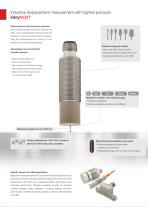
Industrial displacement measurement with highest precision eddyNCDT Robust sensors with maximum precision Eddy current sensors from Micro-Epsilon are often used in applications requiring maximum precision in harsh enviorenmental conditions. They are characterized by immunity to dirt, pressure and extreme temperature. Extensive range of models Advantages over conventional More than 400 sensor models inductive sensors Miniature sensors smaller than 2 mm Customized adaptions and OEM High frequency response for dynamic measurements High resolution in the submicron range High linearity and temperature...
Open the catalog to page 4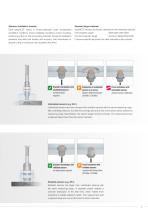
Standard installation situation Standard target materials Each eddyNCDT sensor is factory-calibrated under standardized eddyNCDT sensors are factory-calibrated for the following materials: installation conditions. These installation conditions involve mounting, Ferromagnetic target: positioning of the nut and surrounding materials. Deviations installation Non-ferromagnetic target: situations may affect the linearity and accuracy. Field linearization or Customer-specific adjustment for other materials is also possible. special tuning in the factory may counteract this effect. Standard installation...
Open the catalog to page 5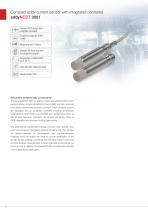
Compact eddy current sensor with integrated controller Robust M12 miniature eddy current sensor The two eddyNCDT 3001 U2 and U4 models are powerful eddy current sensors whose compact dimensions have to date only been reserved for inductive sensors and proximity sensors. These compact sensors are equipped with an integrated controller including temperature compensation while offering an excellent price-performance ratio, as well as easy operation. Therefore, the sensors are ideally suited to OEM integration and machine building applications. The temperature-compensated design provides high stability...
Open the catalog to page 6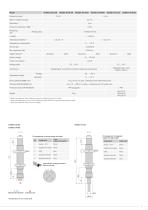
[1] RMS noise relates to mid of measuring range at a frequency response of 5 kHz 2 Values are referenced to the mid of the measuring range within the compensated temperature range 131 Steel: St37 steel DIN1.0037; aluminum: AlMg3 Pin assignment for power supply and signal Pin Assignment 2 Displacement signal White 4 assigned internally Black 5 assigned internally Gray Cable color Displacement signal Green assigned internally Yellow assigned internally Gray iasurement direction Connector side
Open the catalog to page 7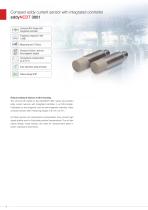
Compact eddy current sensor with integrated controller Robust miniature sensors in M18 housing The U6 and U8 models of the eddyNCDT 3001 series are powerful eddy current sensors with integrated controller in an M18 design Calibrated for ferromagnetic and non-ferromagnetic materials, these compact sensors offer measuring ranges of 6 mm or 8 mm. As these sensors are temperature-compensated, they provide high signal stability even in fluctuating ambient temperatures. Due to their robust design, these sensors are used for measurement tasks in harsh, industrial environments.
Open the catalog to page 8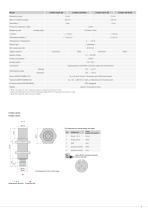
[1] RMS noise relates to mid of measuring range at a frequency response of 5 kHz 2 Values are referenced to the mid of the measuring range within the compensated temperature range 131 Steel: St37 steel DIN1.0037; aluminum: AlMg3 DT3001-U6-SADT3001-U8-SA Pin assignment for power supply and signal Supply +24 V Analog output GND assigned internally assigned internally Gray - 5-pole Ml2x1 housing connector View on pin side All dimensions in mm, not to scale Measurement direction Connector side 9
Open the catalog to page 9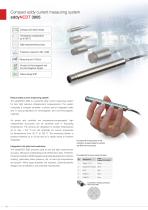
Compact eddy current measuring system Robust eddy current measuring system The eddyNCDT 3005 is a powerful eddy current measuring system for fast, high precision displacement measurements. The system comprises a compact controller, a sensor and an integrated cable and is factory-calibrated for ferromagnetic and non-ferromagnetic materials. As sensor and controller are temperature-compensated, high measurement accuracies can be achieved even in fluctuating temperatures. The sensors are designed for ambient temperatures up to max. +125 °C but can optionally be custom engineered for temperatures...
Open the catalog to page 10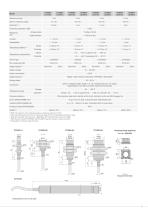
[1] RMS noise relates to mid of measuring range at a frequency response of 5 kHz 2 Values are referenced to the mid of the measuring range within the compensated temperature range 131 Steel: St37 steel DIN1.0037; aluminum: AlMg3 Steel: St37 steel DIN1.0037; aluminum: AlMg3 [4] USB, Ethernet, EtherCAT, PROFINET and EtherNet/IP require an interface module connection [5] Total weight for controller, cable and sensor Clamping flange (optional) Art. no.: 0801058 Measurement direction
Open the catalog to page 11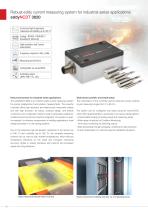
■ Robust eddy current measuring system for industrial series applications Configurable via sensorTOOL Switching output (NPN, PNP, TTL, HTL) Robust and precise for industrial series applications The eddyNCDT 3020 is an inductive eddy current measuring system for precise displacement and position measurements. The powerful controller offers high resolution and detects fast movements reliably and with high precision. Its robust, compact design, and flexible connection and configuration options make it particularly suitable for industrial environments and machine integration. The system is used,...
Open the catalog to page 12All MICRO-EPSILON catalogs and technical brochures
 OEM series applications
20 Pages
 Vacuum
24 Pages
 Metallic Flat & Long Products
20 Pages
 Tracks & Rail Traffic
20 Pages
 Welding Automation
12 Pages
 Watches & Precision Mechanics
12 Pages
 Battery Production
16 Pages
 Medical Technology & Production
28 Pages
 Test Rigs and Road Tests
4 Pages
 Ophthalmic lens metrology
12 Pages
 Automotive Production
24 Pages
 Electronics Production
24 Pages
 Glass Industry
12 Pages
 Machine Tools
16 Pages
 Optics & Laser
8 Pages
 Semiconductor Industry
20 Pages
 Telescopic Supports & Booms
8 Pages
 Wind Turbines
8 Pages
 Surface Finishing
8 Pages
 Plastics Industry
16 Pages
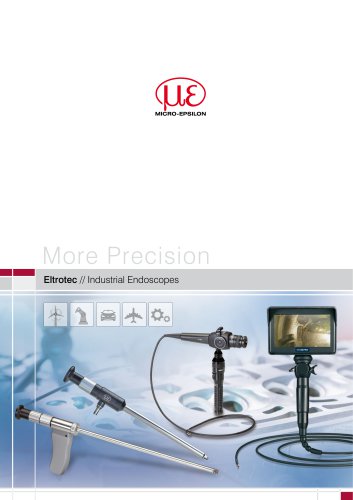 Industrial Endoscopes
32 Pages






Archived catalogs
 Metal Industry
8 Pages

- Measuring device
- Digital pyrometer
- Inspection system
- Industrial thermometer
- °C thermometer
- IR pyrometer
- MICRO-EPSILON thickness gauge
- Waterproof thermometer
- Stainless steel thermometer
- MICRO-EPSILON linear displacement sensor
- Automatic inspection system
- Portable thickness gauge
- Industrial measuring module
- Automatic measurement system
- Inspection machine
- Optical measurement system
- Distance sensor