
- Catalogs
- MICRO-CONTROLE / Spectra-Physics
- Spherical and aspherical lenses


Spherical and aspherical lenses

Spherical and aspherical lenses
This guide assists in selecting the appropriate lens for specific applications by considering factors such as conjugate ratio, lens shape, f/number, lens material, transmission, wavefront distortion, scattered light, types of coating, and cost. It provides a comparison of options available from Newport.
Different lens shapes are recommended based on conjugate ratios to minimize optical aberrations:
- Plano-Convex/Concave Lenses: Best for infinite conjugate ratios.
- Bi-Convex/Concave Lenses: Ideal for finite conjugates close to a 1:1 ratio.
- Achromatic Doublets: Provide the smallest focused spot at f/2.
Lenses are available in materials like BK7 and UV Fused Silica. Coatings enhance performance and durability, including:
- Anti-Reflection Coating (AR): Reduces reflectance and improves transmission.
- Single Layer Magnesium Fluoride AR Coating: Broad wavelength range, cost-effective.
- Broadband Multilayer AR Coating: Reduces reflections over wide wavelengths.
- Laser Line AR V-Coating: Offers maximum transmission at specific wavelengths.
Optimized to reduce surface losses to less than 0.2%, enhancing laser energy transmission. Available for specific wavelengths, with AR.33 for 1064 nm in stock.
Improve transmission efficiency across a wide wavelength range, suitable for multiple and tunable lasers.
Newport's singlet lenses are designed for laser electro-optic applications, made from BK7 or UV grade fused silica, with precise specifications and tolerances.
These lenses offer high precision and are available with broadband or laser line AR coatings.
To order lenses with AR coatings, specific codes are appended to the product number. Examples are provided for formatting these product numbers.
The document includes information on gradient index micro lenses (GRIN lenses), precision aspheric lenses, broadband corrected triplet lenses, microlens arrays, and broadband beam samplers, designed for various applications in laser collimating, focusing, and coupling.
Details on lens holders, infrared lenses, sapphire lenses, calcium fluoride, zinc selenide lenses, and AMTIR-1 lenses are provided, highlighting their specific applications and advantages.
A graph illustrates the reflectance percentage against the angle of incidence for a BK7 substrate with NC.2 coating, showing typical reflectance behavior.
Catalog excerpts
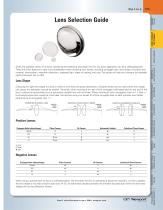
OPTICAL MIRRORS Lens Selection Guide SPHERICAL AND ASPHERICAL LENSES BEAMSPLITTERS Lens Shape IDENTICAL PLANO-CONVEX LENSES paraxial image plane IDENTICAL ACHROMATIC DOUBLETS paraxial image plane paraxial image plane Positive Lenses Plano-Convex Achromatic Doublet Cylindrical Plano-Convex D–Good Ø–Better t–Best Conjugate Ratio (object/image) When using a positive lens to focus a collimated beam, the f/number the lens is operating at becomes important. At f/10 or greater, the lens shape is not that critical to spot size. At f/2, an achromatic doublet provides the smallest focused spot while the other lens shapes will not be diffraction limited. CLEANING & OTHER LAB ESSENTIALS Email: [email protected] • Web: newport.com OPTICAL MODULATORS MULTI-ELEMENT OPTICAL ASSEMBLY Negative Lenses BEAM EXPANDERS Conjugate Ratio (object/image) CYLINDRICAL & OPTICAL WINDOWS & ACHROMATIC LENSES DIFFRACTION GRATINGS SYMMETRIC BI-CONVEX LENS Choosing the right lens shape is critical in order to minimize the optical aberrations. Multiple lenses can be used where one singlet can cancel the aberration caused by another. Generally, when working at or near infinite conjugate (collimated light on one end of the lens), a plano-convex/concave lens or achromatic doublet lens will work best. When working at finite conjugates close to 1:1 ratio, a bi-convex/concave lens would be more ideal. Sometimes using two lenses at infinite conjugate back to back provides even better performance at conjugates near 1:1. Given the available variety of choices, specifying and selecting the proper lens for any given application can be a challenging task. There are a few features to take into consideration when choosing your lenses, including conjugate ratio, lens shape, f/number, lens material, transmission, wavefront distortion, scattered light, types of coating, and cost. This guide will help you compare the available options Newport has to offer.
Open the catalog to page 1
SPHERICAL AND ASPHERICAL LENSES OPTICAL MIRRORS Positive Lenses BEAMSPLITTERS WAVEPLATES AND POLARIZERS PRISMS AND RETRO-REFLECTORS OPTICAL WINDOWS & CYLINDRICAL & DIFFRACTION GRATINGS ACHROMATIC LENSES BEAM EXPANDERS MULTI-ELEMENT OPTICAL ASSEMBLY OPTICAL MODULATORS Achromatic Doublet Cylindrical Plano-Convex CLEANING & OTHER LAB ESSENTIALS An array of shapes and sizes are offered for most substrates, and it is important to choose the right lens type in order to minimize optical aberrations. Lenses are offered in one of the following configurations: Plano-Convex Lenses are the best choice for...
Open the catalog to page 2
Achromatic Doublet Cylindrical Lenses Plano-Convex Aspherical Lenses • Anti-Reflection Coating (AR coating) Newport offers an extensive range of antireflection coatings covering the ultraviolet, visible, near infrared, and infrared regions. For most uncoated optics, approximately 4% of incident light is reflected at each surface, resulting significant losses in transmitted light level. Utilizing a thin film anti-reflection coating can improve the overall transmission, as well as minimizing stray light and back reflections throughout the system. The AR coating can also prevent the corresponding...
Open the catalog to page 3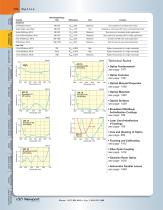
OPTICAL MIRRORS SPHERICAL AND ASPHERICAL LENSES Only available on UV fused silica lenses Available on achromats, KPX series, and Cylindrical lenses Best choice for broadband visible applications Great choice for broadband UV to visible applications Excellent for NIR laser diode applications Ideal for telecom laser diode applications Highest transmission at a single wavelength Highest transmission at a single wavelength Highest transmission at a single wavelength Laser Line • Optical Materials see page 1423 • Optical Surfaces see page 1429 • Laser Line Antireflection V-Coatings see page 709 •...
Open the catalog to page 4
• Rmax <0.25% at a single wavelength • Highest transmission efficiency SPHERICAL AND ASPHERICAL LENSES Through careful optimization, these durable, thin films coatings reduce surface losses to typically less than 0.2%. Valuable laser energy is efficiently transmitted through complex optical systems rather than being lost to surface reflection and scatter. This superior performance, however, is achieved at the cost of reduced wavelength range. AR.33 for 1064 nm is available from stock on most Newport lenses. All other V-coatings can be coated on a semi-custom basis. OPTICAL MIRRORS Laser Line...
Open the catalog to page 5
OPTICAL MIRRORS Singlet Lens SPHERICAL AND ASPHERICAL LENSES • BK 7 and UV grade fused silica • Precision polished surfaces • Precise specifications and tolerances • Broadband or laser line antireflection coatings • Standard diameters and focal lengths • Over 1,000 lenses to provide solutions for your application Designed to meet the demanding requirements of laser electro-optic applications, Newport's singlet lenses are manufactured from fine annealed BK 7 optical glass or UV grade fused silica. These lenses are polished to tight tolerances using master test plates to ensure minimum wavefront...
Open the catalog to page 6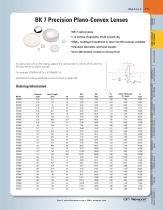
OPTICAL MIRRORS BK 7 Precision Plano-Convex Lenses • l/4 surface irregularity, 40-20 scratch-dig • MgF2, multilayer broadband or laser line AR coatings available • Standard diameters and focal lengths • Over 300 distinct models to choose from To order a lens with an AR coating, append the coating code -C, AR.14, AR.16, AR.18 or AR.33 to the lens product number. Antireflection coating specifications can be found on page 709. CYLINDRICAL & OPTICAL WINDOWS & ACHROMATIC LENSES DIFFRACTION GRATINGS Ordering Information Focal Length (mm) SPHERICAL AND ASPHERICAL LENSES 90.440 CLEANING & OTHER LAB ESSENTIALS...
Open the catalog to page 7
OPTICAL MIRRORS SPHERICAL AND ASPHERICAL LENSES BEAMSPLITTERS WAVEPLATES AND POLARIZERS OPTICAL WINDOWS & CYLINDRICAL & DIFFRACTION GRATINGS ACHROMATIC LENSES LH Series Lens Mounts page 893 Infrared Lenses page 727 CLEANING & OTHER LAB ESSENTIALS OPTICAL MODULATORS MULTI-ELEMENT OPTICAL ASSEMBLY BEAM EXPANDERS IR Achromatic Lenses page 794 Near IR Achromatic Lenses page 787 Broadband Corrected Triplet Lenses page 736
Open the catalog to page 8All MICRO-CONTROLE / Spectra-Physics catalogs and technical brochures
 Precision Motion Control
27 Pages
 OPTICAL FIBER ALIGNMENT
6 Pages
 SA2_90028936F
1 Page
 10BPF10-370_ROHS
1 Page
 10BPF10-320_ROHS
1 Page
 10BPF10-310
1 Page
 M-401
M-4011 Page
 Tunable Diode Lasers
16 Pages
 Custom Component Solutions
6 Pages
 Vision IsoStation Brochure
5 Pages
 Nanopositioning Solutions
55 Pages
 newport ressource
1640 Pages
 Motion PL30
24 Pages
 CONEX-AG-LS25-27P
2 Pages
 Nanopositioners
40 Pages
 Prisms and retroreflectors
9 Pages
 Beamsplitters
34 Pages
 Optrical mirror
33 Pages
 Ultra-Low Loss SuperMirrors™
2 Pages
 Precision Right-Angle Prisms
1 Page
 Parallel Windows
1 Page
 Sapphire Windows
1 Page
 Compensated Attenuators
1 Page
 High-Energy Laser Beam Expanders
2 Pages
 High-Energy Variable Attenuators
3 Pages
 Laser Collimator
1 Page
 Gradient Index Micro Lenses
2 Pages
 Aspheric Condenser Lenses
1 Page
 Molded Glass Aspheric Lenses
3 Pages
 BK 7 Precision Bi-Convex Lenses
2 Pages
 Polarcor™ Linear Polarizers
1 Page
 Precision Linear Polarizers
1 Page
 Broadband Beam Samplers
1 Page
 Pellicle Beamsplitters
1 Page
 Plane Ruled Reflection Gratings
2 Pages
 Volume Bragg Gratings™
1 Page
 Ultrafast Laser Beam Sampler
1 Page
 Ultrafast Laser Chirped Mirrors
2 Pages
 Laser Diode Objective Lenses
1 Page
 Precision Objective Lenses
1 Page
 Reflective Microscope Objectives
2 Pages
 Systems Solutions brochure
6 Pages
 Polarization Controller, Manual
2 Pages
 Fiber Optic Depolarizers
1 Page
 Mode Scrambler
1 Page
 Index-Matching Fluid
1 Page
 Variable Ratio Couplers
2 Pages
 Fixed Fiber Optic Attenuator
1 Page
 Fiber Optic Switches
2 Pages
 Single Branch Fiber Bundles
1 Page
 Fiber Optic Isolator
2 Pages
 Photonic Crystal Fibers
4 Pages
 Oriel Multi-track Fiber Bundles
2 Pages
 Power Delivery Fibers
1 Page
 Liquid Light Guides
2 Pages
 Infrared Fibers
1 Page
 Fast Steering Mirrors
4 Pages
 Optical Delay Line Kit
1 Page
 Long Scan Autocorrelator
1 Page
 I-V Test Station
2 Pages
 Projects in Optics
2 Pages
 Projects in Interferometry
2 Pages
 Azimuth / Elevation Gimbals
2 Pages
 Air-Bearing System
2 Pages
 X-Ray Diffractometer
2 Pages
 Motion System
2 Pages
 LabLegs™ Upgrade Kits
1 Page
 UCS Series Cleanroom Tables
1 Page
 TE Series Table Enclosures
1 Page
 Oriel Integrating Spheres
5 Pages
 Oriel Inspection Probes
1 Page
 Oriel Focusing Lens Assembly
2 Pages
 Xenon Flashlamps
2 Pages
 Oriel InstaSpec X CCD
3 Pages
 Oriel Mini Monochromator
3 Pages
 Oriel 77200 1/4 m Monochromator
3 Pages
 OSM2 Series Spectrometers
2 Pages
 Oriel Optical Choppers
2 Pages
 Electronic Safety Shutters
1 Page
 Oriel Optical Shutter
1 Page
 Iris Diaphragms
1 Page
 X26 Series Mirror Mount
1 Page
 Mini Optical Rails and Carriers
2 Pages
 Slotted Bases
2 Pages
 SDS Series Angle Brackets
1 Page
 Rotation Adaptor
1 Page
 PBN Series Base Plates
1 Page
 Modular Riser Plates
1 Page
 Magnetic Bases
2 Pages
 Kinematic Stops and Nudgers
1 Page
 Kinematic Bases
2 Pages
 Fixed Height Platforms
1 Page
 EQ Series Angle Brackets
2 Pages
 Base Clamps
1 Page
 360 Series Angle Brackets
1 Page
 Rod Platforms
1 Page
 Rod Clamps
1 Page
 Posts and Post Holders
3 Pages
 Post Clamps and Accessories
1 Page
 Pedestal-Base Post Holders
2 Pages
 Modular Construction System
1 Page
 Holders for Pedestal Posts
1 Page
 Heavy Duty Rod Systems
2 Pages
 Dual Rod Systems
1 Page
 Breadboard Support Posts
1 Page
 Pedestal Post System
2 Pages
 Motorized Filter Wheels
1 Page
 Manual Filter Wheels
1 Page
 Indexed Filter Wheel Mounts
1 Page
 Filter Holders
1 Page
 Filter and Optic Holders
1 Page
 V-Blocks
1 Page
 Precision Beam Steerers
1 Page
 Polarizer Rotation Mounts
1 Page
 Pockels Cell Positioner
1 Page
 Kin-a-Flip Mount
1 Page
 Diffraction Grating Mount
2 Pages
 Cube Beamsplitter Holders
1 Page
 Beam Steerers
1 Page
 Aegis Qube™ Beam Routing System
5 Pages
 Variable Lens Holder
1 Page
 Self-Centering Lens Mounts
1 Page
 Multi-Axis Lens Positioners
4 Pages
 Lens Focusing Mount
1 Page
 Fixed Lens Mounts
1 Page
 Cylindrical Lens Holders
1 Page
 Compact Lens Positioners
1 Page
 Adjustable Lens Mounts
1 Page
 UV Objective Lenses
1 Page
 Objective Lenses
1 Page
 Infrared Lenses
1 Page
 Spherical Ball Micro Lenses
1 Page
 Three-Axis Spatial Filters
2 Pages
 Precision Singlet Lens Sets
3 Pages
 OptiSet™ Optics Sets
2 Pages
 Laser Beam Expanders
2 Pages
 Electronic Shutter System
1 Page
 UV Beam Viewer
1 Page
 Interferometer Flats
1 Page
 Light Pipe Homogenizer
1 Page
 VALUMAX® Right-Angle Prisms
1 Page
 VALUMAX® Broadband Mirrors
2 Pages
 Laser Line Dielectric Mirrors
2 Pages
 High-Energy Nd:YAG Laser Mirrors
2 Pages
 Broadband SuperMirrors™
1 Page
 Broadband Metallic Mirrors
2 Pages
 Broadband Dielectric Mirrors
2 Pages
 Oriel TE Cooler Controller
1 Page
 Oriel Current Preamplifier
1 Page
 Micro-Beam Profiler
1 Page
 Laser Beam Profiler
2 Pages
 High-Speed Photodetectors, GHz
7 Pages
 Oriel Silicon Detectors
2 Pages
 Oriel Pb and PbSe Detectors
2 Pages
 Oriel InGaAs and Ge Detectors
2 Pages
 Oriel Photomultiplier Tubes
2 Pages
 Fiber Optic Detectors
2 Pages
 PulseScout Autocorrelator
2 Pages
 Heat Control Filters
1 Page
 Colored Glass Filters
3 Pages
 Bandpass Filters
4 Pages
 Laser Line Filters
2 Pages
 Short and Long-Wave Pass Filters
2 Pages
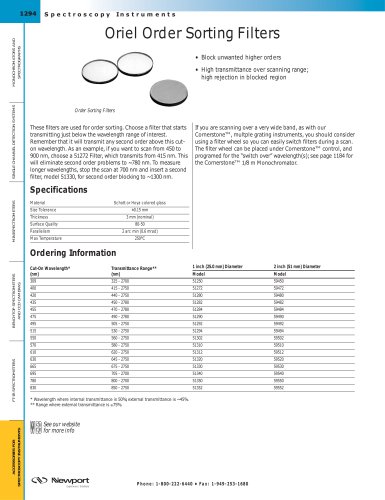 Oriel Order Sorting Filters
1 Page
 UZ Series Vertical Linear Stages
2 Pages
 HXP100 Hexapod
2 Pages
 BG Series Goniometric Cradles
4 Pages
 EL/EN Series Lab Jacks
1 Page
 ECN/ECR Series Lab Jacks
2 Pages
 Single-Mode Fiber Couplers
1 Page
 Multimode Fiber Couplers
2 Pages
 GRIN Lens Fiber Couplers
1 Page
 Fiber Optic Positioners
3 Pages
 BM Series Micrometers
2 Pages
 Apex Fiber Illuminators
2 Pages
 Series Q Deuterium Sources
1 Page
 Deuterium Lamps
2 Pages
 Apex Deuterium Lamp Sources
1 Page
 Oriel Ozone Eater
1 Page
 Ozone Blowers
1 Page
 Flange Mounted Cells
1 Page
 Beam Turning Assemblies
2 Pages
 Aspherab Lens Assemblies
2 Pages
 Mounts for Beam Probes
1 Page
 Input Hood for Light Sources
1 Page
 Holders for Oriel Single Fibers
2 Pages
 Flood Exposure Sources
6 Pages
 Mask Alignment Tools
4 Pages
 Class A Solar Simulators
3 Pages
 150 - 300 W Solar Simulators
2 Pages
 150 W Low Cost Solar Simulator
2 Pages
 Apex Monochromator Illuminators
4 Pages
 Silicon Carbide Light Source
1 Page
 Quartz Tungsten Halogen Lamps
3 Pages
 Blackbodies
2 Pages
 Apex Infrared Light Sources
2 Pages
 Xenon Flashlamp Systems
2 Pages
 Uniform Illuminators
3 Pages
 Simplicity Series Arc Sources
2 Pages
 Series Q Lamp Housings
4 Pages
 Series Q Arc Lamp Sources
2 Pages
 Oriel PhotoMax Lamp Housing
3 Pages
 Fading Test System
1 Page
 Modular Infrared Light Sources
2 Pages
 Digital Arc Lamp Power Supplies
2 Pages
 DC Short Arc Lamps
3 Pages
 Research Arc Lamp Housings
3 Pages
 Apex Arc Lamp Sources
2 Pages
 Pencil Style Calibration Lamps
3 Pages
 Calibrated Sources and Services
2 Pages
 Laser Diode Adaptors
1 Page
 Cylindrical Laser Mounts
1 Page
 Laser Diode Drivers, 500B Series
2 Pages
 TEC Controller, 300B Series
2 Pages
 VBG Raman Laser Modules
2 Pages
 Laser Diode Modules, LQN Series
2 Pages
 Alignment Laser
1 Page
 Ultraviolet Safety Equipment
1 Page
 Laser Safety Glasses and Goggles
4 Pages
 Laser Safety Windows
1 Page
 Infrared IR Viewer
1 Page
 Beam Dump
1 Page
 177 Air-Cooled Ion Lasers
2 Pages
 Empower ® Q-Switched Laser
2 Pages
 V-Xtreme™ Q-Switched Laser
2 Pages
 Fiber Pigtailed Laser Diode
1 Page
 488 nm CW Laser- Cyan™ OEM
2 Pages
 CW Lasers- Excelsior® OEM
4 Pages
 Inspire™ OPO Family
2 Pages
 Kevlar® Shears
1 Page
 Fiber Optic Scribes
1 Page
 Fiber Jacket Stripper
1 Page
 Fiber Optic Collimators
2 Pages
 Fiber Preparation Kit
1 Page
 Fiber Optic Splice
1 Page
 Fiber Coating Stripper
1 Page


Archived catalogs
 Pick & Place Machine
2 Pages
 Metrology Positioning System
2 Pages
 Adaptors and Retaining Rings
1 Page
 Mounting Bridles
1 Page


- Positioning table
- Translation stage
- Digital temperature control
- Motorized positioning table
- Temperature controller
- Precision positioning table
- Digital temperature controller
- Metal stand
- Technology positioning stage
- Automation temperature controller
- PID temperature control
- Single-axis positioning stage
- Manually-operated positioning stage
- Power meter
- 2-axis positioning table
- Compact positioning table
- PID temperature controller
- Glass lens element
- Multi-axis positioning table
- Optical filter