
- Catalogs
- MICRO-CONTROLE / Spectra-Physics
- OPTICAL FIBER ALIGNMENT


OPTICAL FIBER ALIGNMENT

OPTICAL FIBER ALIGNMENT
Optical networks require precise fiber alignment to minimize signal losses at junctions, which is crucial for reliable data transmission. Proper alignment reduces optical power needs, leading to fewer repeaters and lower costs.
Alignment Parameters and Procedures
Effective alignment involves precise motion control and optimized search algorithms. The process includes detecting 'first light' and adjusting fiber positions to maximize signal output. Motion controllers use a six-degree freedom system for adjustments.
Motion Control Parameters
Key parameters include Minimum Incremental Motion (MIM), repeatability, and position stability. MKS Instruments' XMS stages offer 1 nm MIM and high repeatability, crucial for maintaining alignment during assembly.
Search Algorithms
Search algorithms are categorized into 'first light' and 'peak power' searches. Raster and spiral scans are used for initial detection, while hill climb, centroid, and dichotomy searches optimize peak power location.
Motion Control Systems
Systems range from manual stages for R&D to automated systems for production. Options include piezoelectric stages, linear motor stages, and hexapods, each offering different precision and motion capabilities.
Other Fiber Alignment System Components
Components include detectors, power meters, vision systems, and dispensing/bonding systems. These elements ensure precise alignment and secure assembly of optical components.
Conclusion
Accurate fiber alignment is essential for efficient optical networks. MKS Instruments provides comprehensive solutions for alignment applications, supporting precision from nanometer to sub-micron scales.
Note
MKS products are subject to US Export Regulations.
Catalog excerpts
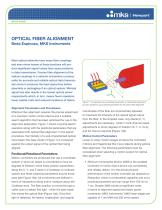
WHITE PAPER Most optical networks have many fiber couplings and even minor losses at these junctions will produce significant signal losses that cause problems in data transmission. Precise fiber alignment at the optical couplings in a network is therefore a prerequisite for accurate and reliable optical data transmission since it produces the least signal loss before assembly or packaging of an optical system. Minimal signal loss also results in the lowest optical power requirements which, in turn, means fewer repeaters, lower capital costs and reduced incidence of failure. Alignment Parameters and Procedures Effective fiber alignment requires the precise adjustment of a precision motion control device and a suitable search algorithm that has been optimized for use in the alignment application. Figure 1 shows a typical search operation along with the positional parameters that are associated with optical fiber alignment. In the search procedure, the intensity of a well-characterized optical input beam (the laser diode in Figure 1) is compared against the output signal of the optical fiber being aligned. Positional/Rotational Parameters Motion controllers are employed that use a coordinate system in which an object is considered to have six degrees of freedom: three linear position parameters, along the X, Y, and Z-axes in a Cartesian co-ordinate system and three rotational parameters around those axes (see Figure 1(b)). All movements are defined in terms of translations along and/or rotations about the Cartesian axes. The fiber position is moved through a raster scan to detect first light - when the laser beam first enters the optical fiber (Figure 1(a)). Once first light is detected, the lateral, longitudinal, and angular Figure 1. The operations and positional parameters of optical fiber alignment; (a) scan operations; (b) positional parameters for the optical fiber alignment. coordinates of the fiber are incrementally adjusted to maximize the intensity of the optical signal output from the fiber. In the simplest case, only lateral (X, Y) adjustments are necessary, while in multi-channel cases, adjustments to all six degrees of freedom (X, Y, Z, 0x,0y, and 0z) may be required (Figure 1(b)). Motion Control Parameters Linear or rotary motion stages produce the controlled motions and trajectories that move objects during optical fiber alignment. The following parameters must be considered when selecting a motion system for optical fiber alignment: • Minimum Incremental Motion (MIM) is the smallest increment of motion that a device can consistently and reliably deliver. It is the actual physical performance of the motion controller (as opposed to Resolution which is a theoretical capability and not a practical parameter) and can range from 100 nm to 1 nm. Smaller MIM comes at significant costs in terms of alignment speed and beam power increments. MKS Instruments’ XMS linear stages are capable of 1 nm MIM and 300 mm/s speed.
Open the catalog to page 1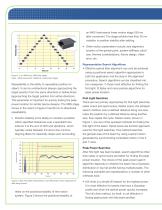
an MKS Instruments linear motion stage 250 ms after movement. The stage exhibits less than 20 nm variation in position stability after settling. • Other motion parameters include: axis alignment, location of the gimbal point, system stiffness, pitch/ yaw, thermal considerations, fixture design, Abbe error, etc. Figure 2. 1 nm MIM of an XMS linear stage; Insert – MKS Instruments’ XMS50-S Linear Motor Stage. Repeatability is the ability to repeatably position an object. It can be unidirectional (always approaching the target position from the same direction) or bidirectional (approaching the target...
Open the catalog to page 2
• Centroid Search moves along one axis and finds a peak then moves along a second axis to find the final peak. Centroid searches are useful with top-hat or multi-peak profiles. • Dichotomy Search explores one axis at a time in large increments until a peak is identified. Within this peak, another search cycle is performed using finer steps to find the peak maximum. Motion Control Systems Different kinds of motion control systems can be employed in fiber alignment, ranging from simple manual stages suitable for small scale and R&D applications to fully automated production systems with high precision...
Open the catalog to page 3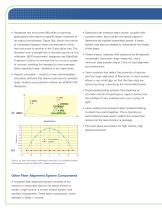
• Hexapods can encounter difficulties in scanning applications that require a specific linear, rotational or arc path to be followed. Figure 5(b), shows the motion of a standard hexapod when commanded to move from one point to another in the X-axis (blue line). The deviation from a straight line in the path can be up to a millimeter. MKS Instruments’ hexapods use RightPath Trajectory Control to minimize the run-out to a couple of microns, enabling the hexapod to more precisely follow specified linear, rotational or arc trajectories. • exaViz simulation − HexaViz is free, downloadable H simulation...
Open the catalog to page 4
Table 1. MKS Instruments Components for Fiber Alignment Systems. Conclusion Fast, accurate, and precise optical fiber alignment is critically important to the efficient operation of optical communication networks. Poorly aligned junctions between fibers and between fibers and optical devices result in excessive signal losses in a network which, in turn, results in higher equipment costs to avoid excessive incidence of failure. MKS Instruments provides a suite of motion control systems, search software, and ancillary system components that are ideal for use in optical fiber alignment applications....
Open the catalog to page 5
Newport" ••mks | Newport"www.newport.com DS-011903 Optical Fiber Aligment WP_01/22 ©2022 MKS Instruments, Inc. Specifications are subject to change without notice. MKS products provided subject to the US Export Regulations. Diversion or transfer contrary to US law is prohibited. mksinst™ is a trademark of MKS Instruments, Inc., Andover, MA.
Open the catalog to page 6All MICRO-CONTROLE / Spectra-Physics catalogs and technical brochures
 Precision Motion Control
27 Pages
 SA2_90028936F
1 Page
 10BPF10-370_ROHS
1 Page
 10BPF10-320_ROHS
1 Page
 10BPF10-310
1 Page
 M-401
M-4011 Page
 Tunable Diode Lasers
16 Pages
 Custom Component Solutions
6 Pages
 Vision IsoStation Brochure
5 Pages
 Nanopositioning Solutions
55 Pages
 newport ressource
1640 Pages
 Motion PL30
24 Pages
 CONEX-AG-LS25-27P
2 Pages
 Nanopositioners
40 Pages
 Prisms and retroreflectors
9 Pages
 Beamsplitters
34 Pages
 Spherical and aspherical lenses
35 Pages
 Optrical mirror
33 Pages
 Ultra-Low Loss SuperMirrors™
2 Pages
 Precision Right-Angle Prisms
1 Page
 Parallel Windows
1 Page
 Sapphire Windows
1 Page
 Compensated Attenuators
1 Page
 High-Energy Laser Beam Expanders
2 Pages
 High-Energy Variable Attenuators
3 Pages
 Laser Collimator
1 Page
 Gradient Index Micro Lenses
2 Pages
 Aspheric Condenser Lenses
1 Page
 Molded Glass Aspheric Lenses
3 Pages
 BK 7 Precision Bi-Convex Lenses
2 Pages
 Polarcor™ Linear Polarizers
1 Page
 Precision Linear Polarizers
1 Page
 Broadband Beam Samplers
1 Page
 Pellicle Beamsplitters
1 Page
 Plane Ruled Reflection Gratings
2 Pages
 Volume Bragg Gratings™
1 Page
 Ultrafast Laser Beam Sampler
1 Page
 Ultrafast Laser Chirped Mirrors
2 Pages
 Laser Diode Objective Lenses
1 Page
 Precision Objective Lenses
1 Page
 Reflective Microscope Objectives
2 Pages
 Systems Solutions brochure
6 Pages
 Polarization Controller, Manual
2 Pages
 Fiber Optic Depolarizers
1 Page
 Mode Scrambler
1 Page
 Index-Matching Fluid
1 Page
 Variable Ratio Couplers
2 Pages
 Fixed Fiber Optic Attenuator
1 Page
 Fiber Optic Switches
2 Pages
 Single Branch Fiber Bundles
1 Page
 Fiber Optic Isolator
2 Pages
 Photonic Crystal Fibers
4 Pages
 Oriel Multi-track Fiber Bundles
2 Pages
 Power Delivery Fibers
1 Page
 Liquid Light Guides
2 Pages
 Infrared Fibers
1 Page
 Fast Steering Mirrors
4 Pages
 Optical Delay Line Kit
1 Page
 Long Scan Autocorrelator
1 Page
 I-V Test Station
2 Pages
 Projects in Optics
2 Pages
 Projects in Interferometry
2 Pages
 Azimuth / Elevation Gimbals
2 Pages
 Air-Bearing System
2 Pages
 X-Ray Diffractometer
2 Pages
 Motion System
2 Pages
 LabLegs™ Upgrade Kits
1 Page
 UCS Series Cleanroom Tables
1 Page
 TE Series Table Enclosures
1 Page
 Oriel Integrating Spheres
5 Pages
 Oriel Inspection Probes
1 Page
 Oriel Focusing Lens Assembly
2 Pages
 Xenon Flashlamps
2 Pages
 Oriel InstaSpec X CCD
3 Pages
 Oriel Mini Monochromator
3 Pages
 Oriel 77200 1/4 m Monochromator
3 Pages
 OSM2 Series Spectrometers
2 Pages
 Oriel Optical Choppers
2 Pages
 Electronic Safety Shutters
1 Page
 Oriel Optical Shutter
1 Page
 Iris Diaphragms
1 Page
 X26 Series Mirror Mount
1 Page
 Mini Optical Rails and Carriers
2 Pages
 Slotted Bases
2 Pages
 SDS Series Angle Brackets
1 Page
 Rotation Adaptor
1 Page
 PBN Series Base Plates
1 Page
 Modular Riser Plates
1 Page
 Magnetic Bases
2 Pages
 Kinematic Stops and Nudgers
1 Page
 Kinematic Bases
2 Pages
 Fixed Height Platforms
1 Page
 EQ Series Angle Brackets
2 Pages
 Base Clamps
1 Page
 360 Series Angle Brackets
1 Page
 Rod Platforms
1 Page
 Rod Clamps
1 Page
 Posts and Post Holders
3 Pages
 Post Clamps and Accessories
1 Page
 Pedestal-Base Post Holders
2 Pages
 Modular Construction System
1 Page
 Holders for Pedestal Posts
1 Page
 Heavy Duty Rod Systems
2 Pages
 Dual Rod Systems
1 Page
 Breadboard Support Posts
1 Page
 Pedestal Post System
2 Pages
 Motorized Filter Wheels
1 Page
 Manual Filter Wheels
1 Page
 Indexed Filter Wheel Mounts
1 Page
 Filter Holders
1 Page
 Filter and Optic Holders
1 Page
 V-Blocks
1 Page
 Precision Beam Steerers
1 Page
 Polarizer Rotation Mounts
1 Page
 Pockels Cell Positioner
1 Page
 Kin-a-Flip Mount
1 Page
 Diffraction Grating Mount
2 Pages
 Cube Beamsplitter Holders
1 Page
 Beam Steerers
1 Page
 Aegis Qube™ Beam Routing System
5 Pages
 Variable Lens Holder
1 Page
 Self-Centering Lens Mounts
1 Page
 Multi-Axis Lens Positioners
4 Pages
 Lens Focusing Mount
1 Page
 Fixed Lens Mounts
1 Page
 Cylindrical Lens Holders
1 Page
 Compact Lens Positioners
1 Page
 Adjustable Lens Mounts
1 Page
 UV Objective Lenses
1 Page
 Objective Lenses
1 Page
 Infrared Lenses
1 Page
 Spherical Ball Micro Lenses
1 Page
 Three-Axis Spatial Filters
2 Pages
 Precision Singlet Lens Sets
3 Pages
 OptiSet™ Optics Sets
2 Pages
 Laser Beam Expanders
2 Pages
 Electronic Shutter System
1 Page
 UV Beam Viewer
1 Page
 Interferometer Flats
1 Page
 Light Pipe Homogenizer
1 Page
 VALUMAX® Right-Angle Prisms
1 Page
 VALUMAX® Broadband Mirrors
2 Pages
 Laser Line Dielectric Mirrors
2 Pages
 High-Energy Nd:YAG Laser Mirrors
2 Pages
 Broadband SuperMirrors™
1 Page
 Broadband Metallic Mirrors
2 Pages
 Broadband Dielectric Mirrors
2 Pages
 Oriel TE Cooler Controller
1 Page
 Oriel Current Preamplifier
1 Page
 Micro-Beam Profiler
1 Page
 Laser Beam Profiler
2 Pages
 High-Speed Photodetectors, GHz
7 Pages
 Oriel Silicon Detectors
2 Pages
 Oriel Pb and PbSe Detectors
2 Pages
 Oriel InGaAs and Ge Detectors
2 Pages
 Oriel Photomultiplier Tubes
2 Pages
 Fiber Optic Detectors
2 Pages
 PulseScout Autocorrelator
2 Pages
 Heat Control Filters
1 Page
 Colored Glass Filters
3 Pages
 Bandpass Filters
4 Pages
 Laser Line Filters
2 Pages
 Short and Long-Wave Pass Filters
2 Pages
 Oriel Order Sorting Filters
1 Page
 UZ Series Vertical Linear Stages
2 Pages
 HXP100 Hexapod
2 Pages
 BG Series Goniometric Cradles
4 Pages
 EL/EN Series Lab Jacks
1 Page
 ECN/ECR Series Lab Jacks
2 Pages
 Single-Mode Fiber Couplers
1 Page
 Multimode Fiber Couplers
2 Pages
 GRIN Lens Fiber Couplers
1 Page
 Fiber Optic Positioners
3 Pages
 BM Series Micrometers
2 Pages
 Apex Fiber Illuminators
2 Pages
 Series Q Deuterium Sources
1 Page
 Deuterium Lamps
2 Pages
 Apex Deuterium Lamp Sources
1 Page
 Oriel Ozone Eater
1 Page
 Ozone Blowers
1 Page
 Flange Mounted Cells
1 Page
 Beam Turning Assemblies
2 Pages
 Aspherab Lens Assemblies
2 Pages
 Mounts for Beam Probes
1 Page
 Input Hood for Light Sources
1 Page
 Holders for Oriel Single Fibers
2 Pages
 Flood Exposure Sources
6 Pages
 Mask Alignment Tools
4 Pages
 Class A Solar Simulators
3 Pages
 150 - 300 W Solar Simulators
2 Pages
 150 W Low Cost Solar Simulator
2 Pages
 Apex Monochromator Illuminators
4 Pages
 Silicon Carbide Light Source
1 Page
 Quartz Tungsten Halogen Lamps
3 Pages
 Blackbodies
2 Pages
 Apex Infrared Light Sources
2 Pages
 Xenon Flashlamp Systems
2 Pages
 Uniform Illuminators
3 Pages
 Simplicity Series Arc Sources
2 Pages
 Series Q Lamp Housings
4 Pages
 Series Q Arc Lamp Sources
2 Pages
 Oriel PhotoMax Lamp Housing
3 Pages
 Fading Test System
1 Page
 Modular Infrared Light Sources
2 Pages
 Digital Arc Lamp Power Supplies
2 Pages
 DC Short Arc Lamps
3 Pages
 Research Arc Lamp Housings
3 Pages
 Apex Arc Lamp Sources
2 Pages
 Pencil Style Calibration Lamps
3 Pages
 Calibrated Sources and Services
2 Pages
 Laser Diode Adaptors
1 Page
 Cylindrical Laser Mounts
1 Page
 Laser Diode Drivers, 500B Series
2 Pages
 TEC Controller, 300B Series
2 Pages
 VBG Raman Laser Modules
2 Pages
 Laser Diode Modules, LQN Series
2 Pages
 Alignment Laser
1 Page
 Ultraviolet Safety Equipment
1 Page
 Laser Safety Glasses and Goggles
4 Pages
 Laser Safety Windows
1 Page
 Infrared IR Viewer
1 Page
 Beam Dump
1 Page
 177 Air-Cooled Ion Lasers
2 Pages
 Empower ® Q-Switched Laser
2 Pages
 V-Xtreme™ Q-Switched Laser
2 Pages
 Fiber Pigtailed Laser Diode
1 Page
 488 nm CW Laser- Cyan™ OEM
2 Pages
 CW Lasers- Excelsior® OEM
4 Pages
 Inspire™ OPO Family
2 Pages
 Kevlar® Shears
1 Page
 Fiber Optic Scribes
1 Page
 Fiber Jacket Stripper
1 Page
 Fiber Optic Collimators
2 Pages
 Fiber Preparation Kit
1 Page
 Fiber Optic Splice
1 Page
 Fiber Coating Stripper
1 Page


Archived catalogs
 Pick & Place Machine
2 Pages
 Metrology Positioning System
2 Pages
 Adaptors and Retaining Rings
1 Page
 Mounting Bridles
1 Page


- Positioning table
- Translation stage
- Digital temperature control
- Motorized positioning table
- Temperature controller
- Precision positioning table
- Digital temperature controller
- Metal stand
- Technology positioning stage
- Automation temperature controller
- PID temperature control
- Single-axis positioning stage
- Manually-operated positioning stage
- 2-axis positioning table
- Compact positioning table
- PID temperature controller
- Glass lens element
- Multi-axis positioning table
- Optical filter