
- Catalogs
- METZ CONNECT
- Cables and lines - Intelligent Cabling with Copper and Fiber Optic Cables

Cables and lines - Intelligent Cabling with Copper and Fiber Optic Cables
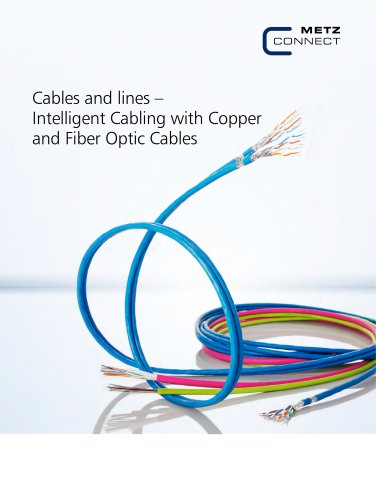
Cables and lines - Intelligent Cabling with Copper and Fiber Optic Cables
The document compares fiber optic and copper data cables for workplace networks, focusing on deployment environment, network technology, and planning horizon. METZ CONNECT provides both cable types to meet local network needs, ensuring future-proof solutions.
METZ CONNECT offers data cables for various applications, emphasizing high transmission performance, electromagnetic compatibility, and fire protection. They provide support for assembly and installation queries.
Modern networks require high speed and transmission capabilities. METZ CONNECT's cables support structured cabling with future-proof features, offering products from Cat.6 to Cat.7A for high transmission speeds.
The document emphasizes the importance of reliable connection technology. METZ CONNECT focuses on creating perfect connections with modern cable concepts.
Various cable types are listed with their bandwidth and category, such as MC GC1300 (10/25 GBit, Cat.7A) and MC GC1000 (10 GBit, Cat.7).
Important cabling standards are outlined, including ISO/IEC and EN standards for different environments. The document also covers the EU Construction Products Directive (CPR), focusing on fire behavior and safety requirements for cables.
- Industrial Applications: Ethernet is prevalent in industrial automation, and METZ CONNECT's cables are suitable for harsh environments.
- Data Centers: Customized solutions are necessary, with fiber technology like OM3, OM4, and OM5 offering high future-proofing.
- Local Area Networks (LAN): High-quality cables support high-speed data transmission in LANs, including Ethernet and Power over Ethernet applications.
The document details fire safety requirements under the EU Construction Products Directive, including CE marking and Euroclasses for fire behavior. It highlights the importance of fire retardant and halogen-free cables for building safety.
The document explains fiber optic technology basics, including signal propagation through total reflection and fiber optic cable structure. It describes multimode fibers for short distances.
- OM1 (62.5/125 µm): Uses LED light, limited transmission distances, gray cladding.
- OM2 (50/125 µm): Uses LED light, longer distances than OM1, orange cladding.
- OM3 (50/125 µm): Improved transmission with VCSEL lasers, aqua cladding.
- OM4 (50/125 µm): Enhanced distances, uses laser light, heather violet cladding.
- OM5 (50/125 µm): Supports wavelength multiplexing, lime green cladding.
- OS2 (9/125 µm): Singlemode fiber, long-distance transmission, yellow cladding.
- Multimode Fibers: OM1 to OM5 support various ranges for standards like 1000 Base-SX, 10GBASE-SR.
- Singlemode Fibers: OS2 supports longer ranges, up to 40,000 m for 10G BASE ER.
- OpDAT Universal Cable: Indoor/outdoor use, LSHF covering, suitable for LAN backbone.
- OpDAT Outdoor Cable: Designed for outdoor use, UV resistant, suitable for direct burial.
- OpDAT Breakout Cable: Indoor use, UV-resistant, suitable for risers and distribution.
- OpDAT Mini Breakout Cable: Indoor use, compact design, suitable for short distance connections.
- OpDAT Industrial Cable: Indoor use, high abrasion resistance, suitable for industrial applications.
- OpDAT Patch Cables: Various configurations for single and duplex connections, suitable for connector assembly.
- Installation Strength: Varies by cable type, with tensile strengths ranging from 60 N to 5000 N.
- Bending Radius: Smallest bending radius during operation ranges from 7.5 mm to 224 mm.
- Temperature Range: Operational temperatures vary, with some cables supporting -40 to +70°C.
- Two Ø 2 mm cables with a common outer sheath and a 900µm solid core each, strain-relieved by aramid yarn.
- Halogen-free and flame-retardant outer sheath.
- Suitable for connector assembly and insensitive to bending.
- Singlemode fiber compliant with ITU-T G.657.A2 and compatible with G.652.D.
- Cable diameter: 5.0 x 2.0 mm, Weight: 18 kg/km.
- Max tensile strength during installation: 120 N.
- Smallest bending radius during operation: 20 mm.
- Transverse compressive strength: 4000 N/dm.
- Temperature range during operation: +30 to +60°C.
- Color options: OM3 aqua, OM4 heather violet, OM5 lime green, OS2 yellow.
- Universal, Outdoor, Breakout, Mini Breakout, and Industry cables available in various fiber types (OM3, OM4, OM5, OS2) and configurations.
- Patch cords available in lengths of 20 m, 50 m, and 100 m.
- 10 GBit Ethernet offers higher bandwidth and performance, requiring full duplex operation and compliance with "Alien-Crosstalk" properties.
- Shielding is essential to suppress Alien Crosstalk and ensure system reserves.
- High-quality components are necessary to maintain transmission safety and electromagnetic compatibility (EMC).
- Shielding improves system reserves by suppressing Alien Crosstalk.
- Coupling loss and coupling resistance are key parameters for assessing shielding effectiveness.
- IEC standards define these parameters for structured cabling.
- Allows power supply up to 100 watts, requiring consideration of cable heating and insertion loss.
- Larger conductor cross-sections and shielded cables recommended for longer distances to minimize heating.
- Copper cables insulated with foam-skin polyethylene, with various shielding options.
- Suitable for primary, secondary, and tertiary structured building cabling.
- Fire-resistant and compliant with multiple international standards.
Copper data cables are detailed with various specifications including outer diameter, fire load, weight, tensile force, bending radius, copper number, operating temperature range, and fire class. The cables are designed with copper wire insulated with polyethylene, stranding 4 pairs to the core, and include pair shielding with pet/aluminum foil and tinned twin wire AWG26. The cable sheath is LSHF (LSOH) and flame retardant according to multiple standards such as EN 60332-1 and IEC 60332-1.
The cables are suitable for data and communication use in secondary and tertiary applications in structured building cabling, adhering to standards like EN 50173-1 and ISO 11801-1. The document also references fire classes such as Cca and Dca, indicating compliance with specific safety standards.
For installation, the bending radius should be ≥ 60 mm, and during operation, it should be ≥ 30 mm. The operating temperature range varies from -20 to +60°C, depending on the cable type.
The document provides a product overview of various cable types, including MC GC1300 pro22, MC GC1000 plus23, MC GC600 F1, MC 550, and MC GC400 SL, with details on bandwidth, class, AWG, cable structure, fire class, pairs, and packing options.
METZ CONNECT offers an online cable configurator for planning and expanding network cable systems. This tool allows users to configure and request structured cabling, providing key information such as article numbers, descriptions, and pricing.
The document lists contact details for METZ CONNECT offices in the USA, France, Austria, China, Hong Kong, and Germany.
Catalog excerpts
Cables and lines -Intelligent Cabling with Copper and Fiber Optic Cables
Open the catalog to page 1
METZ CONNECT – Cables and lines Cable concepts with a perspective The world is becoming more and more networked. Consistent as well as transparent information - available everywhere and at all times - devices that communicate with other devices to depict processes - all of this is increasingly determining our daily lives. All this requires reliable connection technology. Creating perfect connections - that is the core competence of METZ CONNECT. The decision between fiber optic or copper data cables as the ideal solution for the workplace depends on many factors: deployment environment, network...
Open the catalog to page 2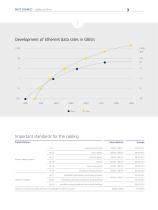
METZ CONNECT – Cables and lines Development of Ethernet data rates in GBit/s 1.000 Important standards for the cabling Standardization General requirements Office spaces Industrial spaces Data centre spaces Distributed building services Installation specification and Quality assurance Generic cabling systems Cabling installation Installation planning and practices inside buildings Installation planning and practices outside buildings Telecommunications bonding networks for buildings and other structures
Open the catalog to page 3
METZ CONNECT – Cables and lines Products and solutions We provide solutions today. For the innovations of tomorrow.
Open the catalog to page 4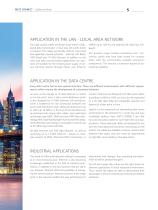
METZ CONNECT - Cables and lines APPLICATION IN THE LAN - LOCAL AREA NETWORK Our high-quality cables are always used where a highspeed data transmission in local area net-works (LAN) is required. The cables are thereby used for structured and application neutral networks - Ethernet 100 BaseT, 1000 BaseT and 10 GBit Ethernet. In addition to the voice and data communication applications our solutions are suitable for the remote power supply of various terminal devices through Power over Ethernet (4PPoE up to 100 W) and HighEnd 4K video (e.g. HD-BaseT). Our product range includes installation and...
Open the catalog to page 5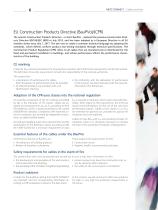
METZ CONNECT - Cables and lines EU Construction Products Directive (BauPVo)/(CPR) The new EU Construction Products Directive - in short BauPVo - replaced the previous Construction Products Directive 89/106/EEC (BPR) in July 2013, and has been adopted as a European Directive in all EU member states since July 1, 2017. The aim was to create a common technical language by adopting the standards, which defines uniform product and testing standards through technical specifications. The Construction Product Regulation (CPR) refers to all cables that are manufactured or distributed for the fixed and...
Open the catalog to page 6
METZ CONNECT - Cables and lines Fire behavior For years, flame retardancy has been one of the minimum requirements for indoor cables. PVC cables are often used. Although they are highly fire retardant they will not prevent the fire spreading. They can even release highly corrosive and toxic gases. High-quality LSHF (FRNC) materials with significantly improved properties offer a proven and future-proof alternative to PVC cables in the event of fire. Innovative cable solutions - for more safety Fire class B2ca Building with a very high security requirement Fire class Cca Building with a high security...
Open the catalog to page 7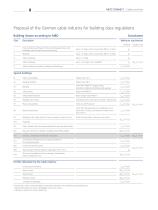
METZ CONNECT - Cables and lines Class Description Euroclasses Minimum requirement Building Escape route Free-standing buildings and free-standing agricultural and buildings used for agriculture and forestry Other buildings Other buildings Other buildings including underground buildings up to 7 m high, with no more than 400 m2 in total up to 7 m high, with no more than 400 m2 in total Special buildings 51 High-rise buildings 56 Building with rooms more than 1600 m2 largest storey, excluding residential buildings and garages Rooms larger than 400 m2 Individual rooms Use with more than 100 persons...
Open the catalog to page 8
METZ CONNECT – Cables and lines
Open the catalog to page 9
Fiber optic
Open the catalog to page 11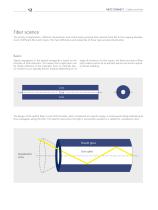
METZ CONNECT – Cables and lines Fiber science The variety of applications, different requirements and continuously growing data volumes have led to the ongoing development of different fiber optic types. The main differences and properties of these types are described below. Basics Signal propagation in the optical waveguide is based on the principle of total reflection. This means that a light beam can be totally reflected at the transition from an optically denser medium to an optically thinner medium depending on its angle of incidence. For this reason, the basic structure of fiber optic cables...
Open the catalog to page 12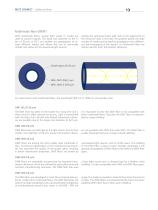
METZ CONNECT – Cables and lines Multimode fiber (MMF) With multimode fibers, several light waves or modes are used to transmit signals. The large core diameter of the fiber of 50 µm or 62.5 µm enables the propagation of several different modes and allows the use of technically simpler and, above all, less expensive light sources. Despite the optimized beam path due to the adjustment of the refractive index in the fiber, the gradient profile the large number of modes quickly leads to propagation time differences and overlapping of the signals, so multimode fibers are mainly used for short transmission...
Open the catalog to page 13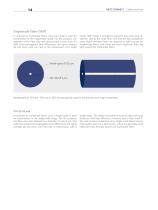
METZ CONNECT – Cables and lines Singlemode fibers (SMF) In contrast to multimode fibers, only one mode is used for transmission in the singlemode range. For this purpose, the diameter of the fiber core was reduced and is only 9 µm for SMF. Since propagation time differences and signal overlaps do not occur until very late in the transmission of a single mode, SMF makes it possible to transmit data over long distances. Due to the small fiber core and the low acceptance cone, highly efficient lasers are required as light sources for singlemode fibers, and these are more expensive than the light...
Open the catalog to page 14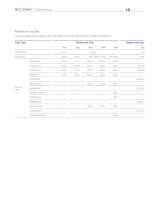
METZ CONNECT - Cables and lines These are approximate figures, they may differ from fiber manufacturer to fiber manufacturer. Core diameter Sheath color orange orange aqua heather violet lime green 900 m 1.000 m 1.100 m
Open the catalog to page 15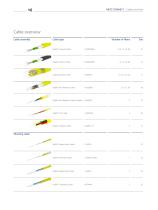
METZ CONNECT – Cables and lines Cable overview Cable assembly Cable type OpDAT Mini Breakout Cable Compact I-VQ(ZN)H OpDAT FITH-Cable OpDAT Industrial Cable OpDAT Simplex Patch Cable OpDAT FITH Patch Cable I-V(ZN)H (weiß) OpDAT Duplex Patch Cable OpDAT Connecting Cable OpDAT Universal Cable OpDAT Outdoor Cable OpDAT Breakout Cable OpDAT Mini Breakout Cable Shunting cable
Open the catalog to page 16All METZ CONNECT catalogs and technical brochures
 RJ45 field plug pro
6 Pages










Archived catalogs
- METZ CONNECT data connector
- METZ CONNECT metal connector
- Data logger
- METZ CONNECT digital I/O
- Polymer connector
- Plastic housing
- Wall-mount box
- METZ CONNECT terminal block
- METZ CONNECT I/O module
- METZ CONNECT female connector
- Terminal box
- Industrial connector
- Industrial housing
- METZ CONNECT IP67 connector
- Rectangular connector
- METZ CONNECT analog I/O
- METZ CONNECT digital I/O module
- METZ CONNECT cable connector
- Straight connector