
- Catalogs
- METTLER TOLEDO
- TMA/SDTA 2+


- Company
- Products
- Catalogs
- News & Trends
- Exhibitions
TMA/SDTA 2+
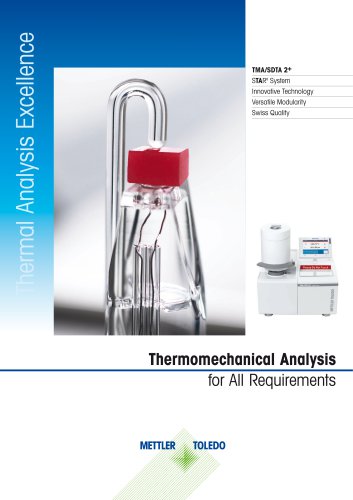
TMA/SDTA 2+
Thermomechanical analysis (TMA) measures dimensional changes in materials as temperature varies, providing insights into thermal expansion, softening, crystallization, and solid-solid transitions. The METTLER TOLEDO TMA/SDTA 2+ system offers advanced features for precise measurements.
- Temperature range: –150 to 1600 °C.
- Simultaneous thermal effects measurement with SDTA.
- OneClick™ functionality for efficient sample measurement.
- Nanometer resolution for small dimensional changes.
- Dynamic load TMA (DLTMA) mode for weak transitions and elasticity.
- Modular design for future expansion and integration with other techniques.
- Sample robot with 20 positions for increased throughput.
The TMA/SDTA 2+ features Swiss precision mechanics for outstanding measurement performance, available in four versions optimized for different temperature ranges, with a unique SDTA sensor for accurate temperature measurements.
The system offers easy sample insertion, various sample holders, and measuring probes for different applications. It supports deformation modes such as penetration, swelling, tension, and volume expansion, with options for cooling using liquid nitrogen or an IntraCooler.
The TMA/SDTA 2+ is suitable for analyzing polymers, ceramics, and composites, measuring properties like viscoelastic behavior, glass transition, and expansion coefficients. It is particularly useful for materials with high filler content and characterizing glass transitions in thin coatings.
- Printed circuit boards (PCBs) analysis for glass transition temperature and stability.
- Creep behavior of elastomers and the effect of vulcanization.
- Moisture-induced curing reactions and high-performance ceramics analysis.
- Solid-solid transitions and coefficient of thermal expansion (CTE) determination.
A diagram shows swelling curves of four elastomers in toluene at 30°C. Fluoroelastomers (FPM) exhibit minimal swelling, making them suitable as sealants, while silicone rubber (MQ) swells significantly.
The STARe software enhances the TMA/SDTA 2+ functionality, allowing for experiment preparation, method development, and flexible result evaluations. It supports DLTMA measurements for detailed viscoelastic property information.
The STARe DataBase securely archives records, protecting raw data from deletion or modification, with filtering options by sample name, date, and user.
TMA is primarily used to determine the coefficient of thermal expansion (CTE), with STARe offering functions for accurate CTE calculation and evaluation.
METTLER TOLEDO provides training courses, e-training, and a library of videos and applications to enhance user productivity, ensuring continuous performance and reliability of thermal analysis systems.
The document details the TMA/SDTA 2+ specifications, including temperature ranges, accuracy, reproducibility, and force data, along with approvals and conformity marks for compliance with international standards.
The TMA/SDTA 2+ is a versatile instrument for thermal analysis, supported by robust software and comprehensive service offerings, suitable for various industrial applications.
Catalog excerpts
Thermal Analysis Excellence TMA/SDTA 2+ STARe System Innovative Technology Versatile Modularity Swiss Quality Thermomechanical Analysis for All Requirements
Open the catalog to page 1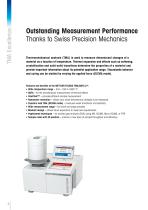
Outstanding Measurement PerformanceThanks to Swiss Precision Mechanics Thermomechanical analysis (TMA) is used to measure dimensional changes of a material as a function of temperature. Thermal expansion and effects such as softening, crystallization and solid-solid transitions determine the properties of a material and provide important information about its potential application range. Viscoelastic behavior and curing can be studied by varying the applied force (DLTMA mode). Features and benefits of the METTLER TOLEDO TMA/SDTA 2+: • Wide temperature range - from -150 to 1600 °C • SDTA - for...
Open the catalog to page 2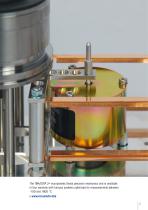
The TMA/SDTA 2+ incorporates Swiss precision mechanics and is available in four versions with furnace systems optimized for measurements between –150 and 1600 °C. www.mt.com/ta-tma 3
Open the catalog to page 3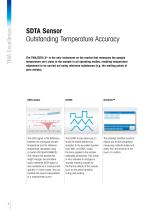
SDTA SensorOutstanding Temperature Accuracy The TMA/SDTA 2+ is the only instrument on the market that measures the sample temperature very close to the sample in all operating modes, enabling temperature adjustment to be carried out using reference substances (e.g. the melting points of pure metals). SDTA sensor DLTMA n_n_AAA OneClick™ The SDTA signal is the difference between the measured sample temperature and the reference temperature calculated using a model (US Patent 6146013). This means that besides the length change, the simultaneously measured SDTA signal is also available as a measurement...
Open the catalog to page 4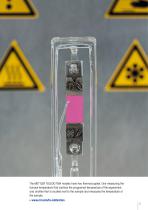
The METTLER TOLEDO TMA models have two thermocouples: One measuring the furnace temperature that controls the programed temperature of the experiment, and another that is located next to the sample and measures the temperature of the sample. www.mt.com/ta-calibration 5
Open the catalog to page 5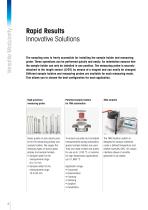
Versatile Modularity Rapid ResultsInnovative Solutions The sampling area is freely accessible for installing the sample holder and measuring probe. These operations can be performed quickly and easily. An indentation ensures that the sample holder can only be installed in one position. The measuring probe is securely attached to the length sensor (LVDT) by means of a magnet and can easily be changed. Different sample holders and measuring probes are available for each measuring mode. This allows you to choose the best configuration for each application. Patented sample holders for TMA automation...
Open the catalog to page 6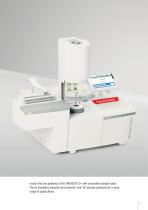
Unlock the true potential of the TMA/SDTA 2+ with innovative sample robot. This is incredibly versatile and powerful, with 20 sample positions for a wide range of applications.
Open the catalog to page 7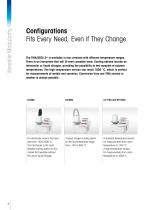
Configurations Fits Every Need, Even if They Change The TMA/SDTA 2+ is available is four versions with different temperature ranges. There is an instrument that will fit every possible need. Cooling options include an Intracooler or liquid nitrogen, providing the possibility to test samples at subzero temperatures. The high temperature version can reach 1600 °C, which is perfect for measurements of metals and ceramics. Conversion from one TMA version to another is always possible. An IntraCooler version that operates from –80 to 600 °C. The IntraCooler is the most effective cooling option on...
Open the catalog to page 8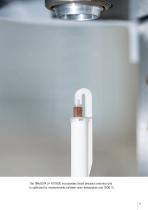
The TMA/SDTA 2+ HT/1600 incorporates Swiss precision ceramics and is optimized for measurements between room temperature and 1600 °C.
Open the catalog to page 9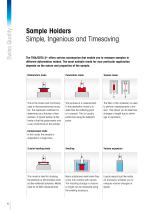
Swiss Quality Sample HoldersSimple, Ingenious and TimesavingThe TMA/SDTA 2+ offers various accessories that enable you to measure samples in different deformation modes. The most suitable mode for your particular application depends on the nature and properties of the sample.Dilatometric mode This is the mode most commonly used in thermomechanical analysis. The expansion coefficient is determined as a function of temperature. A typical feature of this mode is that the probe exerts only a very small force on the sample. Compression mode In this mode, the sample is subjected to a large force. 3-point...
Open the catalog to page 10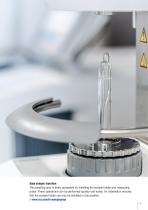
Easy sample insertion The sampling area is freely accessible for installing the sample holder and measuring probe. These operations can be performed quickly and easily. An indentation ensures that the sample holder can only be installed in one position. www.mt.com/ta-sampleprep 11
Open the catalog to page 11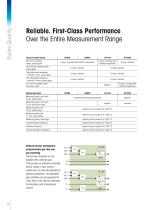
Swiss Quality Reliable. First-Class PerformanceOver the Entire Measurement Range Types of sample holder Defined furnace atmosphere, programmable gas flow and gas switching. The furnace chamber can be purged with a defined gas. This process is software controlled, which makes it very easy to switch from an inert atmosphere to reactive conditions. The standard gas controler can be upgraded to a GC 302 or GC 402 for improved functionality and atmosphere control.
Open the catalog to page 12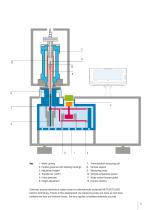
7. Thermostatted measuring cell 10. Sample temperature sensor 11. Water-cooled furnace jacket 2. Parallel guidance with bending bearings Extremely precise mechanical system based on internationally acclaimed METTLER TOLEDO balance technology. Thanks to this development, the measuring probe can move up and down perfectly free from any frictional forces. The force applied is therefore extremely accurate.
Open the catalog to page 13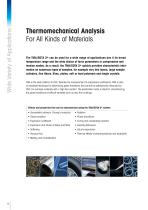
Wide Variety of Applications Thermomechanical AnalysisFor All Kinds of Materials The TMA/SDTA 2+ can be used for a wide range of applications due it its broad temperature range and the wide choice of force parameters in compression and tension modes. As a result, the TMA/SDTA 2+ quickly provides characteristic information on numerous types of samples, for example very thin layers, large sample cylinders, fine fibers, films, plates, soft or hard polymers and single crystals. TMA is the ideal addition to DSC. Besides the measurement of expansions coefficients, TMA is also an excellent technique...
Open the catalog to page 14
Thermomechanical analysis (TMA) is used to measure the dimensional changes of a material as a function of temperature. TMA allows you to determine expansion coefficients and softening temperatures, as well as measure relaxation effects that are often not detected by other thermal analysis techniques. www.mt.com/ta-applications 15
Open the catalog to page 15All METTLER TOLEDO catalogs and technical brochures
 LE740
1 Page
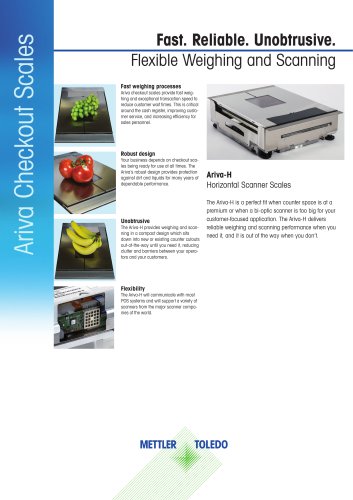 Ariva-H
2 Pages
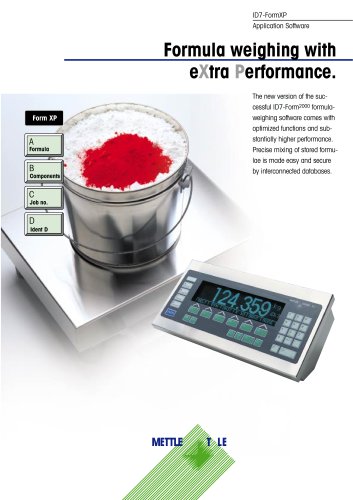 ID7-FormXP
4 Pages
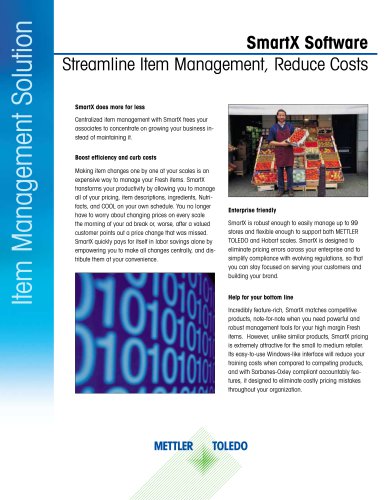 SmartX Software
4 Pages
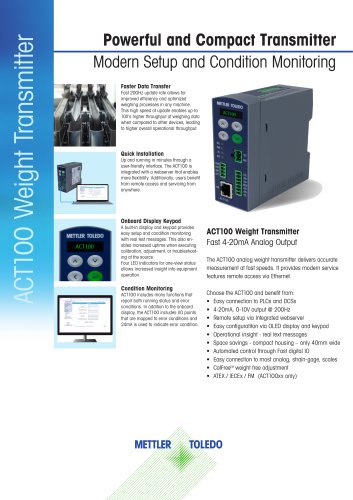 ACT100 Weight Transmitter
3 Pages
 InPro 6000 Sensor Series
12 Pages
 Portable pH Meter Pro2Go
4 Pages
 InPro® 3100 / InPro® 3100UD
4 Pages
 IND690batch
4 Pages
Archived catalogs
 C-Series Checkweighers
6 Pages
 Industrial Weighing Catalog
136 Pages
 Weighing Component Catalog
272 Pages
 Compact Weighing Systems
20 Pages
 Validation Support
12 Pages
 eBook: Connected Weighing
12 Pages
 ACT100 Weight Transmitter
2 Pages


- Force sensor
- Measuring device
- Mettler Toledo gas analyzer
- Mettler Toledo concentration analyzer
- Monitoring analyzer
- Management software solution
- Automation software solution
- Analysis software solution
- Mettler Toledo liquids analyzer
- Process software
- Tension/compression force transducer
- Automatic analyser
- Steel load cell
- Strain gauge force sensor
- Mettler Toledo benchtop analyzer
- Solids analyser
- Mettler Toledo digital scale
- Stainless steel force transducer
- Gas detector
- Process analyzer