
- Catalogs
- Metso Corporation
- Fluid Beds and Rotary Dryers and Coolers Brochure

- Company
- Products
- Catalogs
- News & Trends
- Exhibitions
Fluid Beds and Rotary Dryers and Coolers Brochure

Fluid Beds and Rotary Dryers and Coolers Brochure
Drying is a critical process in various industries, involving the removal of water from solids, liquids, or gases. Efficient drying systems are essential for successful process design and implementation. The primary methods for water removal include mechanical means and thermal processing equipment.
Rotary Dryers
Rotary dryers are cylindrical shells that are slightly inclined and supported by riding rings. They are versatile, capable of handling materials with varying sizes and compositions. Key design factors include dryer diameter, lifter design, and flow configuration (parallel or counterflow). Metso's patented rotary air seal enhances thermal efficiency by preventing leakage.
Fluid Bed Dryers
Fluidized beds involve finely divided solids through which gas passes, creating a state similar to a boiling liquid. This method ensures thorough mixing and uniform temperature conditions, preventing overheating. Metso's entrainment dryer incorporates fluid bed technology for longer residence times and reduced build-up.
Indirect Drying Systems
Indirect systems are used when materials cannot contact combustion gases. These include steam tube dryers, indirect fired rotary kilns, and indirect fluid bed dryers. They transfer heat through radiation or steam tubes, suitable for fine materials.
Coolers
Drying systems can also function as coolers using ambient air or cooling water. Metso classifies coolers into direct air swept, water-cooled shell, and water tube types.
Materials Processed
Metso has extensive experience with over 400 different materials, ensuring better performance and easier maintenance. Materials may behave differently during drying, requiring specific handling and drying techniques.
Conclusion
Metso provides both separate drying units and complete systems, offering process and mechanical warranties for unmatched performance. Their experience and database of material handling characteristics contribute to efficient plant design.
Catalog excerpts
Fluid beds and rotary dryers and coolers
Open the catalog to page 1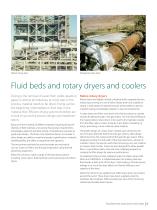
Potash rotary dryer Phosphate rotary dryer Fluid beds and rotary dryers and coolers Drying is the removal of water from solids, liquids or Metso rotary dryers Rotary dryers are slightly inclined cylindrical shells supported by two gases. In almost all industries, at some step in the riding rings running on a set of rollers. Rotary dryers are suitable for process, material needs to be dried. Drying can be drying a wide range of materials because of their ability to process the beginning, intermediate or final step in the materials having considerable variation in size and composition. material...
Open the catalog to page 2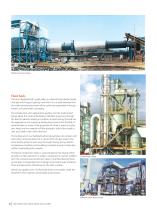
Nickel ore rotary dryer Fluid beds The term “fluidized bed” usually refers to a bed of finely divided solids through which a gas is passing and which is in a state between that of a static bed and one where all the solids are suspended in the gas stream, as in pneumatic conveying. The introduction of an appropriate gas flow into the material bed brings about the onset of fluidization. Bubbles of gas pass through the bed of material creating a condition of rapid mixing. The bed has the appearance of a vigorously boiling liquid, and in fact the bed of material takes on many of the properties of...
Open the catalog to page 3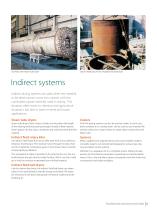
Stainless steel steam tube dryer Steam heated aluminum hydrate fluid bed dryer. Indirect systems Indirect drying systems are used when the material to be dried cannot come into contact with the combustion gases normally used in drying. This situation often exists in chemical and agricultural situations, but also in some mineral and waste applications. Steam tube dryers Steam tube dryers have a series of tubes running down the length of the rotating shell and passing through the bed of feed material. Steam passes into the tubes, condenses and uniformly heats the feed material. All of the drying...
Open the catalog to page 4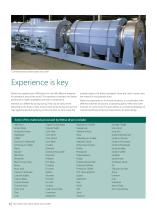
Combined rotary indirect dryer and cooler Experience is key Metso has supplied over 4,000 dryers for over 400 different materials for operations around the world. This experience translates into better performance, higher availability and easier maintenance. Materials act differently during drying. They may be sticky when being fed to the dryer, or they may become sticky during drying. They may agglomerate during drying, or become dust. In some cases the material needs to be dried completely, “bone dry”, and in some cases the material is only partially dried. Metso has experience in all of these...
Open the catalog to page 5
• Metso Minerals Industries Inc. 350 Railroad Street, Danville, PA 17821-2046, USA, Phone: +1 570 275 3050, Fax: +1 570 275 6789 • Metso Minerals Industries, Inc. 2715 Pleasent Valley Road, York, PA 17402, USA, Phone: +1 717 843 8671 • etso Minerals (South Africa) (Pty) Ltd. M Private Bag X2006, Isando, Johannesburg,1600, South Africa, Phone: +27 11 961 4000, Fax: +27 11 397 2050 • Metso Minerals (Australia) Ltd. Level 2, 1110 Hay Street, West Perth, WA 6005, Australia, Phone: +61 8 9420 5555, Fax: +61 8 9320 2500 • Metso Minerals (India) Pvt Ltd 1th floor, DLF Building No. 10, Tower A, DLF Cyber...
Open the catalog to page 6All Metso Corporation catalogs and technical brochures
 RCSTM flotation cell
8 Pages
 MHC™ Series Hydrocyclone
5 Pages
 Superdeal® and Goodeal
6 Pages
 Metso Vertimills®
12 Pages
 HRC™
HRC™7 Pages
 Nordtrack™ mobile solutions
36 Pages
 Microcel™
6 Pages
 Nordberg® HP900
2 Pages
 Metso Air Classifiers
4 Pages
 Trellex FLEXOPIPE® Brochure
8 Pages
 Conveyor Belts Solutions Handbook
158 Pages
 Trellex Poly-Cer Brochure
9 Pages
 Trellex SQ300 Brochure
4 Pages
 Belt Feeders Brochure
4 Pages
 Wobble Feeders Brochure
4 Pages
 Apron Feeders Brochure
8 Pages
 Balance Crane Brochure
8 Pages
 Pebble Lime Cooler Brochure
4 Pages
 Spiral Dewaterer Brochure
8 Pages
 Tube Press Brochure
8 Pages
 Metso in Filtration
8 Pages
 LIMS Programs Brochure
4 Pages
 LIMS Wet Drum Iron Ore Brochure
12 Pages
 Metso Ball Mills Brochure
3 Pages
 Metso QdX4TM Mill Brochure
4 Pages
 Minerals processing equipment
24 Pages


- Rail conveyor
- Kiln
- Transport rail conveyor
- Heat treatment kiln
- Belt conveyor
- Metso mill
- Metso crusher
- Horizontal conveyor
- Solids separator
- Metso screener
- Feeder
- Drying kiln
- Metso bulk material screener
- Centrifugal classifier
- Roller conveyor
- Metso stationary crusher
- Liquids separator
- Mobile crushing plant
- Combustion kiln
- Inclined conveyor