
- Catalogs
- Metso Automation
- Slurry pump basic


- Products
- Catalogs
- News & Trends
- Exhibitions
Slurry pump basic

Slurry pump basic
This document provides guidelines for slurry pumping, focusing on the Metso PumpDim™ software for pump sizing. It covers hydraulic transportation of solids, types of solids and liquids, and slurry flow limitations.
Slurry pumps are defined by their purpose, naming conventions, and considerations for dry or semi-dry operations. Wear conditions affecting slurry pumps are also discussed.
The document details slurry pump components, focusing on impeller and casing designs, including vane numbers and configurations.
It addresses abrasion and erosion effects on pump components, options for wear protection, and material selection based on particle size.
Critical parameters for seal selection are outlined, including types of leakage and seal locations, with discussions on flushing and non-flushing seals.
The document covers transmission designs, shaft factors, bearing life, configurations, and selection criteria.
It discusses indirect and direct drives, V-belt transmissions, and variable speed drives, including limitations and considerations for combustion engine drives.
Hydraulic performance is analyzed through pump curves, affinity laws, and performance corrections for settling and non-settling slurries.
The document describes the pipe system, friction losses, and velocity calculations, covering sump arrangements and multiple-pump installations.
This section covers viscosity basics, including apparent viscosity and non-Newtonian fluids, providing foundational knowledge for fluid dynamics.
The BEP section discusses hydraulic effects of operating at the efficiency point, including radial and axial loads.
This part introduces the Metso Minerals Slurry Pump program, detailing nomenclature and features for abrasive duties and slurry seals.
Detailed descriptions of various slurry pump types and configurations, including frame and wet-end modular configurations.
The application guide provides selection criteria for pumps based on duty, industrial application, and slurry type.
Slurry pumps have evolved significantly, initially developed by companies like Denver and Sala, now part of Metso.
Hydraulic transportation of solids is crucial in wet industrial processes, with slurry flows ranging from 1 m3/hour to 20,000 m3/hour.
Slurry pumps are robust centrifugal pumps designed for handling abrasive materials, categorized by the type of solids they handle.
Slurry pumps operate under harsh conditions, with key components including the impeller, casing, sealing arrangement, bearing assembly, and drive.
This document provides a comprehensive overview of slurry pumps, their history, applications, and mechanical design.
Slurry pump impellers are designed with external and internal vanes, with two main vane designs: Francis and Plain.
More vanes generally result in higher efficiency, with a practical maximum of five vanes for metal impellers over 300 mm.
Closed impellers are more efficient than open ones but are prone to clogging with coarse particles.
The diameter affects the head produced, while the width governs the flow rate.
The casing converts flow from the impeller into a desirable pattern and reduces flow velocity.
Wear in slurry pumps is caused by abrasion, erosion, and corrosion, with material selection based on factors like particle size and slurry temperature.
Hard metals like high chrome iron are used for coarse materials, while elastomers like natural rubber are cost-effective for fine solids.
Seals in slurry pumps vary based on parameters like slurry leakage, air leakage, shaft deflection, and inlet head.
The document provides a comprehensive guide on slurry pumps, focusing on shaft seals, bearings, drives, and hydraulic performance.
Shaft seals are crucial in preventing leakage where the shaft enters the pump casing, with three main types: soft packing, mechanical, and dynamic seals.
Flushing seals typically use clear water to extend seal life, with two flushing options: full flow and low flow.
Centrifugal seals, or expellers, provide a reliable seal without flush water, effective only when the pump is running.
Mechanical seals are essential for submersible pumps and require a rigid shaft and bearing arrangement for successful operation.
The document discusses the design of shafts and bearings in slurry pumps, emphasizing robust shaft design due to higher loads.
Two basic drive designs are outlined: indirect drives for horizontal and vertical pumps and direct drives for submersible pumps.
Understanding the hydraulic performance of slurry pumps is crucial, with pump curves illustrating performance.
When altering pump speed or impeller diameter, flow rate, head, and power are affected, with efficiency remaining approximately constant.
Pump performance curves require corrections for slurries, categorized as settling or non-settling.
Understanding the difference between head and pressure is crucial, with centrifugal pumps generating head, not pressure.
NPSH is the required pressure on the suction side to prevent cavitation.
Cavitation occurs when local pressure drops to vapor pressure, causing vapor bubbles that can damage the pump.
Maximum suction lift is calculated as atmospheric pressure minus NPSHR and vapor pressure.
Froth affects hydraulic performance by trapping air, which can block slurry flow.
Consider hydraulic losses in the system, with the duty point where the pump performance curve intersects the system head curve.
Friction losses in pipes depend on diameter, length, material, and flow rate.
This document provides technical guidelines and specifications for slurry pump systems, focusing on friction losses and pump configurations.
Friction losses in systems with valves and fittings are calculated using the "Equivalent pipe length" method.
Slurry systems require careful calculation of friction losses, varying based on slurry type.
Guidelines for designing pump sumps include maintaining a minimum angle for sump bottoms.
Multiple pumps are used when a single pump cannot meet head or flow requirements.
Viscosity affects slurry flow and pump performance, with accurate measurements crucial for calculations.
The BEP is the optimal operating point for slurry pumps, minimizing radial and axial loads.
The document outlines various types of slurry pumps, including horizontal and vertical configurations.
Accurate calculation of system losses and proper pump selection are essential for efficient slurry pump operation.
This document provides a comprehensive technical description of various slurry pump models and their features.
Pumps are designed to fit specific applications with adjustable stationary seal rings and high-tech silicon carbide seal faces.
Emphasis on high efficiency, minimized solids effect, and new wear materials for long life and low maintenance costs.
Detailed descriptions of pump series like XM, Thomas, Vasa HD and XR, Orion, and Sala.
Detailed charts provide dimensions, weight, and performance metrics for each pump model.
Inlet and outlet sizes, weight, and dimensions for each pump model are specified.
The document outlines the technical specifications and design features of Metso's slurry pumps.
Integrated unit combining pump, sump, and motor for flexible layout and easy installation.
The VF pumps enhance the pumpability of frothy suspensions by separating air from slurry.
Example: VF 100 indicates the pump range and outlet size in mm.
Various models with specific dimensions, weights, and sump volumes.
Simple installation with cantilever design, no submerged bearings or shaft seal.
Example: VS 100 indicates the pump range and outlet size in mm.
Models like VS25, VS50 with specific dimensions and weights.
BA and BF seals designed for light to medium slurry duties.
Double seal type BA requires sealing liquid pressure 1-2 bar above pump discharge pressure.
Cantilever design with no journal bearings below liquid level.
The document provides detailed technical descriptions of various pump series.
The document provides a detailed technical description of the Sala series of horizontal torque flow pumps, type STHM.
The STHM pumps come with specifications for dimensions, motor weight, and impeller types.
This section guides the selection of the correct slurry pump range for various applications.
The document provides detailed recommendations for selecting pumps based on specific duties.
This section offers practical guidance based on experience from various industrial segments.
Use metal pumps for coarse particles and high head applications; use rubber pumps for fine and sharp particles.
Recommendations for various industries like coal, waste & recycling, power & FGd, pulp & paper, metallurgy, chemical, and mining.
Steps for determining slurry type, setting up duty details, and selecting the right pump and motor size.
The PumpDim™ software is used for sizing and selecting Metso’s pumps.
This document provides an overview of the Metso PumpDim™ software, used for calculating actual flow through existing installations.
The software is designed for settling slurries with normal particle size and distribution.
The software is proprietary to Metso and must be returned upon request.
A registration form is provided for users to fill out and send to their local Metso office.
The document includes various conversion factors and pulp density data.
Catalog excerpts

Slurry Pump Basic Basic guidelines in slurry pumping Introducing the pump sizing software - Metso PumpDim™ for Windows™
Open the catalog to page 1
Published by Metso Minerals (Sweden) AB S-733 25 Sala, Sweden Telephone +46 224 570 00 Telefax +46 224 169 50
Open the catalog to page 2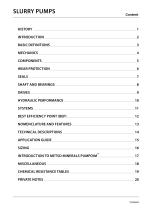
SLURRY PUMPS HISTORY 1 INTRODUCTION 2 basic definitions components 5 wear protection seals 7 shaft and bearings drives 9 hydraulic performance SYSTEMS 11 BEST EFFICIENCY POINT (BEP) technical descriptions application guide sizing 16 introduction to METSO MINERALS pumpdim™ 17 Miscellaneous 18 Chemical resistance tables Private notes
Open the catalog to page 3
1. HISTORY Slurry Pumps – history Whilst Denver and Sala, later forming business area Pumps & Process within the Svedala Group (which in September 2001 became Metso), were both very active in Slurry Pumping, they did not originally offer their own pump designs. Both companies started as mineral process equipment manufacturers. Denver concentrating on flotation as the key product and Sala offering both flotation and magnetic separation as their major products. Following a period of success with mineral processing equipment, it soon became very obvious that there was an urgent need to become active...
Open the catalog to page 11
Horizontal Slurry Pumps Slurry Pumping, being the foundation of all wet mineral processing, was becoming more and more important to customers of both Denver and Sala. Denver’s answer was to take on a licence for the Allis Chalmers design of the SRL (Soft Rubber Lined) Slurry Pump. The developed version of this pump was the foundation for Denver’s Slurry Pump programme for many decades and is still considered by many to be an industry standard. In 1984 Denver acquired the Orion hard metal Slurry Pump range, which, in parallel with the SRL, has been developed over the years; both designs complementing...
Open the catalog to page 12
Vertical Sump and Tank Pumps As many plant floors were flooded, customers also tried to develop a pump concept able to cope with the work of keeping the plant floor clean of slurry. Accordingly, the ”sump pump” was developed. The birth of the first operational sump pump for these clean up purposes was in the mid 40’s, again designed specifically to meet a need. Both the vertical tank pump and the vertical sump pump were developed within the Boliden Mining Company throughout the 40’s. Sala was a regular supplier of these pumps to Boliden on a subcontract basis, until 1950 when Sala signed an agreement...
Open the catalog to page 13
2. INTRODUCTION Hydraulic transportation of solids In all wet industrial processes ”hydraulic transportation of solids” is a technology, moving the process forward between the different stages of Solid/ Liquid mixing, Solid/ Solid separation, Solid/ Liquid separation, etc. These wet industrial processes are further described in section 15. What type of solids? Solids can be almost anything that is Hard Coarse Heavy Abrasive Crystalline Sharp Sticky Flaky Long Fibrous Frothy You name it - it can be transported hydraulically ! What type of liquids? In most applications the liquid is only the...
Open the catalog to page 15
What are the limitations in flow? In theory there are no limits to what can be hydraulically transported. Just look at the performance of hydraulic transportation of solids in connection with the glaciers and the big rivers! In practice the limitations in flow for a Slurry Pump installation are from 1 m3/hour up to 20 000 m3/hour. The lower limit is determined by the efficiency drop for smaller pumps. The higher limit is determined by the dramatic increase of costs for large Slurry Pumps (compared with multiple pump installations). What are the limitations for solids? The limitation for the solids...
Open the catalog to page 16
3. Basic definitions Why Slurry Pumps? By definition Slurry Pumps are a heavy and robust version of a centrifugal pump, capable of handling tough and abrasive duties. ”Slurry Pump should also be considered as a generic term, to distinguish it from other centrifugal pumps mainly intended for clear liquids”. Slurry Pump – name by duty The term Slurry Pump, as stated, covers various types of heavy duty centrifugal pumps used for hydraulic transportation of solids. A more precise terminology is to use the classification of solids handled in the various pump applications. Slurry Pumps cover pumping...
Open the catalog to page 19
Slurry Pump – dry or semi dry? Dry installations Most horizontal Slurry Pumps are installed dry, where the drive and bearings are kept out of the slurry and the ”wet end” is closed. The pumps are free standing, clear from surrounding liquid. The vertical Tank pump has an open sump with the pump casing mounted directly to the underside of the tank. The cantilever impeller shaft, with its bearing housing and drive mounted on the tank top, rotates the impeller inside the pump casing. The slurry is fed from the tank into the “wet end” around the shaft and is discharged horizontally from the outlet....
Open the catalog to page 20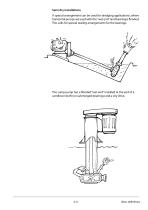
Semi dry installations A special arrangement can be used for dredging applications ,where horizontal pumps are used with the ”wet end” (and bearings) flooded. This calls for special sealing arrangements for the bearings. The sump pump has a flooded “wet end” installed at the end of a cantilever shaft (no submerged bearings) and a dry drive. Basic definitions
Open the catalog to page 21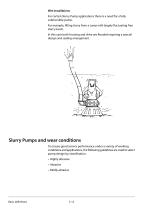
Wet installations For certain Slurry Pump applications there is a need for a fully submersible pump. For example, lifting slurry from a sump with largely fluctuating free slurry levels. In this case both housing and drive are flooded requiring a special design and sealing arrangement. Slurry Pumps and wear conditions To ensure good service performance under a variety of working conditions and applications, the following guidelines are used to select pump design by classification. • Highly abrasive • Abrasive • Mildly abrasive Basic definitions
Open the catalog to page 22
Summary: All pumps in the Slurry Pump range are centrifugal pumps! “Slurry Pump” is a generic definition! All Slurry Pumps are in practice named after the given application: • Slurry Pumps • Gravel pumps • Dredge pumps • Sump pumps • Froth pumps • Carbon Transfer pumps • Submersible pumps There are principally three different designs: • Horizontal and vertical tank (dry installation) • Vertical sump (semi dry installation) Slurry Pump designs are selected and supplied according to the wear conditions • Highly abrasive • Abrasive • Mildly abrasive Basic definitions
Open the catalog to page 23All Metso Automation catalogs and technical brochures
 Metallrecycling-Services
12 Pages
 EtaCrush® series
1 Page
 more capability brochure
4 Pages
 Neles Flow Control Solutions
12 Pages
 Crushing and screening solutions
51 Pages
 Primary gyratory stations
9 Pages
 Process Capacity IPS
6 Pages
 Slurry Hose System
20 Pages
 Mill discharge pumps
8 Pages
 STGVA - STHM
8 Pages
 Metso Slurry Pump program
16 Pages
 Vasa HD
4 Pages
 Metso Balance Cranes (MBC)
8 Pages
 Aftermarket Training
2 Pages
 Hot Kiln Survey
2 Pages
 Holo-Flite®
8 Pages
 Dryers and Coolers
6 Pages
 Coke Calcining Systems
8 Pages
 Metso pebble lime cooler
4 Pages
 Spiral Dewaterers
8 Pages
 LIMS dry drum
4 Pages
 HGMS cyclic
5 Pages
 HGMS
HGMS12 Pages
 HGMS Continuous
8 Pages
 HGMF
HGMF8 Pages
 LIMS iron ore
12 Pages
 IPS LTK
1 Page
 Inclined Plate Settler
8 Pages
 Microcel Flotation Columns
6 Pages
 Flotation Machines DR
8 Pages
 Feed Forward for Flotation
2 Pages
 Flotation Machines RCS
8 Pages
 Tube press
8 Pages
 Tube press booster range
8 Pages
 Metso in filtration
8 Pages
 High efficiency cyclones
2 Pages
 Air Classifiers
4 Pages
 Gearless AG/SAG Mills
2 Pages
 Vertimill for limeslaking
2 Pages
 Grinding and enrichment
12 Pages
 Flue Gas Desulfurization
4 Pages
 Ball mills
2 Pages
 Apron feeders
8 Pages
 Wobbler feeders
4 Pages
 Lokotrack CT3.2 and CW3
2 Pages
 HRC 800
8 Pages
 MP1250 Cone crusher
6 Pages
 Metso screening media
114 Pages
 Trellex dust control
8 Pages
 Metso lining and sheeting
44 Pages
 Trellex wear lining solutions
16 Pages
 Trellex PSV conveyor rollers
4 Pages
 Trellex flexopipe
8 Pages
 Trellex belt cleaning
12 Pages
 Trellex loading stations
8 Pages
 Trellex Cer-Lag
4 Pages
 Trellex belt guiding system
8 Pages
 Trellex conveyor accessories
12 Pages
 Jamesbury Valve Solutions
28 Pages
 Actuator
2 Pages
 Chlorine
4 Pages
 Metso DNA Drive Controls
2 Pages
 Flow control solutions
12 Pages


Archived catalogs
 MetsoPulpExpert_brochure
8 Pages
 Metso_FS300_brochure
4 Pages
 Alkali Analyser
4 Pages
 SmartLX
6 Pages
 Neles SwitchGuard
6 Pages
 Pneumatic Actuator
10 Pages
 Series 3000 Ball Valves
4 Pages
 TheArtOfConsistency_brochure
8 Pages
 Butterfly Valves
20 Pages
 Metso_MCA_brochure
6 Pages
 Neles Manual Gear Actuators
2 Pages
 Actuator Accessories
2 Pages


