
- Catalogs
- Metso Automation
- Process Capacity IPS


- Products
- Catalogs
- News & Trends
- Exhibitions
Process Capacity IPS

Process Capacity IPS
The document explores sedimentation as a method for solid/liquid separation in mechanical process engineering. It is used to sort solids by particle size or material density, with water typically serving as the liquid phase. An example is potash processing, where potassium chloride is thickened from a saturated salt solution using inclined plate settlers. Currently, three new Setl-type settlers are being installed at the Werra Works of K+S Kali GmbH by Metso Minerals.
Potash mining in the Werra Valley began at the end of the Palaeozoic era, with significant developments in the late 19th century. The potash seams in Hesse and Thuringia led to a mining boom. K+S Kali GmbH now operates six potash mines in Germany, contributing 13% to global potash and magnesium fertilizer production.
K+S produces over ten inorganic fertilizers from crude potash, containing potassium, magnesium, sodium, and sulfur. Separation of materials is achieved through hot dissolution, flotation, and electrostatic separation. The hot dissolution process at Unterbreizbach relies on the differing solubility of sodium chloride and potassium chloride in water.
Inclined plate settlers increase settling efficiency by stacking several settling levels, allowing liquid to flow upwards and particles to settle onto plate surfaces. This method is more space-efficient than traditional circular thickeners.
Inclined plate settlers are constructed from reinforced polypropylene or ABS, with plates inclined at 55° and spaced 50 or 100 mm apart. Available in four sizes, they offer settling areas between 110 and 260 m². The tanks are circular, with a diameter of 10.5 m and a height of 6 m, capable of buffering 240 m³ of sludge.
The slurry enters settling channels through slotted feed ports, initiating thickening. Clarification occurs in the calmed flow zone above these ports. Overflow apertures create a pressure gradient for slurry distribution and laminar flow. A 4 kW motor-driven rake system moves sediment to the tank center for discharge.
High corrosion protection standards are emphasized, with multi-layer coatings on external and product-contact surfaces. Structural sections should be open and accessible, avoiding tubes. The rake shaft is solid with a 210 mm diameter.
The thickeners handle a throughput of 1,300 m³/h suspension and 120 to 150 t/h solids. Solids content in the feed suspension ranges from 120 to 200 g/l, reducing to below 2 g/l after clarification. Underflow solids concentration can exceed 400 g/l.
Froth skimmers, developed with Metso Minerals, manage froth accumulation above the plate modules. These skimmers use tilting blades on a rail-mounted crossbar to push froth into discharge launders.
Catalog excerpts
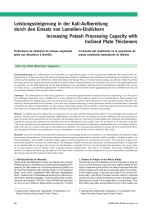
Leistungssteigerung in der Kali-Aufbereitung durch den Einsatz von Lamellen-Eindickern Increasing Potash Processing Capacity with Inclined Plate Thickeners Performance de traitement de potasse augmentée grâce aux décanteurs à lamelles Incremento del rendimiento en la preparación de potasa empleando espesadores de láminas Dipl.-Ing. Dieter Reitemeyer, Wuppertal*) Zusammenfassung Die Sedimentation von Feststoffen aus Suspensionen gehört zu den viel genutzten Methoden der mechanischen Verfahrenstechnik. Sie kann der reinen Fest-Flüssig-Trennung dienen, findet in modifizierter Form aber ebenso Anwendung zur Sortierung von Feststoffen nach Korngrößen oder Stoffdichten. Meist bildet Wasser die flüssige Phase im Sedimentationsvorgang; das Ziel des Verfahrensschrittes kann aber auch in der Separierung eines Feststoffes von einem anderen Feststoff bestehen, der zu diesem Zweck in einer Flüssigkeit gelöst wird. So geschieht es in der Kaliaufbereitung, bei der Kaliumchlorid aus einer gesättigten Salzlösung durch Sedimentation eingedickt wird. Für diesen Zweck sind u. a. Lamellenklärer gebräuchlich. Im Werk Werra der K+S Kali GmbH werden gegenwärtig drei neue Großklärer vom Typ Setl von der Metso Minerals (Deutschland) GmbH installiert. Summary The sedimentation of solids from suspensions is a commonly applied method in mechanical process engineering. It can be used for pure solid/liquid separation, but in modified form it is also suitable for sorting solids by particle size or material density. Water usually forms the liquid phase in the settling process; the aim of the process stage can, however, be the separation of one solid from another solid that is dissolved in a liquid specifically for this purpose. This is the case in potash processing, in which potassium chloride is thickened from a saturated salt solution by means of sedimentation. For this purpose, inclined plate settlers are very effective. At the Werra Works of K+S Kali GmbH, three new large-size Setl-type settlers supplied by Metso Minerals (Deutschland) GmbH are currently being installed. Résumé La sédimentation des solides dans les suspensions est une des méthodes fréquemment utilisées de la technologie des procédés mécaniques. Elle peut servir à la simple séparation solide/liquide, mais elle peut aussi être utilisée sous forme modifiée pour le classement des solides en fonction de la granulométrie ou de la densité. Dans la plupart des cas, l’eau forme la phase liquide dans l’opération de sédimentation; l’objectif du processus de traitement peut toutefois aussi être la séparation de deux solides, dont l’un est dissout à cet effet dans un liquide. C’est ce qui se produit lors du traitement de la potasse où le chlorure de potassium est épaissi par sédimentation dans une solution saline saturée. Pour cela, on a recours entre autres à des décanteurs à lamelles. Trois nouveaux gros décanteurs du type Setl de la société Metso Minerals (Deutschland) GmbH sont actuellement en cours d’installation à l’usine de Werra de la société K+S Kali GmbH. Resumen Uno de los métodos frecuentemente empleados en la tecnología de procesos mecánicos es la sedimentación de materiales sólidos provenientes de suspensiones. O bien puede utilizarse únicamente para la separación de materiales sólidos y líquidos, o también se aplica – en forma modificada – para clasificar materiales sólidos según el tamaño del grano o la consistencia del material. Por lo general, el agua representa la fase líquida en el proceso de sedimentación. Sin embargo, el objetivo de este paso del proceso también puede residir en la separación de un material sólido de otro que, para este fin, ha sido disuelto en un líquido. Este es el caso de la preparación de potasa, en la que se espesa el cloruro potásico de una solución salina saturada mediante sedimentación. Para este fin se emplean, entre otros, clarificadores de láminas. En la planta de Werra, que pertenece a la K+S Kali GmbH, actualmente se están instalando tres nuevos clarificadores industriales del tipo Setl por parte de Metso Minerals (Alemania) GmbH. 1. History of Potash in the Werra Valley Gegen Ende des Paläozoikums waren die Gebirge des heutigen Mitteleuropa durch Verwitterung und Abtragung weitgehend eingeebnet, die Täler hatten sich mit dem Erosionsschutt gefüllt und ein Flachmeer bedeckte weite Teile der Region. In der hessischen Senke, einer durch vorgelagerte Riffe zeitweise abgeriegelten Bucht, entstand durch Meerwasserverdunstung ein mehrere hundert Meter mächtiges Salzpaket, mit einer horizontalen Ausdehnung von über tausend 1.000 km2. Über 200 Millionen Jahre später, kurz vor der modernen Zeitenwende, wurde dort, im Raum Towards the end of the Palaeozoic era, the mountains of what we know as Central Europe today had been largely levelled off as a result of weathering and erosion, the valleys had been filled with eroded material, and a flat sea covered large areas of the region. In the Hessian trough, a bay that was locked in for a time by offshore reefs, a salt dome of several hundred metres in thickness was formed over a horizontal expanse of over a thousand square kilometres as a result of the evaporation of the sea water. Over 200 million years later, shortly before the turn of the modern era, *) Ingenieurbüro Reitemeyer, Wuppertal, in Kooperation mit Metso Minerals (Deutschland) GmbH, Ketsch *) Ingenieurbüro Reitemeyer, Wuppertal, in co-operation with Metso Minerals (Deutschland) GmbH, Ketsch
Open the catalog to page 1All Metso Automation catalogs and technical brochures
 Metallrecycling-Services
12 Pages
 EtaCrush® series
1 Page
 more capability brochure
4 Pages
 Neles Flow Control Solutions
12 Pages
 Crushing and screening solutions
51 Pages
 Primary gyratory stations
9 Pages
 Slurry Hose System
20 Pages
 Mill discharge pumps
8 Pages
 Slurry pump basic
204 Pages
 STGVA - STHM
8 Pages
 Metso Slurry Pump program
16 Pages
 Vasa HD
4 Pages
 Metso Balance Cranes (MBC)
8 Pages
 Aftermarket Training
2 Pages
 Hot Kiln Survey
2 Pages
 Holo-Flite®
8 Pages
 Dryers and Coolers
6 Pages
 Coke Calcining Systems
8 Pages
 Metso pebble lime cooler
4 Pages
 Spiral Dewaterers
8 Pages
 LIMS dry drum
4 Pages
 HGMS cyclic
5 Pages
 HGMS
HGMS12 Pages
 HGMS Continuous
8 Pages
 HGMF
HGMF8 Pages
 LIMS iron ore
12 Pages
 IPS LTK
1 Page
 Inclined Plate Settler
8 Pages
 Microcel Flotation Columns
6 Pages
 Flotation Machines DR
8 Pages
 Feed Forward for Flotation
2 Pages
 Flotation Machines RCS
8 Pages
 Tube press
8 Pages
 Tube press booster range
8 Pages
 Metso in filtration
8 Pages
 High efficiency cyclones
2 Pages
 Air Classifiers
4 Pages
 Gearless AG/SAG Mills
2 Pages
 Vertimill for limeslaking
2 Pages
 Grinding and enrichment
12 Pages
 Flue Gas Desulfurization
4 Pages
 Ball mills
2 Pages
 Apron feeders
8 Pages
 Wobbler feeders
4 Pages
 Lokotrack CT3.2 and CW3
2 Pages
 HRC 800
8 Pages
 MP1250 Cone crusher
6 Pages
 Metso screening media
114 Pages
 Trellex dust control
8 Pages
 Metso lining and sheeting
44 Pages
 Trellex wear lining solutions
16 Pages
 Trellex PSV conveyor rollers
4 Pages
 Trellex flexopipe
8 Pages
 Trellex belt cleaning
12 Pages
 Trellex loading stations
8 Pages
 Trellex Cer-Lag
4 Pages
 Trellex belt guiding system
8 Pages
 Trellex conveyor accessories
12 Pages
 Jamesbury Valve Solutions
28 Pages
 Actuator
2 Pages
 Chlorine
4 Pages
 Metso DNA Drive Controls
2 Pages
 Flow control solutions
12 Pages


Archived catalogs
 MetsoPulpExpert_brochure
8 Pages
 Metso_FS300_brochure
4 Pages
 Alkali Analyser
4 Pages
 SmartLX
6 Pages
 Neles SwitchGuard
6 Pages
 Pneumatic Actuator
10 Pages
 Series 3000 Ball Valves
4 Pages
 TheArtOfConsistency_brochure
8 Pages
 Butterfly Valves
20 Pages
 Metso_MCA_brochure
6 Pages
 Neles Manual Gear Actuators
2 Pages
 Actuator Accessories
2 Pages


