


Application note: Measuring power with clamp meters

Application note: Measuring power with clamp meters
Clamp meters are versatile tools that extend beyond basic voltage and current measurements. They are equipped to measure power and power quality, including AC/DC voltage and current, signal waveform analysis through Total Harmonic Distortion (THD) and crest factor, and can save measurements for later analysis.
- Real/Active Power: Measures net energy transfer towards the load in watts.
- Reactive Power: Measures net energy transfer towards the generator in volt-ampere reactive.
- Apparent Power: The vector sum of real and reactive power, measured in volt-ampere.
- Power Factor: The ratio of real to apparent power, also known as cos ϕ.
- Crest Factor: Ratio between the highest and RMS value of the signal, affecting other measurements.
- Total Harmonic Distortion (THD): Ratio of higher harmonic components to the base one, indicating power quality and potential losses.
Clamp meters use different sensor types like current transformers, Hall probes, or Rogowski coils to measure power. The process involves integrating the product of voltage and current over one period, breaking it down into active, reactive, and apparent power. Accurate measurements require correct setup, especially in multi-phase systems.
Crest factor is crucial for estimating power quality, especially in audio systems. THD provides insights into network power quality, with higher harmonic content leading to losses and potential network issues.
- MD 9272: Suitable for lower AC currents up to 100 A, measures both AC and DC voltage up to 600 V, and offers functions like THD, power factor, and crest factor.
- MD 9240: Measures both AC and DC voltage, AC current up to 1000 A, suitable for industrial environments, and supports data logging.
- MD 9235: Measures both AC and DC voltage, AC current, and is designed for unbalanced three-phase systems, capable of logging energy usage independently.
Catalog excerpts

Application Note Measuring power with clamp meters There are times when one would like more from their multimeter than just a basic voltage and current measurement. Modern clamp meters are often equipped with at least some options for measuring power and power quality. They can measure voltage and current in AC or DC, analyse signal waveform through THD or crest factor, and finally even save some measurements for later analysis. Power measurements Handheld clamp meters most commonly measure the following: • Real/active power: net transfer of energy in the direction of the load, measured in watts; • Reactive power: net transfer of energy in the directions of generator, measured in volt-ampere reactive • Apparent power: vector sum of the former, whole power in the network, measured in volt-ampere • Power factor: ratio of real to apparent power, no unit; also called cos ϕ. Distortion factors are not immediately part of power measurement, but they can help evaluate losses. • Crest factor: ratio between highest and RMS value of the signal. Clamp meters often don't show it, but one needs to keep in mind it affects other measurements. • Total harmonic distortion (THD): ratio between effective values of higher harmonic components and the base one. Principle of power measurements in clamp meters Handheld instruments rarely measure power by itself, for example with thermal effect, so this article won't touch this. The clamp can be a current transformer
Open the catalog to page 1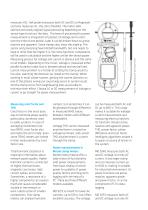
Measuring crest factor and THD Crest factor is the most basic way to estimate power quality, particularly commonly used in audio systems. In case of averaging multimeter (not true RMS), crest factor also estimates the error made. Even some TRMS meters are limited in their measurement by crest factor size. Total harmonic distortion is important information about network power quality. Higher harmonic content is connected to higher thermal losses, magnetic core losses, high current spikes, and similar. Sometimes, a resonance of a higher components can express itself and causes considerable trouble...
Open the catalog to page 2
current. Its defining features are measuring whole power in an unbalanced three-phase system and measurement and logging of used energy on its own, without the use of PC. It notes the type of load in capacitive/inductive sense. METREL D.D. Measuring and Regulation Equipment Manufacturer Ljubljanska 77, SI-1354 Horjul, Slovenia T +386 (0)1 75 58 200, F +386 (0)1 75 49 226 [email protected], www.metrel.si
Open the catalog to page 3All METREL catalogs and technical brochures
 MI 3136 EurotestCOMBO XC EN
4 Pages
 MI 2992 Power Analyser ENG
6 Pages
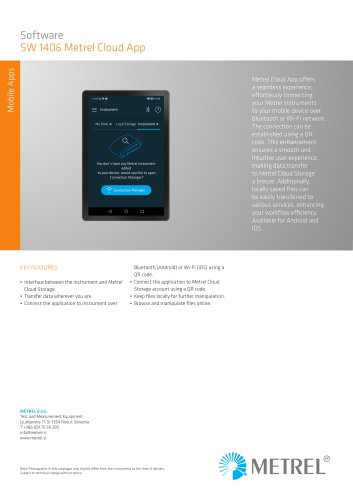 SW 1406 Metrel Cloud App
1 Page
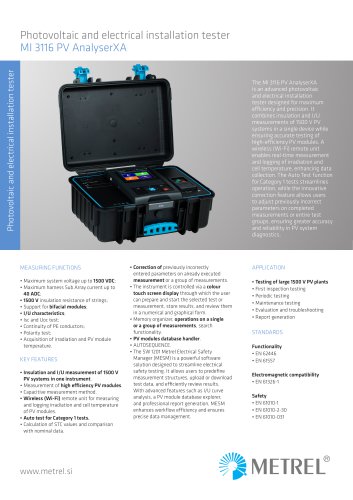 MI 3116 PV AnalyserXA
2 Pages
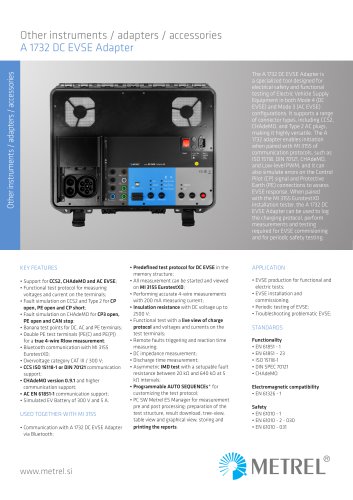 A 1732 DC EVSE Adapter EN
2 Pages
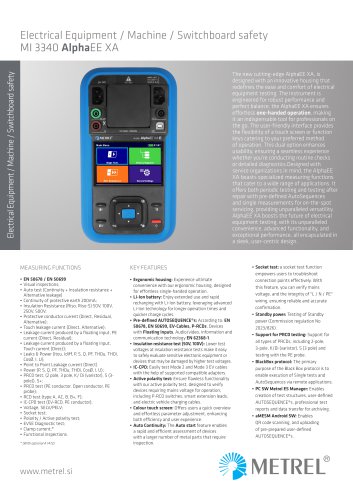 MI 3340 AlphaEE XA EN
6 Pages
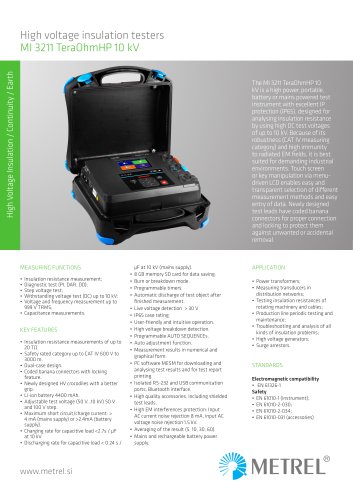 MI 3211 TeraOhmHP 10 kV EN
2 Pages
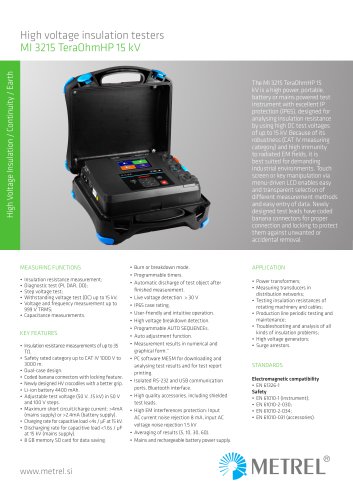 MI 3215 TeraOhmHP 15 kV EN
2 Pages
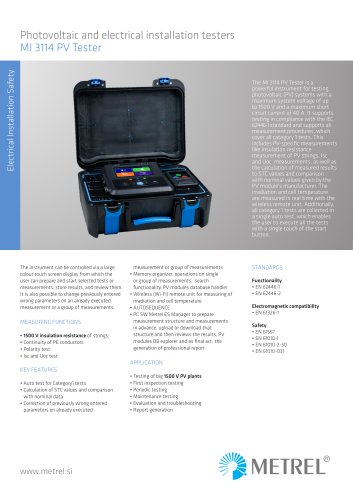 MI 3114 PV Tester EN
2 Pages
 MI 3115 PV Analyser EN
2 Pages
 MI 3132 EV Tester EN
3 Pages
 MI 3365 OmegaEE XD EN
8 Pages
 MI 3365 M OmegaEE XD EN
8 Pages
 MI 3365 F OmegaEE XD EN
8 Pages
 MI 3365 25A OmegaEE XD EN
8 Pages
 MI 3360 OmegaGT XA guide EN
56 Pages
 MD 9210 Mini Clamp Meter EN
2 Pages
 MD 9930 Thermal camera EN
2 Pages
 Medical Facilities catalogue
64 Pages
 Building Facilities catalogue
72 Pages
 General catalogue 2023 EN
272 Pages
 MI 3299 HV demo BOX
1 Page
 SW 1203 Metrel SDK EN
3 Pages
 MI 3360 OmegaGT XA EN
4 Pages
 MI 3325 MultiServicerXD EN
4 Pages
 MI 3394 CE MultiTesterXS EN
2 Pages
 MI 3394 CE MultiTesterXA EN
3 Pages
 MI 6601 MediTest EN
4 Pages
 MI 3110 EurotestIM EN
2 Pages
 A 1722 PRCD adapter EN
2 Pages
 A 1632 eMobility Analyser EN
2 Pages
 A 1532 XA EVSE adapter EN
2 Pages
 A 1532 EVSE adapter EN
2 Pages
 MI 2093 Line Tracer EN
2 Pages
 MI 3109 EurotestPV Lite EN
2 Pages
 MI 3108 EurotestPV EN
2 Pages
 MI 3125 BT EurotestCOMBO EN
2 Pages
 MI 3125 EurotestCOMBO EN
2 Pages
 MI 3100 SE EurotestEASI EN
2 Pages
 MI 3102 BT EurotestXE EN
2 Pages
 MI 3143 Euro Z 440 V EN
2 Pages
 MI 3144 Euro Z 800 V EN
2 Pages
 MI 3202 GigaOhm 5 kV EN
2 Pages
 MI 3201 TeraOhm 5 kV Plus EN
2 Pages
 MI 3311 GammaGT EN
2 Pages
 MI 3309 BT DeltaGT EN
2 Pages
 MI 3242 MicroOhm 2A EN
2 Pages
 MI 3250 MicroOhm 10A EN
2 Pages
 MI 3252 MicroOhm 100A EN
2 Pages
 MI 3281 WR Analyser EN
2 Pages
 MI 2891 Power Simulator EN
2 Pages
 MI 2883 Energy Master EN
4 Pages
 MI 2885 Master Q4 EN
4 Pages
 MI 2884 Energy Master XA EN
4 Pages
 MI 2892 Power Master EN
4 Pages
 MI 2893 Power Master XT EN
4 Pages
 MI 3205 TeraOhmXA 5kV EN
2 Pages
 MI 3210 TeraOhm XA 10kV EN
2 Pages
 MI 3290 Earth Analyser EN
4 Pages
 MI 3280 DT Analyser EN
2 Pages
 MI 3209 TeraOhmLT 10kV EN
2 Pages
 MI 3152 EurotestXC EN
2 Pages
 Metrel application catalogue
28 Pages
 MI 3155 EurotestXD EN
4 Pages
 MI 3102 BT EurotestXE
2 Pages


- Digital imager
- Industrial camera module
- Automation software solution
- Management software solution
- Monitoring analyzer
- Analysis software solution
- Infrared imager
- Process software
- Automatic analyser
- METREL Windows software
- Calibration system
- Cloud-based software
- Control software
- USB camera module
- METREL portable tester
- Monitoring software solution
- Portable analyzer
- METREL measurement software
- METREL digital tester
- Thermographic camera