


Application note: Current harmonics

Application note: Current harmonics
Current harmonics are sinusoidal components of a periodic wave with frequencies that are integral multiples of the fundamental frequency. They can significantly impact equipment connected to electrical supply systems, causing various operational issues.
- Unexplained tripping of circuit breakers.
- Distortion of voltage waveforms and potential interference with communication lines.
- Negative effects on supply networks, such as increased power consumption and overheating in motors due to 'torque fight'.
- Reduced transmission capacity of supply networks.
- Increased risk of fire due to high neutral conductor currents.
- Influence on supply voltage harmonics, affecting end-user equipment.
To address harmonic issues, it is crucial to measure and analyze the electrical system using appropriate instruments. The Metrel Master series can record voltage and current harmonics, interharmonics, and total harmonic distortion (THD), providing detailed insights into the system's condition.
- Office IT equipment typically generates high 3rd, 5th, 7th, 11th, and 13th harmonics.
- Variable frequency drives (VFDs) produce high 5th, 7th, 11th, 13th, 17th, and 19th order harmonics.
- 3rd, 6th, 9th, and 12th harmonics can cause high neutral conductor currents in 3-phase, 4-wire systems.
The PQA Master instruments comply with standards such as IEC 61000-4-30, IEC 61000-4-7, and IEEE 519, which guide harmonic control and measurement techniques.
- Select equipment with low THD content when purchasing new devices.
- Ensure the neutral conductor in 3-phase systems is appropriately sized for harmonic content.
- Use active or passive filters to limit current harmonics to acceptable levels.
- Active filters are particularly effective for variable electronic loads, adapting to the existing harmonics spectrum.
METREL D.D., Measuring and Regulation Equipment Manufacturer, Ljubljanska 77, SI-1354 Horjul, Slovenia. Contact: T +386 (0)1 75 58 200, F +386 (0)1 75 49 226, [email protected], www.metrel.si
Catalog excerpts
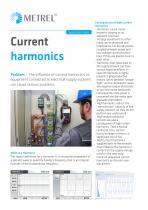
Application Note Current harmonics Problem - The influence of current harmonics on equipment connected to electrical supply systems can cause serious problems. What is a Harmonic The typical definition for a harmonic is: a sinusoidal component of a periodic wave or quantity having a frequency that is an integral multiple of the fundamental frequency. Consequences of high current harmonics - Harmonics cause circuit breakers tripping at no apparent overload. - Voltage waveforms to other loads can be distorted and interference can be inductively coupled between power and low-voltage communication lines if they are placed close to each other. - Harmonics that flows back to the supply network can have various negative effects. In case 5th harmonic is highly present 3-phase inductive motors can ex perience “torque fight” as this component cause the negative torque that tends to turn the motor backwards. Consequently more power is consumed and the motor gets gradually overheated. - High harmonics reduce the “transmission” capacity of the supply network, as they do not perform any useful work. - High neutral conductor currents are also a consequence of high current harmonics. Thus a neutral conductor cross-section has to be larger or there is a significant risk of fire. - High current harmonics supplied back to the network may influence the harmonics content on the supply voltage, which in the next step result on unwanted current harmonics on the end-user equip
Open the catalog to page 1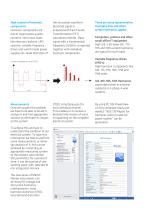
High content of harmonic components Harmonic components are one of major power quality concerns. Non-linear loads like electronic ballasts, UPS systems, variable frequency drives and switch mode power supplies all create distortion of the sinusoidal waveform. Distorted signal is analysed with Fast Fourier Transformation (FFT) calculation method. Basic signal with a fundamental frequency 50/60Hz is reported together with individual harmonic components. There are some representative examples how and when certain harmonics appear. Computers, printers and other small office IT equipment High 3rd,...
Open the catalog to page 2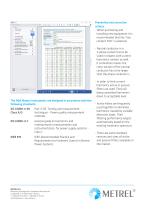
Preventive and corrective actions - When purchasing and installing new equipment it is recommended that the “low content THD” is selected. - Neutral conductor in a 3-phase system has to be sized in respect with current harmonics content as well. It sometimes means the cross-section of the neutral conductor has to be larger than the phase conductor’s. - In order to limit current harmonics active or passive filters are used. They will damp unwanted harmonics down to acceptable level. The PQA Master instruments are designed in accordance with the following standards: IEC 61000-4-30 Class A/S Part...
Open the catalog to page 3All METREL catalogs and technical brochures
 MI 3136 EurotestCOMBO XC EN
4 Pages
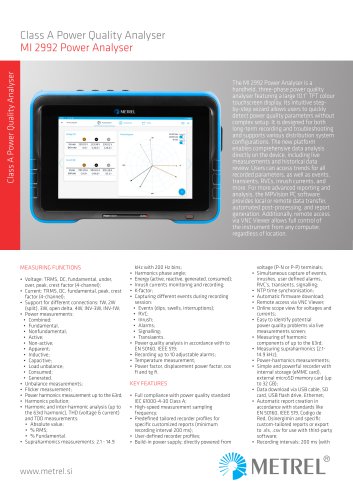 MI 2992 Power Analyser ENG
6 Pages
 SW 1406 Metrel Cloud App
1 Page
 MI 3116 PV AnalyserXA
2 Pages
 A 1732 DC EVSE Adapter EN
2 Pages
 MI 3340 AlphaEE XA EN
6 Pages
 MI 3211 TeraOhmHP 10 kV EN
2 Pages
 MI 3215 TeraOhmHP 15 kV EN
2 Pages
 MI 3114 PV Tester EN
2 Pages
 MI 3115 PV Analyser EN
2 Pages
 MI 3132 EV Tester EN
3 Pages
 MI 3365 OmegaEE XD EN
8 Pages
 MI 3365 M OmegaEE XD EN
8 Pages
 MI 3365 F OmegaEE XD EN
8 Pages
 MI 3365 25A OmegaEE XD EN
8 Pages
 MI 3360 OmegaGT XA guide EN
56 Pages
 MD 9210 Mini Clamp Meter EN
2 Pages
 MD 9930 Thermal camera EN
2 Pages
 Medical Facilities catalogue
64 Pages
 Building Facilities catalogue
72 Pages
 General catalogue 2023 EN
272 Pages
 MI 3299 HV demo BOX
1 Page
 SW 1203 Metrel SDK EN
3 Pages
 MI 3360 OmegaGT XA EN
4 Pages
 MI 3325 MultiServicerXD EN
4 Pages
 MI 3394 CE MultiTesterXS EN
2 Pages
 MI 3394 CE MultiTesterXA EN
3 Pages
 MI 6601 MediTest EN
4 Pages
 MI 3110 EurotestIM EN
2 Pages
 A 1722 PRCD adapter EN
2 Pages
 A 1632 eMobility Analyser EN
2 Pages
 A 1532 XA EVSE adapter EN
2 Pages
 A 1532 EVSE adapter EN
2 Pages
 MI 2093 Line Tracer EN
2 Pages
 MI 3109 EurotestPV Lite EN
2 Pages
 MI 3108 EurotestPV EN
2 Pages
 MI 3125 BT EurotestCOMBO EN
2 Pages
 MI 3125 EurotestCOMBO EN
2 Pages
 MI 3100 SE EurotestEASI EN
2 Pages
 MI 3102 BT EurotestXE EN
2 Pages
 MI 3143 Euro Z 440 V EN
2 Pages
 MI 3144 Euro Z 800 V EN
2 Pages
 MI 3202 GigaOhm 5 kV EN
2 Pages
 MI 3201 TeraOhm 5 kV Plus EN
2 Pages
 MI 3311 GammaGT EN
2 Pages
 MI 3309 BT DeltaGT EN
2 Pages
 MI 3242 MicroOhm 2A EN
2 Pages
 MI 3250 MicroOhm 10A EN
2 Pages
 MI 3252 MicroOhm 100A EN
2 Pages
 MI 3281 WR Analyser EN
2 Pages
 MI 2891 Power Simulator EN
2 Pages
 MI 2883 Energy Master EN
4 Pages
 MI 2885 Master Q4 EN
4 Pages
 MI 2884 Energy Master XA EN
4 Pages
 MI 2892 Power Master EN
4 Pages
 MI 2893 Power Master XT EN
4 Pages
 MI 3205 TeraOhmXA 5kV EN
2 Pages
 MI 3210 TeraOhm XA 10kV EN
2 Pages
 MI 3290 Earth Analyser EN
4 Pages
 MI 3280 DT Analyser EN
2 Pages
 MI 3209 TeraOhmLT 10kV EN
2 Pages
 MI 3152 EurotestXC EN
2 Pages
 Metrel application catalogue
28 Pages
 MI 3155 EurotestXD EN
4 Pages
 MI 3102 BT EurotestXE
2 Pages


- Digital imager
- Industrial camera module
- Automation software solution
- Management software solution
- Monitoring analyzer
- Analysis software solution
- Infrared imager
- Process software
- Automatic analyser
- METREL Windows software
- Calibration system
- Cloud-based software
- Control software
- USB camera module
- METREL portable tester
- Monitoring software solution
- Portable analyzer
- METREL measurement software
- METREL digital tester
- Thermographic camera