

EDM TODAY

EDM TODAY
The document provides a comprehensive analysis of iso-molded graphite, focusing on its production, properties, and applications in the EDM (Electrical Discharge Machining) industry. It is designed for professionals in the EDM sector, offering insights into manufacturing processes and the historical context of graphite use.
Graphite Production Methods
Graphite is produced using extrusion and isostatic pressing, with the latter preferred for EDM applications due to its ability to minimize grain directionality, resulting in uniform properties.
History of Graphite
The graphite industry evolved from the carbon industry, with significant advancements in the late 19th century. The graphitization process, patented in 1893, enabled the conversion of carbon materials into graphite, facilitating industrial-scale production.
Properties of Graphite
Graphite is valued for its high electrical and thermal conductivity, strength, machinability, and stability at high temperatures, making it ideal for EDM electrodes.
Raw Materials
Artificial graphite is made from petroleum coke and coal tar pitch, with specific requirements for softening points and chemical compositions to ensure quality.
Manufacturing Process
The production involves several steps: milling coke filler, mixing with coal tar pitch and additives, cold isostatic pressing to form billets, baking to solidify the carbon binder, heating to 3000°C for graphitizing, and testing physical properties to ensure quality.
Mersen USA
Mersen, formerly Carbone and Stackpole, is a leading producer of specialty graphite, with a history dating back to the 1890s. The company has expanded its capabilities, including commissioning the world's largest cold isostatic press.
DarkStar Particle
Mersen developed the DarkStar particle, an ultra-fine grain graphite, to enhance EDM performance, resulting in the DS-4 graphite grade.
Conclusion
Mersen's advancements in graphite technology and production capabilities position it as a leader in the EDM industry, offering high-quality graphite products for various applications.
Overview
The document discusses the range of EDM graphite grades offered by Mersen, highlighting their applications, properties, and manufacturing details. Mersen provides a complete line of EDM grades from coarser grain E+18 to ultra-fine grain DS-4.
Specifications
The document lists the physical properties of different Mersen EDM graphite grades, such as grain size, bulk density, flexural strength, hardness, and resistivity. For example, the DS-4 grade has a grain size of less than 5 microns, a bulk density of 1.88 g/cc, flexural strength of 13,500 psi, hardness of 70 Shore, and resistivity of 0.00052 ohm-inch.
Manufacturing
Mersen manufactures these EDM graphite materials in large quantities at its St. Marys, PA facility, ensuring competitive costs and high quality, emphasizing local production and quality assurance.
Product Highlights
The DS-4 grade, featuring the DarkStar ultra-fine carbon particle, is noted for its excellent surface finish, ability to handle intricate details, ease of machining, and exceptional strength.
Recommendations
The document encourages users to try the DS-4 grade for challenging EDM machining operations, offering a free sample through EDM distributors or the Mersen website.
Conclusion
Mersen's EDM graphite lineup, particularly the DS-4 grade, is positioned as a leading choice for demanding EDM applications, combining performance and value.
Catalog excerpts
Iso-Molded Graphite –
Open the catalog to page 1
cover story A Graphite Primer Graphite is one of the three readily occurring solid raw materials, the graphite particle size, and forms of carbon. It exhibits very unique proper- the molding method used in the production ties which make it an attractive material for use of the material. Of these three, the molding in several industrial applications. Some of these method has the most pronounced effect. unique properties include high electrical and thermal conductivity, good compressive and There are two primary molding methods used flexural strength, machinability to complex to produce graphite:...
Open the catalog to page 2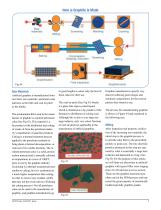
Raw Materials Artificial graphite is manufactured from two basic raw materials: petroleum coke particles as the filler and coal tar pitch as the binder. The predominant filler used in the manufacture of graphite is calcined petroleum coke (See Fig #2). This material is a by-product of the distillation and coking of crude oil from the petroleum industry’s manufacture of gasoline products. Coking is a thermal treatment process applied to the petroleum residuals to bring about a thermal decomposition, or removal of its volatile fractions. The resultant petroleum coke is a solid, porous carbon material...
Open the catalog to page 3
Crushing & Milling After milling, the coke particles and coal tar pitch, along with trace additives to facilitate processing, are combined in a heated mixer (See Fig #6) which melts the pitch and intimately mixes the pitch binder and coke filler. Various mixing times and conditions are utilized, with parameters dictated by the process specification for the particular grade being manufactured. Once the mixing cycle has been completed, the mix is allowed to cool and re-solidify into “mix balls” as they are sometimes referred. These “mix balls” are then crushed and milled into “flour” using a pulverizing...
Open the catalog to page 4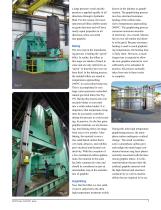
a large pressure vessel and the pressure is applied equally in all directions through a hydraulic fluid. For this reason, the resultant pressed billet exhibits nearly no grain direction and will have nearly equal properties in all directions when converted into graphite. Baking The next step in the manufacturing process is baking the “green” billet. In reality, the billets at this stage are shades of black in color and are only referred to as “green” in that they have not yet been fired. In the baking process, the molded billets are raised to temperatures approaching 1000°C at a prescribed ramp...
Open the catalog to page 5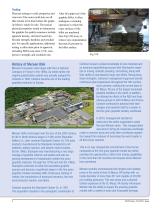
Testing Physical testing to verify properties and removal of the outer mold skin are all that remain to be done before the graphite billet is ready for sale. The typical physical properties tested to characterize the graphite for quality assurance include apparent density, electrical resistivity, flexural strength, hardness and residual ash. For specific applications, additional testing is often done prior to approval, including EDM wear ratio, CTE, compressive strength, and oxidation rate. After QA approval of the graphite billet, it often undergoes a cleaning operation in which the outer surfaces...
Open the catalog to page 6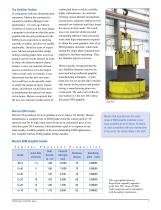
The DarkStar Particle In conjunction with the aforementioned expansion, Mersen has continued to expand its product offerings to the marketplace. 10 years ago Mersen (Carbone of America at the time) began a program to develop an ultra-fine grain graphite that not only performed in the EDM process equivalent to anything currently available, but also was readily machinable. Based on years of experience, Mersen recognized that simply milling existing grades finer was never going to get the results desired. In order to obtain the desired material characteristics, a new raw material and new process...
Open the catalog to page 7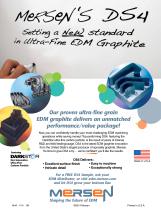
Our proven ultra-fine grain EDM graphite delivers an unmatched performance/value package! Featuring Our Innovative Ultra-Fine Carbon Particle Now you can confidently handle your most challenging EDM machining operations while saving money! Top-performing DS4, featuring the DarkStar ultra-fine carbon particle, is the result of years of intense R&D and field testing/usage. DS4 is the latest EDM graphite innovation from the United State’s largest producer of specialty graphite, Mersen. It’s time to give DS4 a try… we’re confident you’ll like the results. DS4 Delivers: • Easy to machine • Excellent...
Open the catalog to page 8All Mersen USA GS Corp. - St. Marys catalogs and technical brochures
 GRAPHITE GRADES
16 Pages