
- Catalogs
- Mersen Power Transfer Technologies
- Current Collection


Current Collection

Current Collection
Current collection is crucial for electric locomotives, metros, and tramways, enabling them to receive power safely and reliably. Power is transmitted through overhead wires or ground-level rails, with AC systems using overhead wires and DC systems using either method.
Pantographs, typically single or double arm, collect electricity from overhead wires. Single arm pantographs are preferred for their compact design. The choice of contact strips depends on the current to be collected, operating linear current density, and conditions at standstill.
Grades are chosen based on the current to be collected and operating linear current density. Mersen offers various carbon grades designed for specific current densities, with limited copper content to ensure stability and minimize arcing.
Contact strips can be soldered or bonded, with designs tailored for specific applications like the Automatic Dropping Device (ADD) system. Their service life is influenced by electrical, mechanical, and environmental factors.
Third rail systems provide power through a rigid conductor alongside the track, suitable for mass transit systems where overhead wires are impractical. Current is collected via shoes in contact with the rail.
CCD shoes must withstand mechanical impacts, high current loads, and provide good sliding properties. Mersen offers grades specifically designed for these shoes, ensuring durability and performance.
Mersen provides a range of solutions for current collection, ensuring customer satisfaction through continuous innovation and technical support.
The document provides a comprehensive guide on the design, advantages, and technical specifications of carbon-based current collection systems, focusing on contact strips and CCD shoes used in railway and tramway systems.
The document outlines various designs of CCD shoes, including metal end pieces, soldered versions, and cast versions. It emphasizes the role of the carrier, made of aluminum, stainless steel, or copper, in protecting the carbon collector and conducting current.
Carbon materials offer benefits over metallic materials, such as reduced mechanical damage to rails, elimination of greasing, longer lifespan, de-icing capabilities, reduced maintenance costs, and better current collection. Carbon is also noted for its high-speed operation capability and negligible noise.
Key factors influencing the performance of contact strips include current overload, contact strip weight, carbon section size, assembly quality, mixed materials, weather conditions, network conditions, wire stagger, and contact pressure. Mixing different carbon grades or manufacturers is discouraged.
The manufacturing process involves raw material selection, impregnation, extruding, grinding, sieving, blending, baking, copper coating, assembly, and machining. Testing facilities are available for thermal properties, expansion tests, flexural tests, and more.
Mersen emphasizes its commitment to environmental sustainability through EcoDesign solutions and innovative approaches, collaborating with universities and laboratories to develop advanced solutions.
The document provides a checklist for ordering contact strips or CCD shoes, detailing necessary technical information such as dimensions, material, and operating conditions. Customization options for carbon sections and carrier profiles are available.
For further technical assistance or to request complete technical data sheets, customers are encouraged to contact Mersen via email.
Catalog excerpts
Expertise, our source of energy P TECHNICAL
Open the catalog to page 1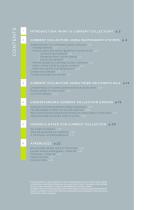
I ntro duction: What is C u rr e nt Colle ction ? p. 3 Curr ent Collection u sing Panto grap h syst e m s p. 4 Grade selection for Overhead Current Collection p.5 l Voltage families p.5 l H ow to select the correct grade for a carbon strip? p.6 Current to be collected p.6 Operating linear current density p.6 Current at standstill p.7 l M ersen grades for overhead Current Collection p.8 l W hy is there a limit to copper content? p.9 Contact strip designs p.10 Contact strip Service Life time p.11 Curr ent Collection u sing T hir d or Fou rth R ail p.12 Characteristics of Current Collection Device...
Open the catalog to page 2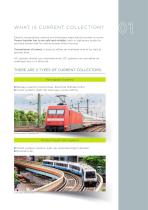
What is C urrent Collection ? Electric locomotives, metros and tramways need electric power to move. Power transfer has to be safe and reliable, both in stationary mode for auxiliary power and for motive power when moving. Transmission of power is done by either an overhead wire or by rails at ground level. AC systems always use overhead wires, DC systems can use either an overhead wire or a third rail. There are 2 types of current collectors: Pantograph Systems l Railways (electric locomotives, Electrical Multiple Units) l Transit systems (light rail, tramways, some metros) © Leonid Andronov...
Open the catalog to page 3
C urrent C ollection using Pantogra p h s y stems 4 The electricity required to power the elec ric traction motors is collected by means t of a pantograph running on a catenary. A catenary is a system of overhead wires used to supply electricity to an electric unit, such as an electric locomotive or an Electrical Multiple Unit (EMU), which is equipped with a pantograph. A pantograph is a system of articulated arms fixed on the roof of the locomotive. It unfolds and extends along a vertical axis. Its role is to transfer power from the contact line to the electric traction unit. The principal...
Open the catalog to page 4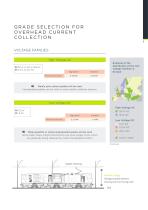
G rade selection f or O verhead C urrent C ollection 5 VOLTAGE FAMILIES High Voltage AC l 25 kV @ 50 or 60 Hz High speed Power of locomotive Example of the distribution of the two voltage families in Europe: Mainly pure carbon grades will be used Impregnated grades can be used on poor quality catenary systems. Low Voltage DC High Voltage AC 25 kV AC High speed Power of locomotive Metal-graphite or metal-impregnated grades will be used Some older, heavy freight locomotives use pure copper strips which are gradually being replaced by metal impregnated carbon. Copper catenary Network voltage (Voltage...
Open the catalog to page 5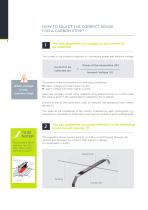
HOW TO SELECT THE CORRECT GRADE FOR A CARBON STRIP? 6 The first parameter to consider is the current to be collected The current to be collected depends on locomotive power and network voltage. ! When voltage is low, current is high Power of the locomotive (W) = Network Voltage (V) The power of the locomotive is a fixed value, therefore: l Higher voltage will mean lower current l Lower voltage will mean higher current Either we calculate current to be collected using above formula, or in most cases this value is given in the specifications supplied by the customer. Current is one of the parameters...
Open the catalog to page 6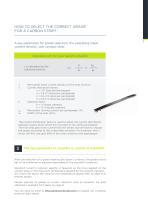
HOW TO SELECT THE CORRECT GRADE FOR A CARBON STRIP? A key parameter for grade selection, the operating linear current density j per contact strip: Calculation of j for your specific situation j is calculated by the following formula: j Permanent linear current density for the strip (A/mm) n Current distribution factor n = 1 if 1 strip per pantograph n = 0.6 if 2 strips per pantograph n = 0.4 if 3 strips per pantograph n = 0.3 if 4 strips per pantograph k Catenary factor k = 1 if single catenary k = 1.5 if double catenary Ip Permanent running current per pantograph (A) w Width of the strip (mm)...
Open the catalog to page 7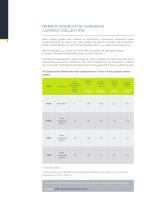
MERSEN GRADES FOR OVERHEAD CURRENT COLLECTION 8 Each carbon grade was created to withstand a maximum operating linear current density. To select the right grade, one has to consider the permanent linear current density (j), and choose a grade with a jmax value at least equal to j. Recommended jmax values for each Mersen grade are tabulated below (Column "Maximum operating linear current density"). Mersen has developed a wide range of carbon grades to meet even the most demanding operating conditions. We recommend that our customers contact our Customer Technical Assistance to correctly select...
Open the catalog to page 8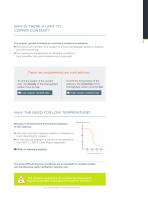
Why is there a limit to copper content? The copper content is limited by customers' technical constraints: l The maximum contact strip weight to ensure pantograph dynamic stability and minimal arcing l The maximum temperature at standstill conditions (see hereafter why low temperature is required) These two requirements are contradictory To limit the weight of the contact strip, the density of the impregnated carbon must be low To limit the temperature of the catenary, the resistivity of the impregnated carbon must be low Low copper content rate High copper content rate WHY THE NEED FOR LOW TEMPERATURE?...
Open the catalog to page 9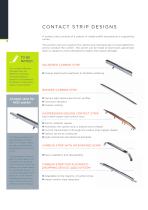
C ontact stri p designs A contact strip consists of a carbon or metal profile mounted on a supporting carrier. The carrier's role is to support the carbon strip mechanically, to resist deflection and to conduct the current. The carrier can be made of aluminium, galvanised steel or copper to resist atmospheric attack and impact damage. To be noted! Soldered carbon strip Our current collection bonded strips are DIN6701-2 certified (German standard specific to the adhesive bonding of components used on rail vehicles). l Copper electrolytic treatment to facilitate soldering Bonded carbon strip Contact...
Open the catalog to page 10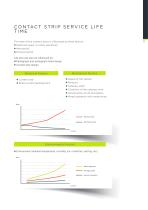
C ontact stri p S ervice L i f e time 11 The wear of the contact strips is influenced by three factors: l Electrical (wear is mostly electrical) l Mechanical l Environmental Life time can also be influenced by: l Pantograph and pantograph head design l Contact strip design Electrical factors Mechanical factors l Brake current feeding back l Pressure l Catenary pitch l Condition of the catenary wire l Construction of rail foundation l Mixed operation with metal strips Electrical wear Mechanical wear Environmental factors l Environment (ambient temperature, humidity, ice / hoarfrost, salt fog,...
Open the catalog to page 11All Mersen Power Transfer Technologies catalogs and technical brochures
 RAILWAYS & TRANSIT
2 Pages
 CG677
CG6772 Pages
 CURRENT COLLECTOR DEVICE
4 Pages
 SURGE PROTECTION SOLUTIONS
24 Pages
 TRANSPORTATION RAILWAYS
6 Pages
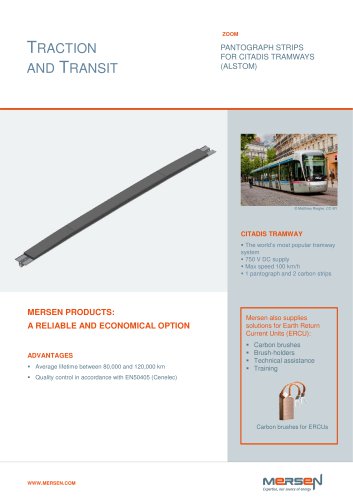
 TRACTION AND TRANSIT
2 Pages
 performance by mersen
20 Pages
 BOOSTEC® SiC
9 Pages
 PRODUCT CATALOG
348 Pages
 BRUSH GEAR SYSTEMS
5 Pages
 ULTIMATE HCl ABSORBER
1 Page
 EcoDesign 3rd rail shoes
2 Pages
 Ski lifts
2 Pages
 MERSEN OEM WIND SOLUTIONS
2 Pages

















- Rectangular housing
- Surge protector
- Electrical rotary joint
- Power transmission belt
- Wall-mount box
- Isolator switch
- Metal slip ring
- Compact housing
- Hollow-shaft electrical slip ring
- Electric electrical rotary joint
- Industrial electrical slip ring
- Greasing system
- Flat power transmission belt
- Stainless slip ring
- Suction unit
- Custom-made slip ring
- Automatic disconnector
- Fiber brush electrical rotary joint
- Steel rail
- High-performance slip ring