


- Company
- Products
- Catalogs
- News & Trends
- Exhibitions
Universal power catalogue

Universal power catalogue
- MPQ1000: A hand-held power quality analyzer known for its unmatched capability and user-friendly design.
- MV DAC: A test and diagnosis system for medium voltage (MV) cables, featuring a peak voltage of 30 kV.
- TORKEL900: A battery load tester suitable for systems ranging from 12 to 300 V.
- OTD: An oil tan delta tester for transformer oil testing.
- TDM45: A high-power test and diagnosis combination for MV cables.
- UHF PDD: A hand-held online substation partial discharge detector.
- CENTRIX 2.0: A cable test van system that combines cable testing, diagnostics, and fault techniques.
- DC diagnostic and overvoltage testing, AC insulation testing, and low resistance testing are covered, highlighting their importance in identifying insulation breakdowns and ensuring equipment reliability.
- Includes circuit breaker testing, contact resistance testing, analyzer systems, primary injection testing, and protective relay testing.
- Features tan delta test systems, CT testers, turns ratio systems, transformer ohmmeters, and multifunction test systems.
- Focuses on diagnostic testing, partial discharge detection, VLF cable testing, and cable fault location techniques.
- Covers power quality measurement, earth or ground testing, battery testing, and test data management software.
- Insulation Resistance Testers: Various models like S1-568, S1-1068, and S1-1568 offer features such as high noise rejection, remote control, and real-time data download.
- High Voltage Test Units: Models like T99/1 and 220000 series provide portable and powerful DC voltage sources for testing electrical components.
- AC Insulation Testers: Systems like HPA100AC and DELTA4000 series offer accurate insulation condition assessments with features like automatic power factor measurement and temperature correction.
1. Power Supply Voltage Tester (EGIL)
This device provides a controllable DC power source for breaker coils and spring-charging motors, ideal for minimum pick-up and under voltage tests as per IEC 62271-1 standards.
2. Vacuum Interrupter Tester (VIDAR)
Features include low weight, small size, fast testing, and immediate pass/fail feedback with a test voltage range of 10-60 kV DC.
3. Load Tap Changer Testing Power Supply (LTC135)
Used with Megger's circuit breaker analysers to record dynamic voltage and resistance, enhancing understanding of tap changers.
4. Static and Dynamic Resistance Measurement (SDRM202)
Utilizes high current supply for accurate DRM results, fast charging, and low weight. It measures contact resistance during operations and is compatible with all Megger circuit breaker analysers.
5. Vibration Testing
Directly measures mechanical behavior of circuit breakers using CABA Win Vibration software, which provides intuitive analysis and feedback.
6. Breaker Analyser Software (CABA Win)
Offers pre-defined test plans, a Test Plan Editor, and convenient report generation. Compatible with TM1800, TM1700, and EGIL.
7. Primary Injection Testing Systems
Includes systems like ODEN AT and PCITS2000/2 for testing protective relay equipment and circuit breakers, featuring advanced measurement capabilities and flexible configurations.
8. Relay and Substation Test Systems (SVERKER Series)
Designed for three-phase testing, these systems offer a combination of current and voltage sources with versatile measurement possibilities. The SVERKER900, SVERKER650, SVERKER750, and SVERKER780 models cater to various testing needs.
9. Test Terminal Blocks and Timer Units
Provide reliable panel connections and precise timing for substation applications.
10. Phase Angle Meter (PAM410)
Measures phase angle relationships in high voltage substations and industrial locations.
- PAM410 and PAM420: These models offer an extended range of measurements including phase angle, voltage, current, frequency, and timing. They are automatic single-phase relay test sets.
- SMRT Series: Known for being powerful, tough, and light, these systems are housed in rugged plastic cases and offer modular designs. They include models like SMRT1, SMRT33, SMRT43, SMRT46, and SMRT410, each varying in the number of voltage and current channels, weight, and flexibility.
- FREJA500 Series: Distinguished by built-in touch screens running FREJA Win Local software, these systems offer IEC61850 testing capabilities and are suitable for testing relay panels or electromechanical relays.
- DELTA4000: A tan δ test system that offers accurate temperature correction and dynamic frequency response testing. It is suitable for assessing the condition of electrical insulation in high-voltage equipment.
- CDAX605: A capacitance and dissipation factor bridge designed for laboratory, production line, or field testing of electrical equipment insulation.
- TTR300 Series: These 3-phase turns ratio testers allow for automated testing of transformers, measuring phase deviation and verifying phase errors.
- MRCT: A current transformer tester that performs various tests including demagnetization, ratio, saturation, and insulation tests on current transformers.
- MWA300 Series: A 3-phase ratio and winding resistance analyzer that tests all sizes and types of transformers, offering high productivity and performance in noisy environments.
- RTMS: Relay and test management software compatible with the entire Megger SMRT family, offering a full relay database management system.
- PowerDB OnBoard: Embedded asset management software providing consistent, repeatable tests and data analysis without the need for an external computer.
- Automatic and manual testing options with various control interfaces including touch screens and PC software.
- IEC61850 testing capabilities for modern relay systems.
- Modular designs allowing for daisy chaining of units to increase channels and power.
- Advanced features like dynamic noise suppression, intelligent temperature correction, and comprehensive data storage and transfer options.
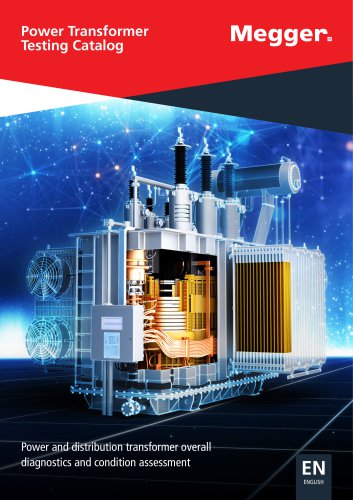
This document provides an overview of various testing instruments and technologies used in electrical power systems, focusing on transformer testing, dielectric strength testing, and multifunction test systems.
Communication Technologies
The instruments feature advanced communication technologies, including USB and Ethernet interfaces, allowing seamless integration with peripheral devices such as printers and PCs. Storage is facilitated by internal flash memory or external USB drives.
User Interface and Training
A common user interface across instruments reduces training time. Instruments like the TTR330 feature a large color display and forms-based setup, allowing for easy control and secure report generation.
Power Transformer Testing
The MTO300 series offers automated testing of transformer windings, saving time and ensuring safety with built-in discharge functions. The series includes models like MTO330 with onboard computers for advanced control and data storage.
Dielectric Strength Testing
Megger's OTS test sets measure the dielectric strength of insulating oils, with models designed for both laboratory and portable use. Features include precise electrode gap adjustment and fast HV switch-off to minimize oil deterioration.
Karl Fischer Testing
Karl Fischer test sets, such as KF875 and KF-LAB, measure moisture in insulating oils using titration, a standard method for assessing transformer oil quality.
Multifunction Test Systems
The TRAX system is a versatile tool for testing transformers and substations, offering a range of tests including turns ratio, winding resistance, and power factor. It supports both manual and automated testing via apps.
Frequency Domain Spectroscopy and Analysis
FDS and SFRA techniques are used for assessing moisture content and mechanical integrity of transformers. Instruments like FRAX101 and FRAX150 provide high accuracy and comply with international standards.
Insulation Diagnostic Analyser
IDAX300 and IDAX350 analyzers use FDS techniques for rapid moisture assessment in transformers, offering automated measurement and analysis capabilities.
Partial Discharge Detection
New systems for partial discharge detection enhance Megger's cable testing capabilities, allowing for proactive maintenance and fault prediction in cable networks.
The document provides an overview of various cable testing and diagnostic systems designed for network operators to assess the quality and condition of cables efficiently. These systems utilize advanced technologies to locate faults and perform partial discharge (PD) diagnostics, ensuring reliable decision-making and compliance with international standards.
Combined Cable Test and Diagnosis Systems
The TDS NT40 and TDS NT60 systems offer faster and more reliable information about cable conditions using 50 Hz slope technology. They combine VLF cosine-rectangular voltage (VLF CR) and damped alternating voltage (DAC) for withstand testing and PD diagnosis. These systems are compliant with IEC 60502-2 and IEEE 400.2 standards.
Partial Discharge Pin-Pointing System
The PD LOC system is designed to pinpoint PD in mixed cables and joints of single-core cables. It includes a PD TX impulse transmitter and a Teleflex SX receiving and evaluating unit, which processes signals and visualizes the distance to the transmitting unit.
High Voltage DAC Systems
The HV DAC200 and HV DAC300 systems apply damped AC voltage techniques for maintenance and commissioning of high voltage cables up to 230 kV. They identify and evaluate partial discharges, with measurements comparable to power frequency conditions.
Medium Voltage DAC System
The MV DAC-30 system identifies and evaluates partial discharge in cable insulation and accessories, replicating operational conditions with a waveform similar to the 50/60 Hz power frequency.
Partial Discharge Diagnostics
The PDS60 PD module works with various voltage sources to perform PD diagnostics using automatic analysis algorithms. The UHF PD Detector is a handheld tool for quick, non-invasive surveys in substations, providing accurate PD measurements and noise differentiation.
High Power Test and Diagnostics for MV Cables
The TDM 45 series offers a flexible solution for testing and diagnostics of MV cables, using VLF Sine, VLF CR, and HV DAC methods. Its modular concept allows customization based on specific testing needs.
VLF Insulation Testing
VLF testing at 0.1 Hz is used for XLPE cables to prevent insulation damage. Systems like the VLFCR series and VLF Sinus series offer various voltage and waveform options for comprehensive testing, including sheath testing and fault pinpointing.
Cable Test Vans
Megger provides van-mounted systems for cable fault location and testing, offering modular solutions for low and medium voltage networks. These systems integrate various testing methods and safety features for efficient operation.
- SFX32: A mobile system for testing and fault locating on low and medium voltage cables with test and surge voltages up to 32 kV. It uses the Short Period Arc Reflection Method for high resistance faults and the Teleflex TFX-SX TDR module for low resistance faults.
- SFX40: A mobile, multi-functional system for testing, pre-location, pinpointing, and converting cable faults with DC output up to 40 kV and surge energies of 1000 J or 2000 J.
- SFX5-1000 and SFX8-1000: Portable systems for cable testing and fault location with outputs of up to 5 kV and 8 kV respectively, and surge energies of 1000 J.
- HVB10: A high-voltage bridge for locating cable and sheath faults, especially suited for long HV cables, with a powerful discharge unit for safe cable discharge.
- digiPHONE+: A surge wave receiver integrating audio and electromagnetic functionality for efficient fault pin-pointing in noisy environments.
- MFM10: A sheath fault location system for testing and pinpointing cable sheath faults, enclosed in an IP53 wheeled case for portability.
- ESG NT: Used with DC or pulsed DC sheath test outputs for pinpointing sheath faults using step voltage or pool of potential techniques.
- EasyLoc: A system for detecting and tracing underground cable runs and pipe networks, providing both aural and visual confirmation of location.
- MPQ Series: Power quality analysers compliant with IEC61000-4-30 Class A, capable of measuring various electrical parameters and providing detailed waveform analysis.
- PQA1000 Series: Designed for load analysis, data-logging, and online analysis of networks, with versions offering additional parameters and automatic power reports.
- DET Series: Earth resistance testers with features like noise reduction, CATIV safety rating, and IP54 protection, suitable for various testing techniques including two, three, and four pole methods.
- PowerDB: A relational database system that simplifies the management of electronic test records, preventing data loss through multiple safeguards and synchronization across machines.
- Low Voltage Testing: Includes hand-held test equipment for ensuring safe installations, with products like the LT300 and LTW300 series offering high current loop testing and non-tripping loop testers.
- Residual Current Device Testers: The RCDT300 series tests a range of RCDs with features like auto RCD test and ramp testing.
- Portable Appliance Testing: The PAT series offers testers for in-service inspection and testing of electrical equipment, with options for data storage and high-speed testing.
- Multifunction Installation Tester: The MFT series provides comprehensive testing capabilities, including insulation resistance and earth loop impedance testing, with Bluetooth connectivity for paperless certification.
- Multimeters and Clampmeters: Devices like the AVO410 and DCM series offer true RMS measurements and earth leakage detection, respectively.
- Isolation Test Kits: The TPT320 and MPU690 provide voltage indication and circuit verification.
- Insulation Resistance and Continuity Testers: Various series like MIT400/2 and MIT300 offer diagnostic capabilities and are designed for industrial maintenance and telecommunications.
- These testing devices are suitable for a wide range of applications, including industrial maintenance, electrical contracting, and telecommunications.
- They are designed to meet safety standards, with many offering CAT IV safety ratings.
- The document recommends using these devices for efficient and reliable testing, ensuring compliance with wiring regulations and safety standards.
Catalog excerpts

Test instruments for the maintenance of electrical power systems
Open the catalog to page 1
New products Hand-held power quality analyser MPQ1000 Unmatched capability in a smart easy to use package. See page 49 Test and diagnosis system for MV cables MV DAC A DAC (Damped AC) voltage test set with a peak voltage of 30 kV. Battery load tester TORKEL900 For testing battery systems ranging from 12 to 300 V. See page 53 An addition to Megger’s extensive range transformer oil tests. Test system for MV cables TDM45 High power test and diagnosis combination for MV cables. See page 35 UHF partial discharge detector UHF PDD Hand-held online substation PD surveying system. See page 35 Cable test...
Open the catalog to page 2
INSULATION TESTING AND CONTINUITY DC diagnostic P 4 - 5 DC overvoltage or withstand P 6 - 7 AC insulation testing P 8 - 9 Low resistance testing P 10 - 11 POWER PROTECTION Circuit breaker testing Contact resistance testing P 12 - 13 Analysers systems P 14 - 17 Primary injection testing P 18 - 19 Protective relay testing Relay testing system P 20 - 21 Complex relay test systems P 22 - 23 POWER TRANSFORMER TESTING Tan 6 test system P 24 Turns ratio systems, TTR P 26 - 27 Transformer ohmmeters P 26 - 27 Transformer insulation oil testing P 28 - 29 Multifunction test systems...
Open the catalog to page 3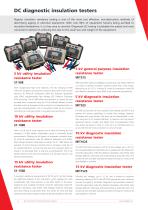
DC diagnostic insulation testers Regular insulation resistance testing is one of the most cost effective, non-destructive methods of identifying ageing in electrical equipment. With over 60% of equipment failures being ascribed to insulation breakdown, it is a key area to monitor. Diagnostic DC testing is probably the easiest and most convenient method of achieving this due to the small size and weight of the equipment. 5 kV utility insulation resistance tester S1-568 With exceptionally high noise rejection, the fast charging S1-568 offers the full gamut of automatic insulation tests with 8 mA...
Open the catalog to page 4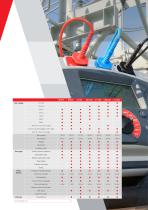
Test voltage 1 kV to max test voltage in 25 V steps Leakage current Test types Timed insulation resistance Polarisation index Dielectric absorption index Step voltage Dielectric discharge Analogue and digital display Short circuit current Timer control and display Other feature Remote control via USB port USB output Bluetooth output Software PowerDB Lite
Open the catalog to page 5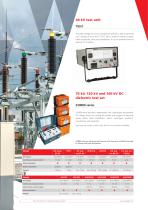
40 kV test unit T99/1 The high voltage test unit is portable and powerful, able to generate a DC voltage of up to 40 kV. The T 99/1 is used for testing of cables, cable accessories, plant and installations. It can be powered from an external 12 V battery. 220000 series provides a dependable, safe, lightweight and portable DC voltage source for testing the quality and integrity of electrical power cables, cable installations, motors, switchgear, insulators, transformers and capacitors. Each test set comes in two units, the HV unit and the controller. 220000 series has advanced performance with...
Open the catalog to page 6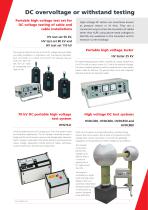
DC overvoltage or withstand testing Portable high voltage test set for DC voltage testing of cable and cable installations HV test set 50 kV, HV test set 80 kV and High voltage DC testers are sometimes known as pressure testers or Hi Pots. They are a convenient way to stress the insulation of cables other than XLPE using above-rated voltages to identify any weakness in the insulation and to measure current leakage. This range of three HV test sets is for the DC voltage testing of cables and cable installations in accordance with international standards. Each set consists of a control unit and...
Open the catalog to page 7
AC insulation testers AC insulation testers most closely replicate the normal operating condition for a substation asset. Consequently they provide the most accurate indication of the insulation condition. AC high voltage test system T22/1 This system is of two piece design and offers continuously variable test voltages up to 75 kV. Its performance is expandable to 150 kV AC by the addition of a second transformer. It features built-in overload protection. The test set can be equipped with a rectifier accessory for DC testing up to 80 kV. DC and AC high voltage test system DC and AC high voltage...
Open the catalog to page 8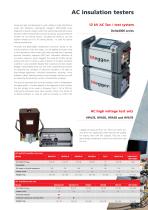
AC insulation testers 12 kV AC Tan δ test system Tough yet light and designed to work reliably in high-interference areas, like substation switchyards, Megger’s DELTA4000 series diagnostic insulation systems offer time saving fully automatic power factor/tan delta measurement and tip-up testing. Also provided are facilities for full manual control –including the ability to vary the applied voltage up to 12 kV during testing – to cater for special testing requirements. Accurate and dependable temperature correction, based on the actual condition of the test object, can be applied to results using...
Open the catalog to page 9
10 A micro-ohmmeter with test results storage and downloading DLRO10X Low resistance testing Low resistance testers or micro ohmmeters have many applications. Most are used for testing the integrity of joints, as there can be serious consequences if there are bad connections in critical electrical systems, poor earths, heating in connections, broken rails on the railways, or on aircraft wings. Routine maintenance using low resistance testers, sometime known as Ducter low resistance ohmmeters, can highlight problems before they become catastrophic. The DLRO10X offers a 0.1 jO resolution with a...
Open the catalog to page 10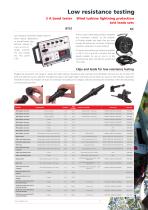
BT51 Low resistance ohmmeter ideally suited for bond testing applications, i.e. aircraft frames. Four terminal method of measurement ranges 0-20.00 mO and 0-2000 mO. Test current is 2A. The KC series of test leads provide a complete and convenient solution to the problem of finding reliable test leads that are long enough for testing the continuity of lightning protection conductors in wind turbines. KC-series wind turbine test leads are available in 100 m, 50 m and 30 m versions that are equally suitable for use on site or in the manufacturing plant. All lead set versions are 10 A rated. Clips...
Open the catalog to page 11
Contact resistance testing For testing circuit breaker contact resistance in compliance with IEC62271-100, specialist low resistance testers are used with a high output current. For this and other applications that require a higher test current, Megger offers an extensive range of testers that will fit your testing regime. Testing with DualGround™ Deregulation changed the business environment for utilities, switchgear owners and their service companies. It has increased the emphasis on efficiency of operation, maintenance and service levels. Likewise the internationalisation of the business has...
Open the catalog to page 12All MEGGER catalogs and technical brochures
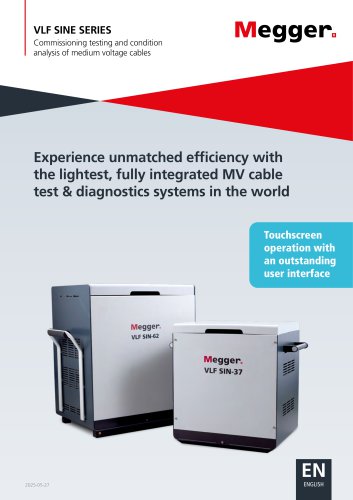 VLF SINE SERIES
8 Pages
 MFT-X
MFT-X9 Pages
 digiPHONE+2
8 Pages
 SPG 5-1000
2 Pages
 SFX32 and SFX40
2 Pages
 PFL22M1500
2 Pages
 BITE ® ACCESSORIES
4 Pages
 EZ-THUMP™ 12 kV, Model V2
3 Pages
 EZ-Restore OVERDRIVE Series
2 Pages
 digiPHONE+
2 Pages
 Stationary battery testing
12 Pages
 Torkel 900
6 Pages
 TRAX Accessory | TDX120
4 Pages
 Easyloc
3 Pages
 SMART THUMP
3 Pages
 TRAX
TRAX24 Pages
 Micro-ohmmeter | MOM2
6 Pages




- Digital imager
- Visible imager
- Measuring device
- Industrial camera module
- Monitoring analyzer
- Dry transformer
- Analysis software solution
- Infrared imager
- Measuring machine
- Automatic analyser
- Real-time software
- Windows software
- Cloud-based software
- Calibration system
- USB camera module
- Detection camera system
- MEGGER portable tester