


- Company
- Products
- Catalogs
- News & Trends
- Exhibitions
Circuit breaker testing catalogue

Circuit breaker testing catalogue
This document serves as a comprehensive guide for testing high and medium voltage circuit breakers, highlighting the necessity of reliable testing equipment and procedures to ensure circuit breakers are operationally ready, as they are vital components in power systems.
- Purpose: Circuit breakers protect power systems by activating during faults. Testing ensures their proper functionality when required.
- When to Test: Testing is conducted during development, production, commissioning, maintenance, fault tracing, and re-commissioning phases.
- Types of Tests: Includes insulation resistance, contact resistance, contact timing, travel (stroke, speed, damping, wipe), and operating coil current tests.
- 28% of breakers fail to close on command.
- 16% fail to open on command.
- 10% experience breakdowns (poles, ground).
This guide provides configurations for various circuit breaker testing scenarios, including main contact timing, coil current, motion, auxiliary contact timing, and resistance measurements. It emphasizes the use of DualGround™ technology for safe and efficient testing.
- TM1700 and TM1800 Series: Modular designs suitable for various breaker types, featuring DualGround™ testing for enhanced safety and efficiency.
- EGIL: Lightweight and user-friendly for medium-voltage breakers, capable of static and dynamic resistance measurements.
- SDRM202: Offers precise dynamic resistance measurement with high current supply.
- VIDAR: Utilizes DC voltage to test vacuum interrupters quickly and reliably.
The document stresses compliance with international standards such as IEC EN 50110-1 and IEC 62271-1, ensuring all parts are earthed and short-circuited during testing. DualGround™ technology is highlighted for maintaining safety throughout the testing process.
- CABA Win: Software for creating test plans, comparing results, and generating reports.
- Accessories: Include power supply units and various measurement modules to enhance testing capabilities.
Reliable testing of circuit breakers is crucial for maintaining the integrity of power systems. Megger provides a range of tools and technologies to facilitate accurate and efficient testing, ensuring circuit breakers are ready to operate when needed.
The document outlines transient voltage levels for different categories of electrical equipment: CAT IV is 6000V, CAT III is 4000V, CAT II is 2500V, and CAT I is 1500V. CAT I transient levels can be specified differently and are designed and tested to withstand expected transients.
The document mentions a guide to low resistance testing available for download at Megger's website. It highlights various micro-ohmmeters for resistance testing, including hand-held and battery-operated models with features like Bluetooth communication, compliance with IEEE and IEC standards, and high noise immunity.
Several models are described, such as the MOM2, DLRO100 series, DLRO200 & DLRO600, MOM690, and MJÖLNER series. These devices offer features like high DC output current, memory for test results, remote control, and software compatibility for data management.
The document discusses the importance of motion diagrams and timing graphs for circuit breaker operations. It emphasizes the need for precise mechanical performance to prevent re-strikes and highlights the significance of breaker contact motion as a parameter for checking interrupting capacity.
First trip testing is presented as an effective method to assess circuit breaker conditions by documenting behavior during the first open operation after a period of inactivity. This method allows for real-world condition testing and helps identify breakers needing further investigation. Key parameters include coil current characteristics and secondary current of current transformers.
The document stresses the importance of flexible test systems to handle various situations, with accessories available in the Circuit Breaker Testing accessory catalogue.
Catalog excerpts

High and Medium Voltage Circuit Breaker Testing The word ‘Megger’ is a registered trademark Copyright © 2016 Megger Limited, Archcliffe Road, Dover CT17 9EN, Englan
Open the catalog to page 1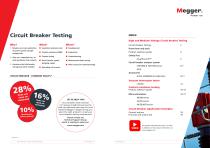
Circuit Breaker Testing INDEX High and Medium Voltage Circuit Breaker Testing Circuit Breaker Testing. 1. Breakers are main protection of power system on high voltage side. ■■ Insulation resistance test Product selection guide Safety first ■■ Travel (stroke, speed, damping, wipe) 2. They are ”extended arm” of relay protection trip contacts 3. Assurance that the breaker will operate when needed ■■ After service (re-commissioning) Circuit breaker analyzer system ■■ Operating coil current CIRCUIT BREAKER - COMMON FAULTS* Vacuum interrupter tester 28% t Does no close on nd comma Contact resistance...
Open the catalog to page 2
High voltage circuit breakers are extremely important for the function of modern electric power supply systems. The breaker is the active link that ultimately has the role of operating the primary circuit when a fault has occurred. The breaker has to perform its duty within a few milliseconds, after months, perhaps years of idly standing by. Since Reliability Centered Maintenance (RCM) and condition based maintenance have become the established strategies for most owners and operators of electric power supply systems, the need for reliable and accurate field test instruments is obvious. Ever...
Open the catalog to page 3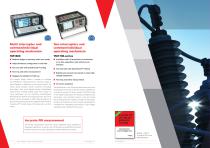
Multi interrupter and common/individual operating mechanism Two interrupters and common/individual operating mechanism ■ Modular design to precisely match your needs ■ Available with full stand-alone functionality or as data acquisition units without user interface ■ Adapt hardware configuration in the field ■ Fast and safe with DualGround™ testing ■ First trip and online measurement ■ Rugged and reliable for field use The modular design makes it possible to configure the TM1800 for measurements on all known types of circuit breakers in operation on the world market. The robust design product...
Open the catalog to page 4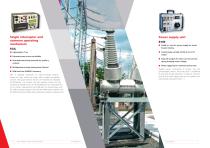
Single interrupter and common operating mechanism Power supply unit B10E ■ Stable a.c. and d.c. power supply for circuit breaker testing ■ Continuously variable 24-250 V AC or DC output ■ Lightweight <7 kg ■ Extremely easy-to-use and reliable ■ Separate outputs for close coil, trip coil and spring charging motor voltage ■ Two dedicated timing channels for auxiliary contacts ■ Direct triggering for minimum pick-up test ■ Multipurpose analog measurement channel Supplies power conveniently to breaker coils and springcharging motors. Since this power is unaffected by load and virtually ripple-free,...
Open the catalog to page 5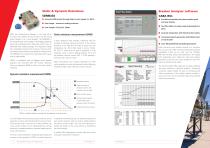
DRM is a reliable method to estimate the length/wear of arcing contact Static & Dynamic Resistance SDRM202 ■ Accurate DRM results through high current supply 2 x 200 A ■ Fast charge - minimum waiting intervals ■ Low weight, 4.3 kg incl. cables Rjfidd CUTVti |A| I 200 ftjfled Supply VoRege 325V DC Iram-iyeirte mWium Rated Frequency |liizf Rated Motor VaRagn |V| 240 VAC Breaker Analyzer software CAB A Win ■ Pre-defined standard test plans enables quick and easy testing ■ Test Plan Editor to easily create customized test plans ■ Accurate comparison with historical test results ■ Convenient...
Open the catalog to page 6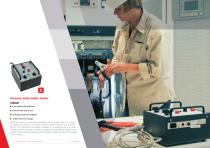
Vacuum interrupter tester VIDAR ■ Low weight and small size ■ Fast test and easy to use ■ Immediate pass/fail feedback ■ 10-60 kV DC test voltage VIDAR tests vacuum in circuit breaker chambers using DC voltage. When AC is used, the capacitive component of the current flowing through the chamber must be tested. With DC, this is eliminated. The resistive component of the leakage current is very small compared with the capacitive component, because of the high dielectric strength of the chamber. The DC flashover voltage is equal to the peak AC voltage. Testing can be completed in a few minutes. High...
Open the catalog to page 7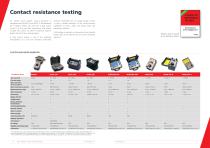
Contact resistance testing For testing circuit breaker contact resistance in compliance with IEC62271 and IEEE C37.09 specialized low recistance testers are used with a high output current. For this and other applications that require a higher test current, we offer an extensive range of testers that will fit your testing regime. A high current output is one of the qualifying characteristics of a true low resistance ohmmeter. Ordinary multimeters do not supply enough current to give a reliable indication of the current-carrying capabilities of joints, welds and bonds under real operating conditions. Little...
Open the catalog to page 8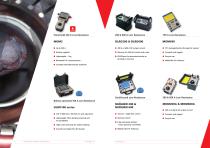
■ CT’s demagnitization through AC output ■ Memory for 300 test results and notes ■ RS232 port for download results or printing in real time ■ Complies with IEEE and IEC standards Battery operated 100 A Low Resistance ■ 200 A or 600 A DC output current ■ CAT IV 600 VAC / 500 VDC for safe operation ■ True DC – ripple free current ■ Lightweight 100 A battery powered unit for portability ■ High noise immunity for stable readings ■ Smooth and ripple free DC Output High and Medium Voltage Circuit Breaker Testing ■ Fully automatic testing - micro-processor controlled ■ Mjölne
Open the catalog to page 9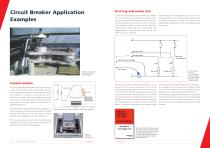
Circuit Breaker Application Examples First trip and online test A good and time effective way to check the condition of a circuit breaker is to document its behavior at the first open operation after it has been idle for long time. The measurement and connections to the circuit breaker are carried out while it is still in service. All of the connections are made inside the control cabinet. The biggest benefit of using first trip testing is to test “real world” operating conditions. Another benefit with this method since the breaker is measured online is that it can be used to quickly screen the breaker...
Open the catalog to page 10All MEGGER catalogs and technical brochures
 VLF SINE SERIES
8 Pages
 MFT-X
MFT-X9 Pages
 digiPHONE+2
8 Pages
 SPG 5-1000
2 Pages
 SFX32 and SFX40
2 Pages
 PFL22M1500
2 Pages
 BITE ® ACCESSORIES
4 Pages
 EZ-THUMP™ 12 kV, Model V2
3 Pages
 EZ-Restore OVERDRIVE Series
2 Pages
 digiPHONE+
2 Pages
 Stationary battery testing
12 Pages
 Universal power catalogue
60 Pages
 Torkel 900
6 Pages
 TRAX Accessory | TDX120
4 Pages
 Easyloc
3 Pages
 SMART THUMP
3 Pages
 TRAX
TRAX24 Pages
 Micro-ohmmeter | MOM2
6 Pages




- Digital imager
- Visible imager
- Measuring device
- Industrial camera module
- Management software solution
- Monitoring analyzer
- Dry transformer
- Analysis software solution
- Infrared imager
- Measuring machine
- Automatic analyser
- Real-time software
- Windows software
- Calibration system
- Cloud-based software
- USB camera module
- Detection camera system
- MEGGER portable tester
- Capacitor