
- Catalogs
- Megger Germany GmbH & SebaKMT
- 4 wave forms


4 wave forms
1 /20Pages
4 wave forms
1 /20Pages
Catalog excerpts
Your compass for testing and diagnostics of medium voltage cables Withstand testing and monitored withstand testing Partial discharge diagnostics Loss factor measurement (Tan Delta) Sheath testing
Open the catalog to page 1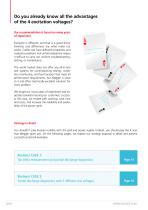
Do you already know all the advantages of the 4 excitation voltages? Our recommendation is based on many years of experience Everyone is different, and that is a good thing. Diversity and differences are what make our world. Cables too have different properties and material conditions. But unfortunately this makes it difficult to carry out uniform troubleshooting, testing, or maintenance. The world market does not offer any all-in-one test systems for commissioning testing, condition monitoring, and fault location that meet all performance requirements, but Megger is close to it and offers technically...
Open the catalog to page 2
Ensuring reliable power supply through advanced cable testing and diagnostics Effective cable testing and diagnostics – the key to the security of supply in cable networks Cable testing and diagnostics are essential tools in ensuring the security of supply in your cable networks. While cable testing is limited to detecting immediately hazardous faults directly after cable routing or repair, cable diagnostics provides a way to obtain detailed information about the integrity of cable insulation. This newly acquired information Budget, plan, and can be used to budget, plan, and integrate future...
Open the catalog to page 4
Asset management Cable asset management is a key tool for energy suppliers to ensure the safe operation of their supply network. There are various strategies to prevent unplanned outages while maximizing the lifespan of the installed technology. Since the early 1990s, cable withstand testing using 0.1 Hz VLF Sine waves and 0.1 Hz VLF cosine-rectangular waves has become standard. These tests confirm that there are no immediate faults in the cable insulation and that the cable system is ready for operation. However, because cable testing cannot predict the future condition of the system, cable...
Open the catalog to page 5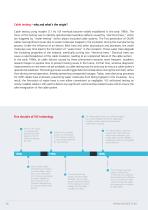
Cable testing – why and what's the origin? Cable testing using modern 0.1 Hz VLF methods became widely established in the early 1990s. The focus of this testing was to identify operationally hazardous defects caused by “electrical trees,” which are triggered by “water-treeing” within plastic-insulated cable systems. The first generation of (XL)PE cables had significant issues due to water molecules trapped in the insulation during the manufacturing process. Under the influence of an electric field, heat and other by-products and processes, the water molecules over time lead to the formation of...
Open the catalog to page 6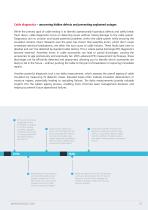
Cable diagnostics – uncovering hidden defects and preventing unplanned outages While the primary goal of cable testing is to identify operationally hazardous defects and safely break them down, cable diagnostics focus on detecting issues without risking damage to the cable system. Diagnostics aim to uncover and locate potential problems within the cable system while ensuring the insulation remains intact. Research over the years has shown that assembly errors, which don’t cause immediate electrical breakdowns, are often the root cause of cable failures. These faults take time to develop and can’t...
Open the catalog to page 7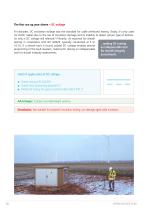
The first ace up your sleeve – DC voltage For decades, DC excitation voltage was the standard for cable withstand testing. Today, it’s only used for HVDC cables due to the risk of insulation damage and its inability to detect certain type of defects. So why is DC voltage still relevant? Primarily, it’s essential for sheath testing in compliance with IEC 60229, typically conducted at 5 to ...making DC testing 10 kV. If a sheath fault is found, pulsed DC voltage enables precise an indispensable tool pinpointing of the fault location, making DC testing an indispensable for sheath integrity tool...
Open the catalog to page 8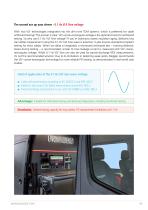
The second ace up your sleeve - 0.1 Hz VLF Sine voltage With two VLF technologies integrated into the all-in-one TDM systems, which is preferred for cable withstand testing? The answer is clear: VLF cosine-rectangular voltage is the optimal choice for withstand testing. So why use 0.1 Hz VLF Sine voltage? If you’re looking to assess insulation aging, dielectric loss (tan delta) measurement using the 0.1 Hz VLF Sine wave is essential. It also ensures standard-compliant testing for short cables. When tan delta is integrated, a monitored withstand test – tracking dielectric losses during testing...
Open the catalog to page 9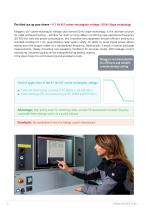
The third ace up your sleeve – 0.1 Hz VLF cosine-rectangular voltage / 50 Hz Slope technology Megger’s VLF cosine-rectangular voltage, also named 50 Hz slope technology, is the ultimate solution for cable withstand testing – whether for short or long cables! Combining near-operational frequency (20-500 Hz) with low power consumption, this innovative test equipment ensures efficient testing at a standard-compliant 0.1 Hz, guaranteeing cable system safety. Its ability to reuse stored power allows testing even the longest cables at a standardized frequency. Additionally, it excels in partial discharge...
Open the catalog to page 10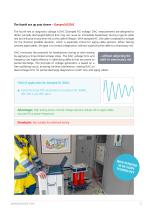
The fourth ace up your sleeve – Damped AC/DAC The fourth test or diagnostic voltage is DAC (Damped AC) voltage. DAC measurements are designed to detect partially discharged defects that may not cause an immediate breakdown during a typical cable test but still pose a long-term risk to the cable’s lifespan. With damped AC, the cable is exposed to voltage for the shortest possible duration, which is especially critical for aging cable sections. When testing severely aged cables, the goal is to conduct diagnostics without subjecting the cable to unnecessary risk. DAC minimizes the potential for...
Open the catalog to page 11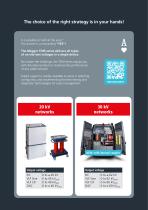
The choice of the right strategy is in your hands! Is it possible to hold all the aces? The answer is a resounding "YES"! The Megger TDM series delivers all types of on-site test voltages in a single device. No matter the challenge, the TDM series equips you with the ideal solution to maximize the performance of any cable network. Expert support is readily available to assist in selecting, configuring, and implementing the best testing and diagnostic technologies for asset management. NEW: with internal coupler Output voltage Output voltage 0 to ± 45 kV 0 to 45 kVpeak 0 to 40 kVRMS 0 to ± 40...
Open the catalog to page 12All Megger Germany GmbH & SebaKMT catalogs and technical brochures
 Cable fault location systems
16 Pages
 SmartEAR
16 Pages
 VLF Sine 37 kV
8 Pages
 HV DAC-200 / HV DAC-300
8 Pages
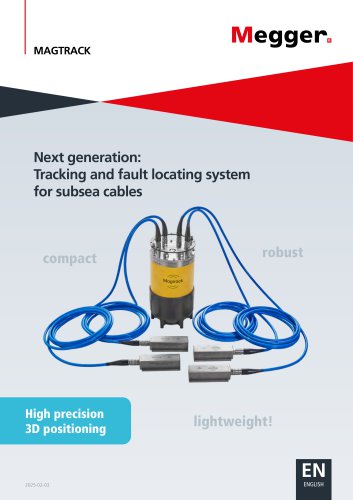 MAGTRACK
8 Pages
 UHF PD detector
12 Pages
 PD SCAN
12 Pages
 Onshore-Offshore
20 Pages
 Case Study: Viking Link
16 Pages
 VLF SINE 62 (V3)
4 Pages
 STX40
STX408 Pages
 M-Thump5-1000
12 Pages
 Correlux C-3
4 Pages
 GT-3-NB-IoT
8 Pages
 Sebalog D-3
4 Pages
 SmartEAR
8 Pages
 Netzwerk-Monitoring
12 Pages
 POSEYEDON
12 Pages
 SebaFlow
8 Pages
 HL 7000
8 Pages
 CI/LCI
8 Pages
 digiPHONE+2
8 Pages
 CARLOC
4 Pages
 FaultSniffer 2
4 Pages
 FERROLUX® SYSTEM
8 Pages
 PRIMEON
20 Pages
 CENTRIX EVOLUTION
16 Pages


- Flowmeter
- Volume flow monitor
- Liquid flow monitor
- Measuring device
- Data logger
- Waterproof flow meter
- Temperature datalogger
- Industrial flow monitor
- Precision flow meter
- Water flow monitor
- Compact flow monitor
- Wireless datalogger
- RS485 flow monitor
- Flow meter with display
- Leak monitor
- Datalogger without display
- Portable gauge
- Ultrasonic flow monitor
- Battery-powered datalogger
- Portable detector