


MEGAFLEX technical handbook

MEGAFLEX technical handbook
Megadyne has been producing transmission belts since 1957, with a focus on polyurethane endless belts since 1990. MEGAFLEX belts, made from thermoplastic polyurethane, offer excellent wear and abrasion resistance. They are customizable and available in grades like MEGAFLEX FCM and MEGAFLEX XMD, suitable for food contact and detectable by metal and X-ray.
MEGAFLEX belts are versatile, used in industries such as ceramics, marble, glass, and food. The range includes models like XL, L, H, XH, T5, TT5, T10, T20, AT5, AT10, AT20, AT15, RPP5, RPP8, RPP14, MTD8, ATG10, and P2.
These belts are made with thermoplastic polyurethane and steel cords, offering high traction and low noise. They resist abrasion, oils, greases, and temperature variations (-25°C to +80°C). Special compounds and cords, including Kevlar®, are available for specific applications.
The handbook includes formulas for calculating belt pitch, length, and pulley size, along with guidelines for belt width and pre-tensioning to ensure proper power transmission.
An example illustrates the selection process for belt pitch, length, and pulley size using machine data like power, RPM, and center distance.
Tables assist in selecting the appropriate belt pitch and width based on power and speed requirements, including friction coefficients and safety factors for various conditions.
- Woodworking Machinery: Includes lathes, band saws, planers, and disk saws with specific torque requirements.
- Brick Machinery: Covers mixers and pug mills with torque specifications.
- Textile Machinery: Details spoolers, warping machines, spinning, and twisting machines.
- Paper Machinery: Includes agitators, calenders, driers, pumps, beaters, and pulpers.
- Printing Machinery: Discusses linotype machines, cutters, folders, and rotary presses.
- Other Equipment: Includes screens, fans, blowers, compressors, pumps, generators, elevators, hoists, centrifuges, rubber machinery, and mills.
- Importance of Correct Tension: Proper belt tension is crucial for system longevity and reliability.
- Pretension Guidelines: Provides formulas for calculating correct pretension based on belt teeth and application type.
- Installation Procedure: Describes using belt tensioning equipment for accurate tension adjustment.
- Alignment and Positioning: Emphasizes the need for parallel and aligned pulleys to prevent belt derailment and equipment damage.
- Material and Construction: Details on compounds, back covers, tooth covers, and cord materials used in MEGAFLEX belts.
- Dimensions and Tolerances: Provides standard widths, thicknesses, and length tolerances for various belt types.
- Tooth Profiles: Conforms to ISO 5296-1 and DIN 7721-1 standards.
- Resistance and Load Capacities: Lists maximum traction loads, breaking strengths, and flexion resistance for different belt materials.
- Use zero or reduced backlash pulleys for improved transmission precision.
- Consult technical staff for specific installation and maintenance queries.
The document discusses the flexibility of cleated belts, noting that belts with teeth have better flexibility than those with welded cleats. It provides standard tolerances for profiles with holes and advises on flexibility and mechanical resistance values.
Megadyne offers custom moulded cleats using high-performance injection systems, allowing for customer-designed profiles.
Megadyne provides special executions for various industries, including self-tracking belts for treadmills and custom belts for marble cutting.
MEGAFLEX belts can be customized with different polyurethane hardness levels and colors, maintaining standard mechanical properties.
Details various cover types and their properties, including hardness, color, cohesion method, thickness range, and resistance to water, abrasion, and oil.
Specifications and performances are subject to change without notice. Consult the Megadyne website for updates.
Catalog excerpts
TECHNICAL HANDBOOK
Open the catalog to page 1
INDEX Introduction to truly endless belts Product range Technical calculation Calculation example Belt selection tables Belt installation Positioning and transmission precision Antistatic polyurethane timing belts Measuring lengths MEGAFLEX feasibility table Special execution photos Special execution feasibility Cover properties MEGAFLEX megadynegroup.com
Open the catalog to page 2
INTRODUCTION TO TRULY ENDLESS BELT Megadyne commenced manufacturing transmission belts in 1957 and extruding polyurethane endless belts in 1990. MEGAFLEX belts are manufactured in thermoplastic polyurethane, which gives superior wear and abrasion resistance. Various grades of steel cords offer good running characteristics even with high tractive load. Great production flexibility grant to designers the possibility to match any technical requirement and solution. By selecting different components and materials, MEGAFLEX belts can be manufactured to meet every customer requirement. Megadyne has...
Open the catalog to page 3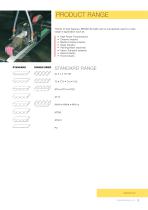
PRODUCT RANGE Thanks to their features, MEGAFLEX belts can be successfully used in a wide range of application such as: • • • • • • • • DOUBLE SIDED High Power Transmissions Ceramic industry Marble & Stone industry Glass Industry Painting Mixer machines Heavy Transport systems Wood industry Food industry
Open the catalog to page 4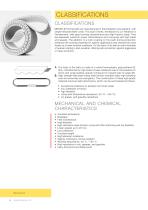
CLASSIFICATIONS CLASSIFICATIONS MEGAFLEX timing belts are manufactured in thermoplastic polyurethane, with single helicoidal steel cords. This type of belts, developed by our Research & Development, offer good running characteristics and high-traction loads. They are especially suited for power transmissions and conveying with high loads and speeds. The addition of a nylon coating on the teeth during production enhances the running properties for specific applications and reduces the noise thanks to a lower frictional coefficient. On the back of the belt an extra thickness of special coating...
Open the catalog to page 5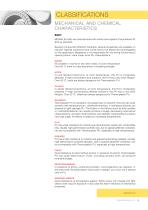
CLASSIFICATIONS MECHANICAL AND CHEMICAL CHARACTERISTICS BODY MEGAFLEX belts are manufactured with white thermoplastic Polyurethane 92 ShA as standard. Special compounds (different hardness, special properties) are available on request. Special compound and cords have to be tested and homologated on the application. Megadyne is not responsible for the wrong functioning of special product. Here under some PU characteristics: WATER No problem in normal or sea clean water, at room temperature. Over 60 ºC there is a fast decrement of breaking strength. ACIDS In acid diluted proportions, at room temperature,...
Open the catalog to page 6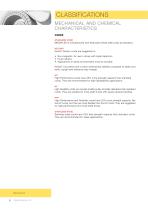
CLASSIFICATIONS MECHANICAL AND CHEMICAL CHARACTERISTICS CORDS STANDARD CORD MEGAFLEX is manufactured with helicoidal zinked steel cords as standard. KEVLAR ® Kevlar ® tension cords are suggested in: • Non-magnetic, for use in drives with metal detectors • Food industry • Applications in damp environments must be avoided Kevlar ® cord belts have a lower dimensional stability compared to steel-cord belts. Length and tolerance may change. HP High Performance cords have 25% more strength capacity than standard cords. They are recommended for high-repeatability applications. HF High Flexibility cords...
Open the catalog to page 7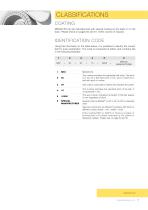
CLASSIFICATIONS COATING MEGAFLEX can be manufactured with special coating on the teeth or on the back. Please check on pages 50 and 51. Other covers on request. IDENTIFICATION CODE Using the information in the table below, it is possible to identify the correct belt for every application. The code is composed of letters and numbers like in the following example: 1 MFX SPECIAL MANUFACTURES This number indicates the requested belt width. The value is in mm for a belt with pitch in mm, and in inches for a belt with pitch in inches. This code is composed by letters and indicates the profile. This...
Open the catalog to page 8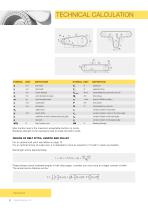
TECHNICAL CALCULATION SYMBOL UNIT SYMBOL UNIT belt width belt length peripheral force centre distance transmittable force per tooth per unit pitch diameter of pulley i drive torque total conveyed mass drive power belt speed force exerted by mass (m) safety factor number of teeth on the pulley i number of teeth in mesh on the drive pulley coefficient of friction between belt and guide number of teeth on the small pulley belt pitch number of teeth on the largest pulley Breaking Strength Max traction load is the maximum acceptable traction on cords. Breaking-strength is the necessary load to break...
Open the catalog to page 9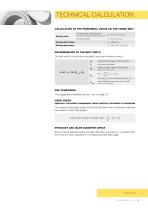
TECHNICAL CALCULATION CALCULATION OF THE PERIPHERAL FORCE ON THE TIMING BELT For horizontal & conveying drives Knowing mass (Note: values of μ can be found in table 3 on page 12) Knowing drive torque Knowing drive power DETERMINATION OF THE BELT WIDTH The belt width b should be calculated using the following formula Cs safety factor from page 13 table number 4 from above calculation number of teeth in mesh on driver pulley (nearest lower integer number) (if calculated Zm > 12 for an open-end application use Zm = 12) transmittable force per tooth per unit width (see table on belt data pages) PRE-TENSIONING...
Open the catalog to page 10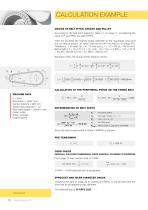
CALCULATION EXAMPLE CHOICE OF BELT PITCH, LENGTH AND PULLEY According to the belt pitch selection, table n.1 on page 11, considering the value of P and RPM, we select RPP5. Then we consider the nearest pulley diameter to the requested value and the corresponding n. of teeth (see technical information on page 29). Therefore z 1 = 30 teeth (d 1 = 47,75 mm) and z 2 = z 1 • 2 = 60 (d 2 = 95,49 mm). Belt length is L = 2c+1,57 (d 1 + d 2) + [(d 2 - d 1)² / 4c] = 2 • 900 + 1,57 • (47,75 + 95,49) + (95,49-47,75)² / (4 • 900) = 2025,5 mm. Because of this, the actual center distance will be: CALCULATION...
Open the catalog to page 11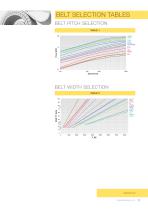
BELT SELECTION TABLES BELT PITCH SELECTION TABLE 1 100 BELT WIDTH SELECTION TABLE 2 100
Open the catalog to page 12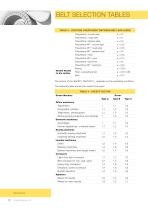
BELT SELECTION TABLES TABLE 3 - FRICTION COEFFICIENT BETWEEN BELT AND GUIDE Volvent friction on dry surface Polyurethane / smooth steel Polyurethane / rough steel Polyurethane / abrasive steel Polyurethane NFT / smooth steel Polyurethane NFT / rough steel Polyurethane NFT / abrasive steel Polyurethane / nylon Polyurethane / aluminium Roller / polyurethane belt The choice of the SAFETY FACTOR C s, depends on the operating condition. The following table shows the value to be used: TABLE 4 - SAFETY FACTOR Driven Machine Computers, printers Teleprinters, photocopiers Motion-picture projectors and...
Open the catalog to page 13All MEGADYNE catalogs and technical brochures
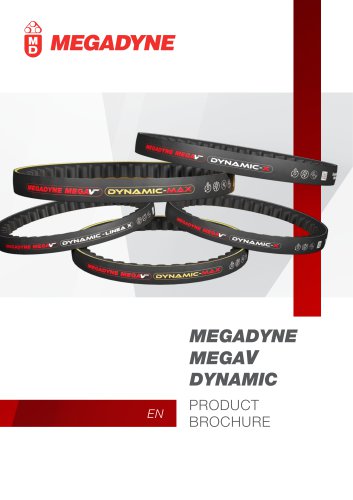 MEGADYNE MEGAV DYNAMIC
8 Pages
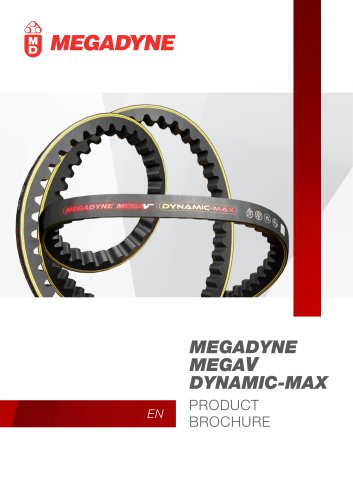 MEGADYNE MEGAV DYNAMIC-MAX
4 Pages
 Fitness industry brochure
12 Pages
 Packaging industry brochure
12 Pages
 Wood industry brochure
12 Pages
 QST system product brochure
8 Pages
 Megapaint product brochure
4 Pages
 PV-belts technical handbook
46 Pages
 MEGAPOWER technical handbook
46 Pages
 MEGAFLAT technical handbook
14 Pages
 MEGALINEAR technical handbook
146 Pages
 Megaweld technical handbook
14 Pages
 V-belts technical handbook
130 Pages
 Engineered and speciality belt
58 Pages
 MegAC4T
2 Pages
 ACCULINK
4 Pages
 MEGADYNE PRODUCTS GUIDE
86 Pages
 MEGALINEAR XHP2
2 Pages


Archived catalogs
 MEGALINEAR RPP14 XHP2
2 Pages
- MEGADYNE industrial belt
- MEGADYNE rubber belt
- MEGADYNE industrial belt
- MEGADYNE plastic belt
- Rigid coupling
- Transmission coupling
- MEGADYNE toothed belt
- MEGADYNE poly V belt
- MEGADYNE sturdy belt
- Sleeve coupling
- Steel flange
- MEGADYNE synchronous belt
- Trapezoidal belt
- Flat power transmission belt
- Pulley belt
- Metal pulley
- Machines belt
- MEGADYNE elastic belt