


MecVel - Screw Jacks Catalogue

MecVel - Screw Jacks Catalogue
This document is the 2023 edition of the MecVel technical catalogue, focusing on screwjacks, bevel gears, shafts, and couplings. It provides detailed specifications, selection guidelines, and maintenance instructions for various models of screwjacks.
The catalogue lists several models of screwjacks, each with specific maximum load capacities and speeds. For example, the HT/HR05 model supports a maximum load of 5000 N with a speed of 58 mm/s, while the HT/HR200 model supports up to 200000 N at 98 mm/s. All models are compatible with AC motors.
Screwjacks are not to be used as safety devices. They convert rotational input into linear motion and can be used individually or in systems. The document emphasizes the importance of considering static and dynamic loads, including pull, compression, side, off-center, shock loads, and vibrations, when selecting a screwjack.
Screwjacks consist of a wormgear system, leadscrew, and nut. Materials include aluminum or cast iron gearboxes, hardened-tempered steel wormscrews, bronze wormwheels, and various types of leadscrews.
Different types of loads affect screwjack performance. Static loads occur when the screwjack is stationary, while dynamic loads occur during movement. The document provides detailed considerations for handling pull, compression, side, and off-center loads.
Backlash between components is minimized for precise movement. Manual and motorized driving options are available, with specific configurations for different screwjack sizes.
Proper installation is crucial to avoid radial loads and ensure perpendicular alignment. Regular maintenance checks are recommended, although the gearstage is filled with long-life grease that typically does not require refills.
The document includes warnings about potential damage from incorrect use, emphasizing the importance of following guidelines for load handling and installation. It also advises on emergency driving procedures and lubrication options.
The document outlines various specifications for MecVel products, including potentiometers, encoders, and screw jacks. Potentiometers are available in 5 k Ohm and 10 k Ohm versions, specifically for the HR-F model. Encoders are available in different configurations such as Push Pull, Line Drive, and Open Collector, with varying pulse per revolution (ppr) ratings.
The document provides detailed specifications for different models of screw jacks (HR/HT 05, HR/HT 10, HR/HT 25, HR/HT 50, HR/HT 100, HR/HT 200). Each model is described with parameters such as maximum force (Fmax), speed, motor size, power, reduction ratio, and pushrod type. The VRS versions are highlighted for specific models.
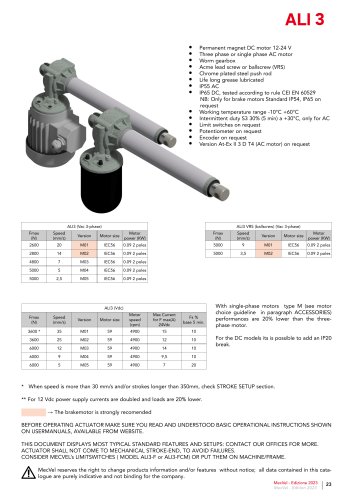
Before operating any actuator, users are advised to read and understand the operational instructions available on the website. For specific applications, contacting MecVel’s technical department is recommended. The use of a brakemotor is strongly advised for safety.
Products are tested according to CEI EN 60529 standards, with IP55 protection as standard and IP54/IP65 available on request for brake motors. The working temperature range is specified as -10°C to +60°C, with intermittent duty S3 30% at 30°C.
The document lists various options and accessories for screw jacks, including different fixing options (eyelet, flanged, clevis, ball joint), additional gearbox settings, and safety features like steel and bronze safety nuts. Dimensions for each option are provided in detailed tables.
MecVel reserves the right to change product information and features without notice. All data in the catalogue are indicative and not binding.
The document outlines various specifications for mechanical components, including nominal stroke, motor data, and protection degrees. It details the types of brakes available, such as DC and AC brakes, and their respective power supply requirements.
Instructions for ordering are provided, including how to specify motor versions, reduction ratios, and additional options like motorflange sizes and protection degrees. The document also includes guidelines for selecting the appropriate brake type based on application needs.
The document emphasizes the importance of using separate power supplies for brakes in motors prepared for frequency converters. It also highlights the need for specific insulation classes and protection degrees depending on the motor version.
Various options are available, such as hand release levers, special motorflanges, and different types of encoders and limit switches. The document also lists additional accessories like safety nuts, potentiometers, and different types of seals.
Performance characteristics of elastomeric elements are detailed, including torque, misalignments, and rigidity. The document provides data on different elastomer hardness levels and their applications, such as low and medium power systems or high transmission torque systems.
A comprehensive list of models and their variations is provided, including different series like HT, HR, and their respective VRS versions. The document also includes information on standard and non-standard options for these models.
Details on standard and clamp-fastened couplings are included, with specifications on torque, material, and installation guidelines. Transmission shaft features are also outlined, focusing on radial mounting, vibration absorption, and material composition.
Buyers must make payments for deliveries even if they fail to withdraw products on time. The Producer will store the products at the Buyer's expense and risk. If the Buyer does not withdraw the products due to reasons not covered under Article 10, the Producer can demand withdrawal within a reasonable time. Failure to comply allows the Producer to terminate the contract and seek damages without court intervention. Penalties for delivery delays must be specified in writing at the contract's conclusion.
The Producer is responsible for remedying defects in design, materials, or processing within 12 months of delivery. Buyers must notify the Producer of defects in writing and allow for repairs. The Producer covers repair costs unless repairs are more convenient on-site. Buyers bear transport costs for defective parts, while the Producer covers costs for repaired or replaced parts. The warranty excludes defects from improper use or modifications without the Producer's consent.
The Producer is not liable for damages if products are modified or used outside intended purposes without consent. Liability for third-party damages requires proof of defect and causation. The Producer is not liable if defects were absent at delivery, if the injured party knowingly exposed themselves to danger, or if damages result from non-compliance with product manuals or use of non-original parts.
Neither party is liable for non-fulfillment due to unforeseeable events beyond control, such as strikes or natural disasters. Parties must notify each other of such events and their impact on obligations. If force majeure persists for over six months, either party may terminate the contract, arranging expense distribution.
Disputes under these conditions are under the exclusive jurisdiction of the Court of Bologna, though the Producer may choose the court where the Buyer is registered.
MecVel reserves the right to change product information without notice; catalog data is indicative and non-binding.
Catalog excerpts

SCREWJACKS BEVELGEARS SHAFTS AND COUPLINGS TECHNICAL CATALOGUE MecVel - Edizione 2023 MecVel - Edition 2023
Open the catalog to page 1
This page is intentionally left blank.
Open the catalog to page 2
MecVel - Edizione 2023 MecVel - Edition 2023
Open the catalog to page 3
MecVel - Edizione 2023 MecVel - Edition 2023
Open the catalog to page 4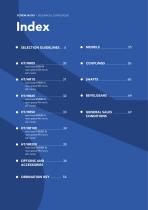
SCREWJACKS - TECHNICAL CATALOGUE max load 5000 N max speed 58 mm/s AC motor max load 10000 N max speed 58 mm/s AC motor max load 25000 N max speed 96 mm/s AC motor max load 50000 N max speed 96 mm/s AC motor max load 200000 N max speed 98 mm/s AC motor MecVel - Edizione 2023 MecVel - Edition 2023
Open the catalog to page 5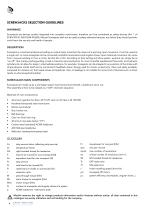
SCREWJACKS SELECTION GUIDELINES WARNINGS Screwjacks are devices usually integrated into compelex machineries, therefore can’t be considered as safety devices (Art. 1 of EC89/392-91-368.93/44.93/689). Mecvel Screwjacks shall not be used as safety elements because, any failure they should provide, could harm the security and health of people. DESCRIPTION Screwjack is a mechanical device providing an output linear movement by means of a spinning input movement. It can be uused as a single unit, or more screwjacks can be connected via shafts transmissions and angular drives. Input rotational movement...
Open the catalog to page 6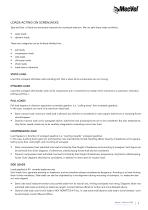
LOADS ACTING ON SCREWJACKS Type and Size of loads are extremely important for screwjack selection. We can split these loads as follows: static loads dynamic loads These two categories can be furtherly divided into: pull loads compression loads side-loads off-center loads shock loads loads due to vibrations STATIC LOAD Load that screwjack shall bear when standing still, that is when all its components are not moving. DYNAMIC LOAD Load that screwjack shall handle, when all its components are in movement (no matter which movement is, extension, retraction, pulling, pushing...). PULL LOADS Pull load...
Open the catalog to page 7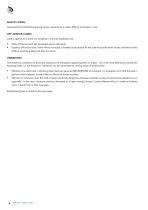
SHOCK LOADS Generated by shocks/bumps along stroke, whose force is rather difficult to foresee or rate. OFF-CENTER LOADS Load is applied on a point not straightly in line with leadscrew axis. Static off-center load: see paragraph about side-loads. Dynamic off-center load: frame where screwjack is installed shall absorb all the side-forces/off-center forces, therefore frame shall be carefully guidad and Size d to do so. VIBRATIONS Generated by oscillations of kinematic sequence (of screwjack) happening after an impact. This is the main difference towards the bumping loads, i.e. the frequence....
Open the catalog to page 8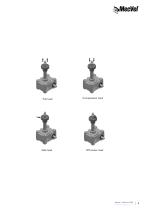
Pull load Compression load Side load Off-center load MecVel - Edizione 2023 MecVel - Edition 2023
Open the catalog to page 9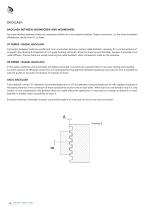
BACKLASH BACKLASH BETWEEN WORMSCREW AND WORMWHEEL Accurate interface between these two components allows for a low angular backlash. Output movement, i.e. the linear translation ofleadscrew, results then 0.1 or lower. HT SERIES - RADIAL BACKLASH Connection between leadscrew profile and inner wormwheel features a certain radial backlash, necessary for a correct workout of screwjack. See drawing A Integration of a 2’ guide bushing (optional), allows for lowering such backlash, because it provides more radial stiffness. Traction loads are usually lowering this radial backlash, while compression...
Open the catalog to page 10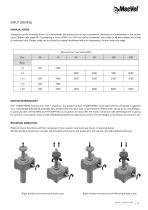
INPUT DRIVING MANUAL DRIVE Screwjacks can be manually driven via a handwheel, the easiest form of input movement. Dimensions of handwheels in the section Input Options (see page 49). Considering a force of 50N on a 250 mm-radius handwheel, max loads (in N) are available according to reduction ratio. Higher loads can be scored by raising handwheel radius or integrating a further reduction stage. Manual drive max loads [daN] Size MOTOR INTEGRATION Size HT200-HR200 features only “bell + coupling”. So, except for Size HT200/HR200, motor gets directly connected to gearbox via a motorflange/hollowshaft...
Open the catalog to page 11
EMERGECY DRIVING In case of power failure, screwjacks can be moved manually via some handwheel: to do this, one inputshaft shall be available on the screwjack (or one of the screwjacks if there are more than one connected together) for connection of this handwheel. If a brakemotor is used, the brake shall be un-clamped firstly, so to allow for movement. Also, a safety switch should be installed in the control panel, so that no power is suppled to motor while operator is using handwheel. LUBRICATION GEARSTAGE INTERNAL LUBRICATION Gearstage, as standard, is lubricated with synthetic long-life grease....
Open the catalog to page 12
INSTALLATION It is extremely important that screwjack gets only axial loads, and no radial ones: so, this shall be considered at earlier design stage. When installing, user shall make sure of perfect perpendicularity between leadscrew and surface where screwjack exerts its force. Also, load to be moved shall be perfectly axial to leadscrew. All this will avoid incorrect working and lubricant leakage. In case of pulling load, screwjack shall be mounted so that tightening bolts to gearbox are not the ones handling the load. Mechanical stroke-ends damage screwjack and its components. Off-center...
Open the catalog to page 13
MAINTEINACE Screwjacks shall be periodically checked: time-schedule is according use and environment where screwjacks are working. Gearstage for all screwjacks is filled with long-life grease that does not require refills. Make sure there are no grease leakages from gearbox: if so, search and eliminate its cause, and re-fill lubricant which escaped. Regarding leadscrew, recurrent control of its cleaniness and correct lubricant layer is necessary. Safety components of installation shall be Size d according to the laws in force. NUT WEAR CHECK-UP ACME nut shall be recurrently checked. Following...
Open the catalog to page 14
SELECTION PARAMETERS FOR SCREWJACK SELECTION The main parameters for a correct selection of a screwjack are: load cycle (trend of the load along the stroke), travelling speed (trend of the speed along the stroke), duty cycle environmental conditions working stroke of the jack supply voltage bucking load type of constrains radial load if any LOAD AND TRAVELLING SPEED Besides their own intrinsic characteristics, load and speed must be evaluated considering the influences generated by the trend of both of them during the working cycle, expecially if heavy inerti a’s phenoma and/or vibrations are...
Open the catalog to page 15All MECVEL catalogs and technical brochures
 HRS series
36 Pages
 ALI3
ALI34 Pages
 AM servoactuators
6 Pages

Archived catalogs
 MecVel Blue Line
4 Pages
 MecVel Silver Line
3 Pages
 MecVel Green Line
5 Pages
 Brochure linear actuators
6 Pages
 Brochure screw jacks
6 Pages
 MecVel Red Line
3 Pages
 Safety nut
2 Pages
 Protective painting
2 Pages
 Lifta
Lifta2 Pages


- Cylinder
- MECVEL linear actuator
- MECVEL electric actuator
- Flexible coupling
- Shaft shaft coupling
- MECVEL screw actuator
- Flange coupling
- MECVEL industrial actuator
- DC actuator
- Industrial cylinder
- MECVEL 24-volt actuator
- Standard cylinder
- Precision actuator
- Electric cylinder
- Extruded aluminum actuator
- 12-volt actuator
- MECVEL ball screw actuator
- Stainless steel actuator