


- Products
- Catalogs
- News & Trends
- Exhibitions
Conveyor systems for boxes

Conveyor systems for boxes
Conveyor systems are crucial in logistics for transporting materials like pallets and boxes efficiently. Automated systems, which use rollers, chains, and belts powered by electric motors, are more cost-effective for repetitive tasks, reducing labor costs and handling errors.
Conveyor Types and Components
The document details various conveyor systems, particularly for boxes, including:
- No-pressure roller accumulator conveyors for straight-line transfer without contact.
- Curved roller accumulation conveyors for navigating obstacles at angles of 45º, 90º, and 180º.
- Continuous activated roller conveyors for constant flow and long-distance transport.
Applications and Benefits
Conveyor systems are suitable for all warehouse sizes, providing constant product flow and enabling complex combinations. They are especially beneficial in automated warehouses, optimizing order preparation, sorting, and assembly processes. Benefits include reduced manual handling, improved safety, and enhanced productivity.
Operational Logic
The document explains the operational logic of conveyor systems, including:
- Reception and distribution of goods using depalletizing robots or manual methods.
- Head ends and picking posts for efficient order preparation.
- Automatic order sorting using barcode identification and branching modules.
- Assembly and verification posts for quality control.
Conclusion
Mecalux provides tailored conveyor solutions based on extensive logistics experience, ensuring optimized installations for specific warehouse needs. Standardization has made these systems more affordable and accessible for various industrial applications.
The document provides technical specifications and operational guidelines for conveyor systems handling boxes:
- Environmental Conditions: Max humidity 70%, temperature range 0º C to 40º C.
- Free Roller Conveyor: For gravity accumulation, max load 100 kg, height 370-3,000 mm.
- Mixed Transfer Roller & Belt Conveyor: For 90º direction changes, speeds 25-45 m/min, max load 100 kg.
- Booster Conveyor: For direction changes, max load 50 kg, speeds 25/45/60 m/min.
- Launcher Roller Conveyor: For 90º direction changes, max load 50 kg, speed 60 m/min.
- Oblique Box Transfer: For high-speed direction changes, max load 50 kg.
- Continuous Belt Conveyor: For straight-line movement, max weight 100 kg/m, speeds up to 60 m/min.
- Bridge Belt Conveyor: For moving boxes between levels, inclinations up to 24º.
- Roller Conveyor with Delay Lifting: For use with stacker cranes, available in mono-load and dual-load models.
- Discontinuous Lift: For vertical lifting or lowering in medium flow circuits.
Safety and Control
Safety devices like metal mesh fences are recommended to prevent contact with moving parts. The control system uses logical sequences to manage movement, with options for PC or PLC installation.
Management Software
- Easy WMS: A warehouse management system handling operations like reception, warehousing, transport, order preparation, and dispatch. Features include entry management, warehousing management, exit management, stock management, and ERP integration.
Catalog excerpts

CONVEYOR SYSTEMS FOR BOXES mecalux.com
Open the catalog to page 1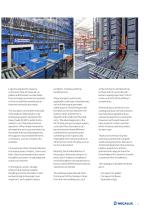
Logistics operations require a continuous flow of materials, as pallets and/or boxes must be taken from a storage or production position or from an overflow warehouse to shipment or production areas. This transport can be done manually if the loads are lightweight, or by employing support equipment for heavy loads (forklifts, pallet trucks, stackers, etc.) that require human operation. When these movements are repetitive and consume resources that make their handling expensive, the support of automated elements is necessary, such as conveyors for example. Conveyors are static transport devices...
Open the catalog to page 3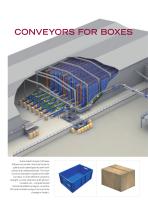
Automated transport of boxes follows very similar criteria to those for pallets and is developed to work with plastic and cardboard boxes. The most common transport module is the roller conveyor, in all its different variations –straight, curved, diversion and injection modules, etc.- complemented by band and belt conveyors, as well as lifts and inclined conveyors to overcome changes in height.
Open the catalog to page 4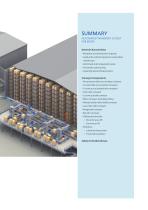
summarY AUTOMATED TRANSPORT SYSTEM FOR BOXES General Characteristics > Reception and distribution of goods > Head ends and picking posts in automated warehouses > Optimised order preparation areas > Automatic order sorting > Assembly and verification posts Conveyor Components > No-pressure roller accumulator conveyor > Curved roller accumulation conveyor > Continuous activated roller conveyor > Free roller conveyor > Continuous belt conveyor > Roller conveyor with delay lifting > Mixed transfer roller & belt conveyor > Launcher roller conveyor > Bridge belt conveyor > Booster conveyor > Oblique...
Open the catalog to page 5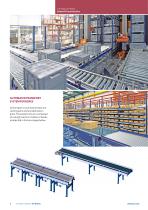
Conveyors for Boxes General Characteristics AUTOMATED TRANSPORT SYSTEM FOR BOXES All transport circuits have at least one starting point and one destination point. The simplest circuit is comprised of a straight section of rollers or bands, as depicted in the two images below. Conveyor Systems for Boxes
Open the catalog to page 6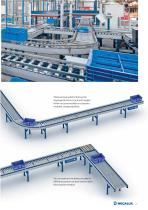
There are two systems that can be employed to form circuits with angles, either via curve modules or crossover modules, as depicted here. You can see how the boxes circulate in different positions on each section with the crossover module.
Open the catalog to page 7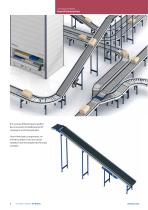
Conveyors for Boxes General Characteristics If circuits at different levels need to be connected, inclined band or lift conveyors must be employed. From these basic components, an infinite number of circuits can be created, from the simplest to the most complex. Conveyor Systems for Boxes
Open the catalog to page 8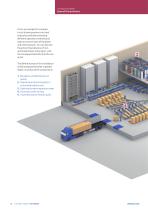
Conveyors for Boxes General Characteristics This is an example of a complex circuit showing various start and end points and demonstrating different operation methods and ways to connect each of the plants and working areas. You can also see the almost total absence of nonautomated internal transport, with the consequent benefits that this can entail. The different areas of this installation will be analysed hereafter in greater depth, as well as all the components. 1. Reception and distribution of goods 2. Head ends and picking posts in automated warehouses 3. Optimised order preparation areas...
Open the catalog to page 10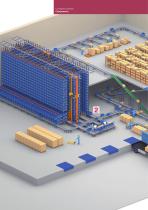
Conveyors for Boxes Components
Open the catalog to page 12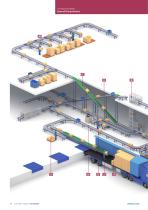
Conveyors for Boxes General Characteristics Conveyor Systems for Boxes
Open the catalog to page 14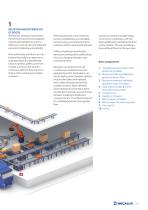
RECEPTION AND DISTRIBUTION OF GOODS Withvarious conveyor components, the entrie process of receiving goods in boxes and transporting them to different circuits can be controlled and executed completely automatically. Placing the boxes onto the circuit can be done manually by an operator or automatically with a depalletising robot. In general, pallets come from outside, arriving on lorries and in containers and from the production lines or other warehouses on pallet conveyors. When goods arrive in sea containers and are not palletised, an extendable band conveyor can be placed into the container...
Open the catalog to page 15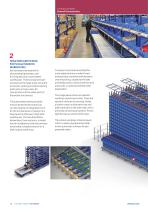
Conveyors for Boxes General Characteristics HEAD ENDS AND PICKING POSTS IN AUTOMATED WAREHOUSES Box conveyors are essential in all automated processes, and this is equally true in automated warehouses. These components are necessary at the head-ends, entry and exit points, picking and reprovisioning posts and, in many cases, for connections with the other parts of the production process. The automated warehouse headend can be extremely simple, but can also require an integrated circuit for the simultaneous circulation of a large quantity of boxes in high yield warehouses. The two illustrations...
Open the catalog to page 16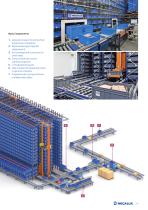
Basic Components 1. General conveyor for entries from production or reception 2. Reprovisioning post (goods replacement) 3. Exit conveyor and connection to other areas 4. Entry and exit racks to the warehousing lanes 5. U-shaped picking post 6. Side conveyor for preparing orders in dynamic channels 7. Prepared order conveyor behind multiple order tables
Open the catalog to page 17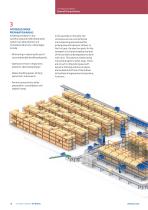
Conveyors for Boxes General Characteristics OPTIMISED ORDER PREPARATION AREAS Installing conveyors in any warehousing and order preparation system is an ideal solution as it increases productivity. Advantages include: - Eliminating or reducing the use of carts and double handling of goods. - Operators remain in ergonomic positions, decreasing fatigue. - Makes handling easier, limiting personnel’s movements. In the example on the right, the conveyors service a conventional manual picking area and another picking area with dynamic shelves. In the first case, the injection posts for the transport...
Open the catalog to page 18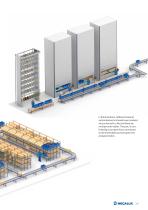
In the illustration, different Clasimat automated vertical warehouse modules are connected in a line and there are multiple order tables. They are, in turn, linked by a conveyor that is connected to the three tables and transports the prepared orders.
Open the catalog to page 19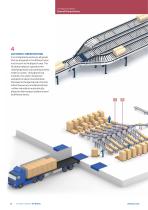
Conveyors for Boxes General Characteristics AUTOMATIC ORDER SORTING In an integrated warehouse, all goods that are prepared in the different areas must be sent to the dispatch area. This illustration depicts a goods sorter, classifying products according to either orders or routes. Using branching modules, this system is based on standard conveyors that distribute the boxes to the appropriate channels where they are accumulated and later –either manually or automaticallyplaced on the transport pallets to send to different clients. 5 Conveyor Systems for Boxes
Open the catalog to page 20All MECALUX catalogs and technical brochures
 Cantilever Racking
24 Pages
 Automated warehouses
120 Pages
 Pallet conveyor systems
64 Pages
 Movirack Mobile Pallet Racking
20 Pages
 Wire mesh partitions & cages
8 Pages
 Mezzanines
20 Pages
 Metal Point Boltless Shelving
24 Pages
 Racking for Live Picking
36 Pages
 M3 Shelving for picking
36 Pages
 M7 Longspan shelving
31 Pages
 Push-back pallet racking
12 Pages
 Conventional Pallet Racking
44 Pages
 Drive-in Pallet Racking
32 Pages
 Live Pallet Racking
28 Pages
 Pallet Shuttle
36 Pages


- Transport rail conveyor
- Automation software solution
- MECALUX shelving
- Real-time software
- Cloud-based software
- Control software
- Industrial software
- MECALUX storage warehouse shelving
- Electric drive conveyor
- Automated software
- MECALUX metal shelving
- MECALUX heavy load shelving
- Rack with shelves
- Adjustable racking
- MECALUX pallet shelving
- Workshop rack