


- Products
- Catalogs
- News & Trends
- Exhibitions
Automated warehouses

Automated warehouses
Automated warehouses leverage modern logistics technologies to enhance efficiency in storage, handling, preparation, and dispatch of goods. They offer advantages such as cost savings, improved productivity, and superior customer care compared to traditional setups.
- Productivity and Availability: High efficiency in goods receipt and dispatch, extended business hours, and continuous workflows.
- Labour Cost Savings: Reduction in the need for forklift operators and administrative staff.
- Lower Maintenance Costs: Decreased damage from improper usage and reduced technical requirements.
- Personnel Safety: Low human intervention, integrated safety systems, and ergonomic workstations.
- Load Security: Goods are secured, reducing losses and breakage.
- Real-time Inventory: Management software for precise tracking and control.
- Space Utilization: High-density storage and maximized use of space.
- Project Implementation: Involves need identification, data collection, and analysis to tailor solutions to customer needs.
- Feasibility Study: Detailed analysis of customer data to determine the best logistics solutions.
- Solution Development: Designing adaptable installations to meet changing logistics requirements.
- Defining Specifications: Includes assembly, commissioning, and training.
- Turnkey Projects: Comprehensive service covering core project management, construction, and safety systems.
- Slab: Essential for stability, designed based on geotechnical studies.
- Structure: Calculated using sophisticated algorithms to withstand various loads and environmental factors.
Designing conventional pallet rack structures requires consideration of factors such as dead weights, external loads, building height, distance between pillars, and the length of open spaces.
Cladding provides impermeability, insulation, and sanitary finishes, with fire resistance determined by regulations. Materials like steel, aluminum, or pre-manufactured tiles are commonly used. For cold storage, refrigerated panels with a "sandwich-type" solution ensure airtightness and energy efficiency.
Cold-storage warehouses require specific refrigeration equipment and careful design to maintain non-ambient temperatures. Automated solutions reduce cooling volume and energy costs, minimizing the need for operators in subzero environments.
Fire safety involves construction measures (using fire-resistant materials), organizational measures (e.g., no smoking policies), and technical measures (e.g., oxygen reduction systems). Automated smoke detection systems are preferred for early fire detection, and sprinkler systems or hypoxic air technology are used for fire extinguishing.
Stacker cranes automate the storage and retrieval of pallets, enhancing productivity. They can perform down-aisle, vertical, and cross-aisle movements. Types include single-mast and twin-mast cranes, with features like vector-controlled frequency inverters and laser rangefinders for precise operation. These cranes are adaptable to various conditions, including freezing temperatures and high humidity.
These cranes operate without an upper guide rail, suitable for existing warehouses. They offer three-sided load retrieval and connect to Easy WMS for automated operations.
The MT line is designed for efficiency, with models suitable for different warehouse heights. They offer energy recovery systems and are adaptable to various pallet types and temperatures.
These cranes are designed for high-capacity storage with low energy consumption. They offer enhanced performance for demanding storage situations, with a range of machines to suit different load heights and weights.
The document outlines the specifications for various models of stacker cranes, including maximum heights for single and double-deep configurations, load capacities, travel and lift speeds, and operational temperature ranges. The cranes can handle Euro pallets and offer optional features like energy recovery systems and maintenance cabins.
The stacker cranes are designed to minimize structural forces, preventing damage to racks and warehouse structures. Key components include masts, guide bases, hoisting mechanisms, and mobile hoisting frames. Masts are reinforced for stability, and guide bases are designed to absorb operational forces. Hoisting operations are managed by AC motors and gear reducers, ensuring precise control.
The document describes various extraction systems, including single, double, and triple-deep telescopic forks, as well as automatic pallet shuttles and roller conveyors. These systems are tailored to optimize storage density and handling speed based on installation requirements.
Electrical cabinets are mounted on the cranes, with safety switches and energy recovery options available. Data transmission is facilitated through infrared systems, ensuring reliable communication even in low temperatures.
The aisle equipment includes guide rails, safety systems, and positioning systems like laser rangefinders and absolute encoders. These components ensure precise positioning and safe operation of the stacker cranes.
The document highlights features like curved tracks for aisle switching and advanced safety mechanisms to prevent accidents during operation.
Specifications and Features:
The stacker cranes are equipped with rotating wheels and side guide rollers for high-speed movement on curved tracks. Transfer bridges allow cranes to move between aisles, though they are less flexible than curved tracks. Aisle change systems are used when high storage capacity is needed without a crane in every aisle.
Operational Modes:
- Manual Mode: Used for maintenance and repair with visual control at low speeds.
- Automated Mode: Executes orders via communication photocell for operations like slotting, extraction, and error correction.
- Semi-automated Mode: Supports functions like automated access and fork cycles.
Safety Equipment:
Includes hand ladders, safety railings, and maintenance platforms. Onboard safety features include safety cables, railings, and heated cabins for extreme conditions. Aisle safety equipment includes emergency stop systems, hydraulic buffers, and overtravel limiters. Wireless safety signal transmission systems are used for emergency stoppages.
Pallet Conveyor Systems:
Mecalux provides a range of devices for transporting unit loads, focusing on standardization to reduce delivery times and costs. Core components include roller conveyors, chain conveyors, and mixed transfers with rollers and chains.
Technical Data:
- Roller Conveyors: Suitable for long-distance pallet transport with a max load of 1,500 kg and speeds of 10-20 m/min.
- Roller Accumulation Conveyor: Handles up to four Euro pallets with a max load of 1,000 kg and speed of 7 m/min.
- Ground-level Roller Conveyors: Allows loading/unloading at ground level with a pallet truck.
- Two-strand Chain Conveyors: Transports pallets perpendicular to skids, enabling circular routes.
- Chain Conveyors with More Than Two Strands: Used for poor-quality pallets or half-pallets.
- Mixed Transfers with Rollers and Chains: Allows 90º and 270º direction changes.
- Turntable Conveyor: Enables load turning for unaligned conveyor transfers.
The document provides detailed specifications and functionalities of various conveying equipment used in automated warehouses. It includes descriptions of twin-load and single-load transfer cars, pallet lifts, stackers, and automated truck loading systems, among others.
- Twin-load Transfer Car: Customizable for distance between loads, with a high load capacity of 2 x 1,000 kg.
- Single-load Transfer Car: Designed for cross-aisle load transfer with high travel speed. Max pallet load is 1,500 kg, with loaded and unloaded transport speeds of 100 m/min and 140 m/min, respectively.
All equipment operates under maximum humidity of 70%, ambient temperatures from 0°C to 40°C, and optional freezer temperatures from -30°C to 0°C.
Used for vertical transport of pallets, with a max unit load weight of 1,500 kg for standard pallets and 500 kg for half-pallets. The lift speed varies with load weight.
Facilitates automatic loading and unloading of lorries, capable of handling up to 32,000 kg. The system significantly reduces loading/unloading time and minimizes accidents.
Offers an alternative to conveyors, using trolleys on an I-shaped rail. It is adaptable, cost-effective, and minimizes operational disruptions.
These cranes operate in a central aisle with lateral racks for storing boxes or trays. The system is controlled by management software for real-time inventory and efficient space utilization.
Overall, the systems enhance productivity, ensure safety, and provide reliable and easy-to-use solutions for automated warehouse operations.
- Single-mast ML Stacker Cranes: Available in ML50 and ML100 series, these cranes handle Euro boxes of varying sizes and weights, with a maximum height of 12 meters.
- Twin-mast MLB Stacker Cranes: Designed for higher capacity, these cranes can handle up to four boxes simultaneously and reach heights over 20 meters.
This document provides a comprehensive overview of various conveyor systems and components used in automated warehouses, focusing on their specifications, functionalities, and operational conditions. It covers different types of conveyors, including oblique and induction box transfers, transfer cars, continuous and non-continuous lifts, and picking stations. Additionally, it discusses safety measures, technical features, and the role of computer systems in managing these operations.
- Oblique and Induction Box Transfers: These systems are designed for moving cardboard and plastic boxes and trays. They have specific load weight limits, conveyor lengths, and speeds, with operational conditions including a maximum humidity of 70% and temperatures ranging from 0°C to 40°C.
- Transfer Cars: Used for horizontal transfer of units, these cars offer flexibility in receipt and dispatch operations, with a maximum load weight of 50 kg and a standard speed of 60 m/min.
- Lifts: Continuous lifts are used for high flow rates, while non-continuous lifts are suitable for medium flows, connecting different floors and circulation levels.
- Picking Stations: These stations are ergonomically designed for operator interaction with the automated system, ensuring safe and efficient load handling.
- Drive Systems: Various drive mechanisms are used, including drive rollers, belts, and shafts, tailored to the unit load and operational requirements.
- Conveyor Components: Components such as rollers, elastomeric belts, and poly-V belts are selected based on the nature of the box and the functional unit's role.
- Environmental Conditions: Systems are designed to operate in temperatures between -30°C and +40°C, with considerations for humidity affecting mechanical and electrical protections.
Safety devices are crucial, with metal mesh partitioning recommended to prevent contact with hazardous parts. The control system halts machine movement when access doors are opened.
The document highlights the importance of computer systems like the EASY WMS for managing warehouse processes, from receiving to dispatching. These systems ensure efficient coordination and control of mechanical and electrical devices, acting as the central decision-making hub.
Mecalux's conveyor systems are designed to meet market demands with high reliability and low maintenance. They integrate seamlessly with warehouse operations, supported by advanced computer systems for optimal performance.
Mecalux provides a comprehensive suite of software solutions designed to enhance the efficiency and security of warehouse operations. These solutions include control and management software that facilitate the seamless operation of logistics installations.
The software solutions are designed to be easily updatable and accessible online, allowing for remote support. They include hot database backups to ensure continuous operation without compromising data security.
The Galileo control software manages electromechanical devices in warehouses, ensuring optimal operation through status auditing, breakdown management, and communication with warehouse management systems (WMS). It is built on a three-layer architecture: user service, warehouse service, and data service layers, ensuring robust and fail-safe operations.
Easy WMS integrates with ERP systems to manage warehouse operations, offering functionalities such as receipts, storage, stock control, dispatch, and automated transport systems. It supports scalable installations and uses standard communication interfaces for seamless ERP integration.
- Receipts: Manages entry orders, unloading plans, and receipt operations, including barcode labeling and document reception.
- Storage: Includes location rules management, cross-docking, tracking, and automated defragmenting.
- Stock Control: Offers dynamic rotation management, recounts, and lost & found location management.
- Dispatch: Manages dispatch orders, planning, picking operations, and dispatch documentation.
- Automated Transport System: Optimizes stacker crane movements and manages station operations.
- Tools: Includes equipment management, report and label designers, and safety management.
Mecalux's software solutions are designed to optimize warehouse operations through advanced control and management functionalities, ensuring high performance and security.
Catalog excerpts

Automated warehouses
Open the catalog to page 1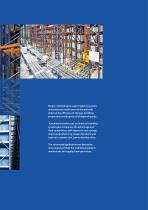
Modern technologies used in logistics systems and processes enable users to dramatically improve the efficiency of storage, handling, preparation and dispatch of all types of goods. Automated warehouses and material handling systems give companies the advantage over their competitors, with respect to cost savings, improved productivity, range of products and superior customer care, just to mention a few. The automated applications are becoming more important than the traditional setups in warehouses and supply chain operations.
Open the catalog to page 3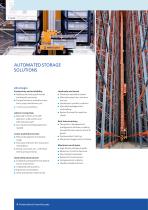
AUTOMATED STORAGE SOLUTIONS Advantages Productivity and availability n Highly productive goods receipt and dispatch processes. n Top performance, extend business hours, easy maintenance, etc. n Continuous workflows. Labour cost savings n Reduced numbers of forklift operators, order pickers and administrative staff. n Less material handling equipment needed. Lower maintenance costs n Reduce damage due to improper usage. n Stop wear and tear from misuse and mishandling n Paving, structures, etc., with fewer technical requirements. Total safety of personnel n Installations designed for low level...
Open the catalog to page 4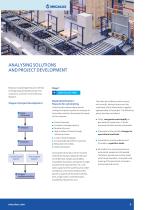
ANALYSING SOLUTIONS AND PROJECT DEVELOPMENT Mecalux has developed its own method of designing automated solutions for customers, as shown in the following diagram: Stages of project development Data collection DATA COLLECTION Need identification: Reasons for automating Gathering the relevant data used to configure a logistics system is necessary to formulate a solution that meets the needs of the customer: The collection of data must be carried out correctly, taking into account the usefulness of the information to apply it appropriately in the project. The following points must be considered:...
Open the catalog to page 5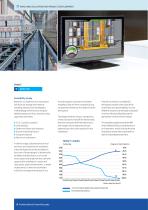
ANALYSING SOLUTIONS AND PROJECT DEVELOPMENT Feasibility study Based on our experience in automated solutions for storage and material handling, Mecalux has developed a methodology which ensures a highlydetailed analysis of all a customer’s data, capacities and needs. A, B, C product rotation. Data analysis. n Determine flows and rotations. n Examine deciding factors. n Study procedures. n Return on investment. n n In the first stage, all potential technical solutions are studied which are able to meet the objectives of the installations. Each one of these designs is defined with variables and...
Open the catalog to page 6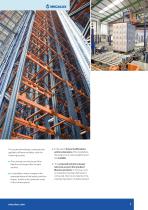
This study methodology is systematically applied to different variables, with the following benefits: n The customer can rest assured that Mecalux will always offer the right solution. It is possible to make changes to the proposed design of the logistics solution design, thanks to the systematic study of the initial proposal. In the case of future modifications and/or extensions of the installations, the study is much more straightforward and scalable. The proposed solutions always take into account the standard Mecalux products. In this way, once an installation has been defined and contracted,...
Open the catalog to page 7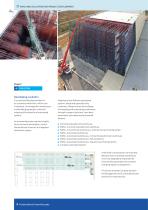
ANALYSING SOLUTIONS AND PROJECT DEVELOPMENT Developing a solution The solutions Mecalux provides for its customers allow them, within a set investment, to manage their warehouses and handling equipment, while still enjoying all the benefits of automated systems. An automated system requires a highly structured work philosophy, in which the warehouse is seen as an integrated distribution system. Adapting to the different operational systems, needs and capacities of its customers, Mecalux faces the challenge of managing and automating warehouses through a range of solutions, from basic automation...
Open the catalog to page 8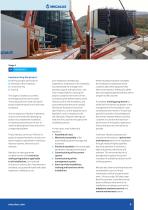
Implementing the project Defining project specifications Assembly of the installation n Commissioning n Training n n This stage is complex as countless technological factors are involved, interacting with each other during the project implementation and in the same workplace. As a consequence, Mecalux implements its own work method for developing projects to complete the installation, to improve productivity on the site, to meet the development times and to limit unexpected problems. Firstly, Mecalux carries out 100% of its project’s engineering works using its own team of experts, specialised...
Open the catalog to page 9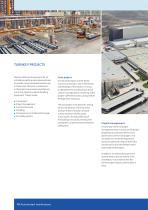
TURNKEY PROJECTS Mecalux offers turnkey projects for all installations getting automated solutions to provide a more comprehensive service. In these cases, Mecalux's involvement in the project more covers areas that are not strictly linked to material handling equipment. These include: Core project Project management n Construction work n Cladding n Temperature controlled cold-storage n Fire safety systems Core project An industrial project must be based around a core project, which defines the overall design of the solution. Its focus is a detailed technical description that is useful in managing...
Open the catalog to page 10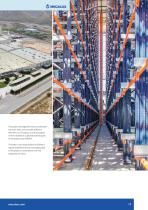
The project management team coordinates the work tasks, ensuring the different elements run smoothly, that the progress of the installation is optimal and the goals of the projects are fulfilled. The team is also responsible for different legal and administrative issues applicable to the project in accordance with the regulations in force.
Open the catalog to page 11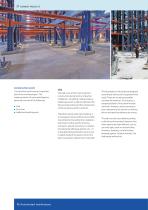
TURNKEY PROJECTS Construction work Construction work forms an important part of any turnkey project. The implementation of automated logistics generally consists of the following: Slab Structure n Additional building work n n Slab The slab is one of the most important construction elements of an industrial installation. A building's slab provides a stable base which is able to withstand the forces produced by all of the components of the warehouse and its contents. Therefore, before starting to building, it is necessary to know all forces that will be transmitted to the slab by the installation...
Open the catalog to page 12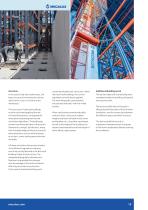
Structure In the case of clad-rack warehouses, the basic structure is formed by the racking itself which, in turn, functions as the warehouse. The structures of clad-rack buildings must be calculated applying the law of material resistance, using powerful and sophisticated programmes and calculation algorithms. The load being stored must always be taken into account (dimensions, weight, distribution), along with the dead weight of the structure and external actions, such as wind (pressure or suction), snow, earthquakes and other live loads. conventional pallet rack structures, rather than clad-rack...
Open the catalog to page 13All MECALUX catalogs and technical brochures
 Cantilever Racking
24 Pages
 Pallet conveyor systems
64 Pages
 Conveyor systems for boxes
48 Pages
 Movirack Mobile Pallet Racking
20 Pages
 Wire mesh partitions & cages
8 Pages
 Mezzanines
20 Pages
 Metal Point Boltless Shelving
24 Pages
 Racking for Live Picking
36 Pages
 M3 Shelving for picking
36 Pages
 M7 Longspan shelving
31 Pages
 Push-back pallet racking
12 Pages
 Conventional Pallet Racking
44 Pages
 Drive-in Pallet Racking
32 Pages
 Live Pallet Racking
28 Pages
 Pallet Shuttle
36 Pages


- Transport rail conveyor
- Automation software solution
- MECALUX shelving
- Real-time software
- Cloud-based software
- Industrial software
- MECALUX storage warehouse shelving
- Electric drive conveyor
- Automated software
- MECALUX metal shelving
- MECALUX heavy load shelving
- Rack with shelves
- Adjustable racking
- MECALUX pallet shelving
- Pallet conveyor
- Workshop rack