


- Products
- Catalogs
- News & Trends
- Exhibitions
Automated warehouses for boxes Miniload

Automated warehouses for boxes Miniload
- Stacker Crane: A robotic system that moves boxes along aisles and places them on conveyors, operating on rails with laser-guided positioning and cable-free communication.
- Racking: Designed for efficient space use, accommodating stacker crane movement.
- Picking and Handling Area: Uses conveyors to facilitate box movement to and from operators.
- Management System: Software managing warehouse operations, integrating with ERP systems, and maintaining real-time inventory.
- Load Unit: Typically euroboxes or trays, designed based on stored products.
- Control and Safety Systems: Includes software and physical barriers for safe operation.
- Stacker Cranes and Warehouse Configuration: Stacker cranes increase capacity and flow by installing multiple cranes in height, with model selection based on warehouse height and movement requirements.
- Optional Elements and Goods Flow: Forklift trucks and sloping channels direct goods from production or reception areas to appropriate levels, ensuring high flow rates and preventing product mixing.
- Picking and Replenishment Positions: Various picking position solutions, including frontal and lateral headers, and cross conveyor belts connect input and output conveyors.
- Live Storage Racking: Installation of live storage racking for handling a large number of SKUs, with stacker cranes replacing channels as boxes are emptied. Pick-to-light devices and conveyors improve operator performance.
- Large-Scale Picking Operations: Warehouses with multiple picking positions and conveyor circuits manage the flow of boxes and prepared orders efficiently.
- Automated Warehouse Integration: Integration with sorters and other systems streamlines order preparation and dispatch processes, using conveyors and elevators to connect different warehouse areas.
- Buffer and Temperature-Controlled Warehouses: Miniloads and live pallet racking serve as buffer solutions, with insulation in temperature-controlled warehouses maintaining energy efficiency.
- Combination with Other Systems: Different warehouse systems can be combined to accommodate various goods and load units, optimizing storage and retrieval based on consumption rates and product characteristics.
Catalog excerpts

Automated warehouses for boxes
Open the catalog to page 1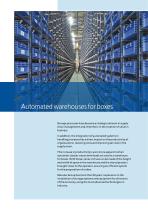
Automated warehouses for boxes Storage processes have become a strategic element in supply chain management and, therefore, in the creation of value in business. In addition, the integration of automated systems in handling processes has a direct impact on the productivity of organisations, reducing costs and improving services in the supply chain. This increase in productivity is even more apparent when automatic stacker cranes (miniload) are used in a warehouse for boxes. With these cranes, full use can be made of the height and width of space in the warehouse and the stored product brought...
Open the catalog to page 2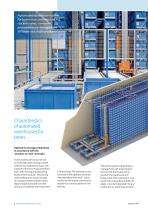
Automated warehouse system for boxes that combines racking, stacker cranes, conveyors, and warehouse management software as a single product. Characteristics of automated warehouses for boxes Optimal for storage and picking in accordance with the “product-to-man” principle. These warehouses consist of one or more aisles with racking on both sides for storing boxes or trays, with a stacker crane moving up and down each aisle, moving and depositing boxes in their location. The picking and handling area, which consists of conveyors where stacker cranes deposit loads extracted from the racking, is...
Open the catalog to page 4
Advantages: - It automates the entry and exit of products. - It saves warehouse space. - It eliminates the need for manually-operated turret trucks and averts accidents as a result of handling errors - It eliminates errors resulting from manual handling in the warehouse. - It can operate 365 days a year. - It monitors and updates inventory management. - It has a short return on investment period (ROI). - It significantly increases capacity for customer service.
Open the catalog to page 5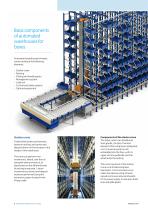
Basic components of automated warehouses for boxes Automated warehouses for boxes consist mainly of the following elements: - Stacker crane - Racking - Picking and handling area - Management system - Load unit - Control and safety systems - Optional equipment Stacker crane A robot that locates and removes boxes on racking, and carries and deposits them on the conveyor in the header of the warehouse. The crane can perform two movements: lateral, over the rail along the aisle and vertical, to place boxes on the different levels of racking as required. Lateral movements to extract and deposit boxes...
Open the catalog to page 6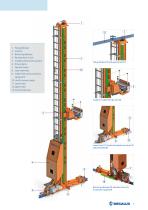
1. Top guide base 2. Column 3. Bottom guide base 4. Remote electric box 5. Cradle and extraction system 6. Drive engine 7. Elevator motor 8. Laser telemeter 9. Cable-free communications equipment 10. Line for power supply 11. Lower track 12. Upper track 13. End-of-aisle stop 2 Top guide base (1) and upper track (12) Cradle or mobile lifting frame (5) Lower track (11), hydraulic adjustment stop (13) and telemeter (8) Bottom guide base (3), elevator motor (7) and power supply (10)
Open the catalog to page 7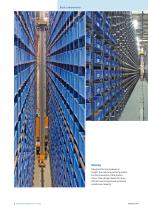
Basic components Racking Designed for storing boxes in height, the racks are perfectly suited for the movement of the stacker crane. Their design allows for more efficient use of space and increased warehouse capacity. 8 Automated warehouses for boxes
Open the catalog to page 8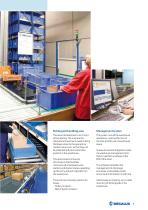
Picking and handling area Management system This area is located next to or in front of the racking. This is where the mechanical movements need to bring the boxes closer to the operator or stacker crane occur, so that they can be collected and returned to their position in the warehouse. This system runs all the warehouse operations, making the most of the time and the use of warehouse space. This area consists of a series of conveyors that facilitate communication between work stations and stacker cranes, speeding up the entry and exit of goods from the warehouse. There are two conveyor systems...
Open the catalog to page 9
Basic components Load unit Automated facilities can also be made to store plastic, metal, or cardboard boxes. The most common plastic boxes are euroboxes that measure 400mm x 600mm or 600mm x 800mm, at normal height. The ideal load unit in automated warehouses for boxes is determined based on the product to be stored. Control and safety systems A powerful and experimented control software program, together with various mechanical and electronic devices, executes movements in a safe and accurate manner. Steel mesh enclosures have been erected in open areas to prevent contact by operators with...
Open the catalog to page 10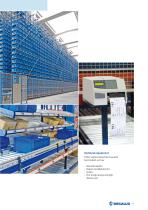
Optional equipment Other support equipment can also be included, such as: - Barcode readers - Report and label printer - Scales - Pick to light and put to light devices, etc.
Open the catalog to page 11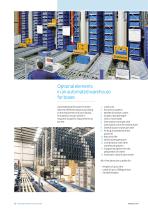
Optional elements in an automated warehouse for boxes Automated warehouses for boxes allow for different options according to the requirements of each facility. The options chosen will be in response to specific requirements to be met. Load units Extraction systems Models of stacker cranes Single or double depth One or more aisles One stacker crane per aisle One stacker crane for several aisles Several stacker cranes per aisle Picking and replenishment positions 10. Role as buffer 11. Working temperatures 12. Combination with other warehouse systems 13. Support equipment for the preparation of...
Open the catalog to page 12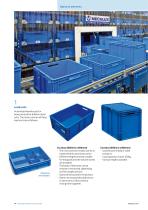
Optional elements Load units Automated warehouses for boxes are built for different load units. The most common of these load units are as follows: Plastic box with dividers 14 Automated warehouses for boxes Eurobox (400mm x 600mm) - The most common model, due to its measurements and construction. - Different heights that are suitable for the goods and the volume stored are available. - The bases of the boxes can be smooth or reinforced, depending on their weight and use. - Optional lid to protect the product. - Option to incorporate subdivisions to store various SKUs without mixing them together....
Open the catalog to page 14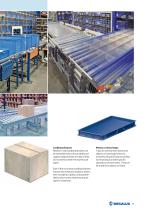
Cardboard boxes Medium-sized cardboard boxes can be stored directly without additional support (plastic boxes or trays) if they do not need to enter the warehouse again. Plastic or metal trays Trays are used to store boxes and objects of varying dimensions, and are built specifically according to the product and the specific operations of each client. They can be made from plastic or metal. Even if the most used cardboard boxes have similar measures to plastic boxes, their variability, rigidity, and possible deformation mean that they require specific treatment.
Open the catalog to page 15All MECALUX catalogs and technical brochures
 Cantilever Racking
24 Pages
 Automated warehouses
120 Pages
 Pallet conveyor systems
64 Pages
 Conveyor systems for boxes
48 Pages
 Movirack Mobile Pallet Racking
20 Pages
 Wire mesh partitions & cages
8 Pages
 Mezzanines
20 Pages
 Metal Point Boltless Shelving
24 Pages
 Racking for Live Picking
36 Pages
 M3 Shelving for picking
36 Pages
 M7 Longspan shelving
31 Pages
 Push-back pallet racking
12 Pages
 Conventional Pallet Racking
44 Pages
 Drive-in Pallet Racking
32 Pages
 Live Pallet Racking
28 Pages
 Pallet Shuttle
36 Pages


- Transport rail conveyor
- Automation software solution
- MECALUX shelving
- Real-time software
- Cloud-based software
- Industrial software
- MECALUX storage warehouse shelving
- Roller conveyor
- Electric drive conveyor
- Automated software
- MECALUX metal shelving
- MECALUX heavy load shelving
- Rack with shelves
- Adjustable racking
- MECALUX pallet shelving
- Pallet conveyor
- Workshop rack