
- Catalogs
- MCQ Instruments
- Gas Sensors: calibration, testing and development


Gas Sensors: calibration, testing and development

Gas Sensors: calibration, testing and development
The MCQ Gas Blender 100 Series is a high-performance gas flow dilutor and mixing system designed for precise control of gas mixtures, essential for both research and production applications. It is particularly useful for calibrating, testing, and developing gas sensors, which are crucial for monitoring ambient conditions.
Gas Sensors
Gas sensors, which can be electrochemical or spectroscopic, require regular maintenance and calibration to ensure accuracy and reliability. The Gas Blender 100 Series facilitates the creation of custom gas mixtures necessary for these calibrations.
Calibration Methods
Standard calibration involves setting a "zero" reading and calibrating the span using premixed gas cans. However, this method can be costly and limited. The Gas Blender 100 Series offers a more versatile solution by allowing users to mix pure gases to create custom atmospheres, thus reducing costs and increasing flexibility.
Custom Calibration
The Gas Blender 100 Series supports custom calibration for both linear and non-linear response gas sensors. It allows precise control over gas concentrations, making it suitable for any custom calibration needs.
Sensor Development
The Gas Blender 100 Series is ideal for developing new gas sensors, offering fast response times (50 ms) and high accuracy, which are critical for evaluating sensor performance.
Compactness and Simplicity
The device is compact and easy to use, designed with a "Lab in a Box" principle to fit into any lab space. It replaces bulky configurations with a manageable product suitable for narrow spaces.
User Interface
The Gas Blender is controlled via the MCQ Gas Mixer Manager software, which is compatible with Windows operating systems. This software provides an intuitive interface for managing the instrument's features and gas mixture properties.
Hardware Configuration
The standard setup involves connecting gas cylinders to the Gas Blender using 6 mm tubes and check valves. The instrument is then connected to a gas sensor, with a computer managing the system via USB.
Catalog excerpts
MCQ Gas Blender 100 Series High Performance Gas flow Dilutor & Gas flow Mixing System with User Interface Application Note MCQ Gas Blender 100 Series Application Gas Sensors: calibration, testing and development Introduction Monitoring ambient conditions is a fundamental feature providing valuable data for both research and production applications. Any basic or advanced experimentation, any standard or crucial step in a production process demands a fine control over working conditions, thus implying the need of a proper monitoring apparatus. Along with temperature and pressure, the ability to check the atmosphere composition becomes relevant since the presence, absence or simply the amount modification of the gas species can strongly affect the final result. For that reason gas sensors are today a part of the essential equipment of many research labs and production facilities, as well as common safety devices for residential buildings. MCQ Gas Blender 100 Series Measurement devices like gas sensors require regular maintenance to check and secure proper functioning. Standard procedures usually involve testing and re-calibration of the sensors, for which working atmospheres with specific composition are needed. Creation, control and management of custom gas mixtures can be easily achieved with the new MCQ professional instrument: the Gas Blender 100 Series. The Gas Blender 100 Series is also an incredible versatile tool for the creation of brand-new gas sensors. The instrument is the optimal choice for developing gas sensors dedicated to applications with specific ambient measurement requirements, for which standard sensors commercially available are not suitable. Gas Sensors There are many types of gas sensor commercially available, built for different purposes and designed for specific applications. Gas sensors can be divided in two main families, electrochemical or spectroscopic, accordingly with their working principle. www.mcqinst.com Gas Blender 100 Series Application Note 1/5
Open the catalog to page 1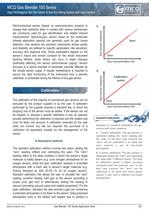
MCQ Gas Blender 100 Series High Performance Gas flow Dilutor & Gas flow Mixing System with User Interface Calibration The calibration of the majority of commercial gas sensors can be executed by the product supplier or by the user. A calibration performed by the supplier requires a standard fee, to which the shipping cost of the sensor must be added. If the sensor can not be shipped, or requires a specific calibration in situ, an operator actually performing the calibration is required and the related cost must be taken into account. A calibration executed by the user does not involve any fee...
Open the catalog to page 2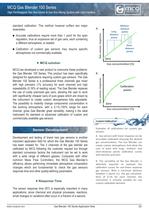
MCQ Gas Blender 100 Series High Performance Gas flow Dilutor & Gas flow Mixing System with User Interface Accurate calibrations require more than 1 point for the span regulation, thus an expansive set of gas cans, each containing a different atmosphere, is needed. Calibration of custom gas sensors may require specific atmospheres not commercially available. A. Gas sensor response standard calibration. This method however suffers two major downsides: MCQ solution Short distance points Zero Gas concentration (%) B. Gas sensor response MCQ has developed a new product to overcome these problems:...
Open the catalog to page 3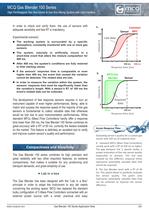
MCQ Gas Blender 100 Series High Performance Gas flow Dilutor & Gas flow Mixing System with User Interface In order to check and verify them, the use of sensors with adequate sensibility and fast RT is mandatory. A. Common Sensor MFC 100 Experimental scenario: The working system is surrounded by a specific atmosphere, constantly monitored with one or more gas sensors. The system, naturally or artificially, incurs in a short-time event that alters the mixture composition for 400 ms. Setpoint % Lost data 0 After 400 ms, the system’s conditions are fully restored to thier starting values. In order...
Open the catalog to page 4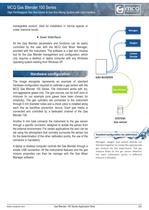
MCQ Gas Blender 100 Series High Performance Gas flow Dilutor & Gas flow Mixing System with User Interface manageable product, ideal for installation in narrow spaces or under chemical hoods. Nitrogen User Interface All the Gas Blender parameters and functions can be easily controlled by the user with the MCQ Gas Mixer Manager, provided with the instrument. The software is a fast and intuitive tool for the Gas Blender management and configuration, which only requires a desktop or laptop computer with any Windows operating system starting from Windows XP. Hardware configuration The image alongside...
Open the catalog to page 5All MCQ Instruments catalogs and technical brochures
 GB 15k
2 Pages
 GB 4000
4 Pages
 GB 2000
4 Pages
 GB 3000
4 Pages
 GB 6000
4 Pages
 GB 100
4 Pages
 GB 100 PLUS
4 Pages
 Products Overview
2 Pages
 MCQ Gas Blender 100 Series
7 Pages
 Sensor module
7 Pages


Archived catalogs
 Gas Blender 106 Series
4 Pages
 Gas Blender 6000
4 Pages
 flow board
4 Pages
 Flow Monitor Software
2 Pages
 data acquisition board
4 Pages


