
- Catalogs
- MCQ Instruments
- Dilution of H2S for detection in THz range


Dilution of H2S for detection in THz range

Dilution of H2S for detection in THz range
Catalog excerpts

H2S DILUTON - MICRO FLOW H2S DETECTION IN THE THZ RANGE A SOLID BUSINESS CASE IN COLLABORATION WITH THE “POLITECNICO DI BARI“ GENERAL INFORMATION ABOUT THE PROJECT Dilution of H2S for detection in THz range HEAD OF PROJECT MANAGEMENT: Vincenzo Spagnolo To dilute a certified gas mixture of 200 ppm of H2S in pure N2 down to 20 ppm MORE INFORMATION ABOUT THE HEAD OF THE PROJECT Vincenzo Spagnolo received the degree (summa cum laude) and the PhD, both in physics, from University of Bari. He works as Full Professor of Applied Physics at the Technical University of Bari. Since 2017, he is the director of the joint-research lab PolySense, created by THORLABS GmbH and Technical University of Bari, devoted to the development and implementation of novel gas sensing techniques and the realization of highly sensitive QEPAS trace-gas senso
Open the catalog to page 1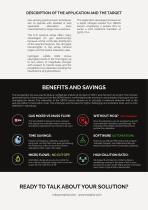
DESCRIPTION OF THE APPLICATION AND THE TARGET Gas sensing spectroscopic techniques aim to operate with isolated or well separated absorption lines characterized by large cross-sections. The application developed is based on a liquid nitrogen-cooled THz QEPAS sensor, employing a pulsed QCL to excite a H2S rotational transition at 95.63 cm-1. The THz spectral range offers many advantages for gas spectroscopy because of the comb-like distribution of the spectral features, the strongest linestrenghts in the whole infrared region and the fastest relaxation rates. Hydrogen sulfide (H2S) shows absorption...
Open the catalog to page 2All MCQ Instruments catalogs and technical brochures
 GB 15k
2 Pages
 GB 4000
4 Pages
 GB 2000
4 Pages
 GB 3000
4 Pages
 GB 6000
4 Pages
 GB 100
4 Pages
 GB 100 PLUS
4 Pages
 Products Overview
2 Pages
 MCQ Gas Blender 100 Series
7 Pages
 Sensor module
7 Pages


Archived catalogs
 Gas Blender 106 Series
4 Pages
 Gas Blender 6000
4 Pages
 flow board
4 Pages
 Flow Monitor Software
2 Pages
 data acquisition board
4 Pages


