Overview: This document is a product catalogue from Mayser GmbH & Co. KG, detailing their safety technology products. It covers quality management, certifications, and product information for safety mats, edges, bumpers, control units, and signal transmission systems.
Quality Management and Certifications: Mayser is certified under ISO 9001:2015 for quality management, ISO 14001:2015 for environmental management, and IATF 16949 for automotive industry products. These certifications ensure compliance with international standards, focusing on continuous improvement and customer satisfaction.
Product Information: The catalogue provides detailed specifications for various safety products:
- Safety Mats: Pressure-sensitive devices that trigger a response when activated, available in various sizes and designs, using 2-wire and 4-wire technology.
- Safety Edges and Bumpers: Designed to detect pressure and stop machinery, available in different models with specific certifications.
- Control Units: Process signals from sensors to ensure correct operation of safety devices.
- Signal Transmission Systems: Ensure reliable communication between safety devices and control units.
Technical Specifications: Each product section includes detailed technical data, such as sensor types, operational principles, and environmental conditions. Emphasis is placed on adhering to safety instructions and maintenance guidelines.
Specifications: Safety mats are designed to detect the presence of a person in a danger zone, preventing hazardous situations. They are resistant to environmental influences and chemicals, with a protection rating of IP65. Available in standard and customized versions, with maximum sizes of 1.5 m² and side lengths ranging from 200 to 3000 mm.
Design and Technology: Safety mats utilize sensors connected to a single control unit, using 2-wire and 4-wire technologies. The 4-wire technology is compatible only with the SG-EFS 104/4L control unit.
Operation and Limits: Mats detect individuals weighing more than 20 kg and are not suitable for detecting walking aids or individuals weighing less than 35 kg. The system can accommodate up to 10 sensors, with a maximum system size of 15 m².
Installation and Maintenance: Proper installation is crucial for safe operation, considering factors like surface condition and correct size selection. Mats are maintenance-free, but regular inspections are recommended.
Performance and Safety Standards: Safety mats comply with ISO 13856-1 and ISO 13849-1 standards, achieving a Performance Level (PL) of d. The response time with the control unit is 18 ms, and mats can withstand static loads up to 800 N/cm².
Environmental and Mechanical Conditions: Safety mats are designed for various environmental conditions, including dry, water, oil, and aggressive substances. They are suitable for room temperature and other specified temperature ranges.
Product Information: Detailed information about the Safety Mats SM11 by Mayser GmbH & Co. KG, including contact details and the company's commitment to innovation.
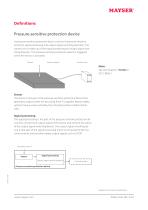
Definitions and Operation Principles: Safety mats function as pressure-sensitive protection devices, consisting of sensors, signal processing, and output signal switching devices. They operate using 2-wire or 4-wire technology.
Intended Use and Limits: Safety mats are used to detect the presence of a person in a danger zone, preventing hazardous situations. They are typically used in areas with moving machinery.
Design and Sizes: Mats are available in rectangular shapes with a maximum size of 1.5 m², featuring non-sensitive edges and a non-slip surface with a protection rating of IP65.
Connection and Installation: Mats can be connected with or without plugs, with a maximum cable length of 100 meters.
Material and Resistance: The surface is made of PUR, providing non-slip and mechanical protection. Mats are resistant to various chemicals, though some substances like acetone and ethanol are not recommended.
Maintenance and Safety Aspects: Regular maintenance and adherence to safety instructions are crucial for safe operation. The document emphasizes the importance of correct installation and surface conditions.
Technical Data and Additional Features: Mats include features like ramp edges and cable conduits for easy installation, designed to withstand specific environmental and mechanical stresses.
Specifications: The document outlines various components and specifications for safety mats and related accessories, including sensor combinations, rod lengths, and materials used for different connectors and wedges.
Procedures: Calculation examples are provided for determining the necessary actuation area in accordance with ISO 13855.
Standards and Safety Aspects: References ISO standards such as ISO 13849-1 and ISO 13856-1 for safety classifications and performance levels.
Maintenance and Cleaning: Sensors are maintenance-free, but regular inspections are recommended. Cleaning should be done with mild agents if necessary.
Technical Data: Technical specifications include sensor sizes, cable lengths, operating conditions, and electrical requirements.
Recommendations: Advises on the appropriate use of sensors, including limitations such as not being suitable for detecting individuals under 20 kg or for use with walking aids.
Overview: The document provides detailed technical specifications and guidelines for the use of safety mats, specifically the TS and SM8 models by Mayser.
Specifications: Safety mats are available in fixed sizes, designed to detect individuals weighing more than 35 kg, with a load capacity of up to 800 N/cm² and a protection rating of IP65.
Installation and Design: Proper installation is crucial for safe operation, including considerations for surface conditions and correct sizing.
Safety and Maintenance: Mats are virtually maintenance-free but require regular inspections for functionality and damage.
Technical Data: Detailed technical data is provided, including response times, actuation forces, and operating conditions.
Applications: Typical applications include use in areas with moving machinery to prevent unauthorized access to danger zones.
Overview: The document provides technical specifications and guidelines for the SM8 safety mats by Mayser, designed to detect the presence of individuals in hazardous areas to prevent accidents.
Specifications: Safety mats use both 2-wire and 4-wire technology for sensor monitoring, with a protection rating of IP65.
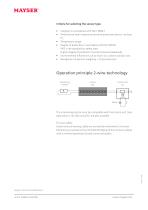
Operation Principles: 2-wire technology involves a monitoring resistor for function checks, while 4-wire technology allows for signal transmission feedback without a monitoring resistor.
Safety and Standards: Mats comply with ISO 13856-1 and ISO 13849-1 standards, achieving a Performance Level (PL) of d.
Design and Installation: Mats feature a non-slip surface and are designed to be installed flush with the floor.
Maintenance: Safety mats require minimal maintenance, with regular inspections recommended.
Technical Data: Mats can handle a static load of up to 800 N/cm² and operate within a temperature range of -25 to +55 °C.
Conformity: Product complies with EC directives 2006/42/EC and 2014/30/EU.
Wire Colours and Sensor Surface: Outlines wire colours and sensor surface specifications for proper installation and maintenance.
Physical and Chemical Resistance: Details on the physical and chemical resistance of materials used in sensors.
Attachment and Aluminium Profiles: Describes attachment methods and provides an overview of different aluminium profile combinations.
Maintenance and Cleaning: Guidelines for maintaining and cleaning sensor profiles.
Technical Data: Technical specifications for various sensor profiles.
Marking and Conformity: Discusses marking requirements and conformity standards.
Definitions and Safety: Key definitions related to pressure-sensitive protection devices, along with safety guidelines.
Design and Performance Level: Design considerations and performance levels according to ISO standards.
Effective Actuation Area: Parameters defining the effective actuation area.
Installation and Operation Principles: Instructions for installation and operation principles.
Specifications: Outlines various sensor profiles, including installation positions and types of sensors available.
Procedures: Installation involves mounting sensor profiles onto main and secondary closing edges.
Standards and Norms: Sensors comply with test principles EN 12978, ISO 13849-1, and ISO 13856-2.
Recommendations: Regular inspection of sensors is recommended to ensure proper functioning.
Technical Data: Key technical specifications include actuation force, response time, and actuation distance.
Material Properties: Sensor profiles are made from TPE material, with specific resistance to various substances.
Maintenance: Sensors are virtually maintenance-free, but regular inspections are necessary.
Technical Specifications: Maximum capacity: 250 mW, contact transition resistance: < 400 Ohm per sensor.
Mechanical and Electrical Operating Conditions: Sensor length: 10 cm to 25 m, cable length: 10 cm to 200 m.
Performance Characteristics: Actuation force varies between 41 N to 58 N depending on the model.
Test Conditions: According to ISO 13856-2, installation position B.
Safety and Compliance: Test principles: EN 12978, ISO 13849-1, ISO 13856-2.
Additional Information: Chemical resistance varies by material and substance.
Introduction: Provides technical specifications and guidelines for normally open safety edges, specifically the SL NO series by Mayser.
Specifications: Outlines different models of safety edges, including GP 38(L)-2, GP 58(L)-2, GP 68-2, and GP 88-2.
Design and Installation: Safety edges consist of a rubber profile, a normally open element, and an aluminum profile.
Operation Principles: Safety edges operate using either 2-wire or 4-wire technology.
Environmental and Chemical Resistance: Safety edges are resistant to various environmental factors and chemicals.
Calculation Examples: Provides examples for calculating the minimum overtravel distance required for safety edges.
Conclusion: Recommendations for selecting the right
safety edge based on specific application requirements.
Specifications: Outlines specifications for various safety edge models, including SL NO GP 38-2 EPDM, GP 38L-2 EPDM, GP 58-2 EPDM, GP 58L-2 EPDM, GP 68-2 EPDM, and GP 88-2 EPDM.
Procedures: Provides calculations for determining the minimum overtravel distance required for safety edges.
Standards and Conformity: Safety edges comply with ISO 13856-2 and ISO 13849-1:2015 standards.
Recommendations: Advises regular inspection and maintenance of sensors.
Technical Data: Includes mechanical and electrical operating conditions for each model.
Safety Aspects: Discusses safety aspects, including the performance level (PL) determined according to ISO 13849-1.
Customised Designs: Customised designs are available, offering features like sensitive ends and durability at extreme temperatures.
Specifications: Outlines specifications for safety edges, including minimum dimensions, operating speed, and maximum load capacity.
Electrical Operating Conditions: Specifies a maximum of 10 sensors of type BK can be connected in series.
Dimensional Tolerances: Length and profile section tolerances are according to ISO 3302 L2 and E2.
Technical Data: Describes the safety edge SL NO as normally open, consisting of a sensor, aluminium profile, and control unit.
Design and Safety: Describes the design of normally closed safety edges SL NC II.
Installation and Connection: Details on installation positions, connection methods, and cable exits.
Environmental and Mechanical Conditions: Guidelines for environmental conditions and mechanical conditions.
Request for Quotation: Provides a template for requesting a quotation.
Additional Information: Includes sections on maintenance, cleaning, and technical data for various profiles and materials.
General Principles for Design: Outlines the importance of using safeguards with reset functions.
Performance Level (PL): PL is determined using a simplified procedure according to ISO 13849-1.
Technical Specifications: Provides detailed specifications for normally closed safety edges.
Cable and Connection Details: Describes cable specifications and emphasizes the importance of protecting cables.
Material and Chemical Resistance: Sensors are resistant to various chemicals and environmental conditions.
Assembly and Mounting: Instructions for mounting sensors using aluminium profiles.
Safety Edge Selection and Calculation: Includes examples for calculating the stopping distance and overtravel distance of safety edges.
Maintenance and Cleaning: Sensors require minimal maintenance but should be inspected regularly.
Technical Data: Detailed technical data for various safety edge models.
Specifications: Provides detailed specifications for various safety edge products.
Procedures: Testing procedures include switching operations, actuation force measurements, and response time evaluations.
Standards and Certifications: Products comply with ISO 13856-2 and ISO 13849-1:2015 standards.
Recommendations: Ensures proper installation according to specified dimensions and tolerances.
Key Data from Tables and Graphs: Includes actuation force and distance measurements, response times, and deformation values.
Critical Information: Maximum load capacity of 600 N, operating temperature range from -10 to +55 °C.
Technical Specifications: Provides detailed technical specifications for the Miniature Safety Edge EKS 038.
Design and Intended Use: Consists of an insulating TPE covering, conductive contact layers, and self-adhesive acrylic foam.
Installation and Connection: Outlines installation procedures, including available lengths, bend angles, and cable connections.
Chemical Resistance: Resistant to various chemicals, including disinfectants and ethyl alcohol.
Attachment and Storage: Attachment is achieved using acrylic-foam adhesive tape.
Safety and Compliance: Includes safety classifications and compliance information.
Conclusion: Reminder to test the suitability of the product for specific applications.
Overview: Provides detailed technical specifications and guidelines for the DIY Miniature Safety Edges produced by Mayser GmbH & Co. KG.
Specifications: Safety edges are available in different models with varying attachment methods.
Electrical Operating Conditions: Operate with a terminal resistance of 1k2 ± 5% and a maximum electrical rating of 250 mW.
Installation and Maintenance: Installation position is flexible, and sensors must not be under pressure in idle state.
Safety and Standards: Comply with ISO 13849-1 Cat. 3 and ISO 13856 standards.
Additional Information: Includes a materials list, definitions of key terms, and detailed descriptions of operation principles.
Technical Specifications: Operating temperature ranges from -25 to +80 °C.
Electrical Operating Conditions: Terminal resistance options include 1k2, 2k2, or 8k2.
Mechanical Operating Conditions: Sensor lengths range from 10 cm to 50 m.
Safety and Standards: Adheres to ISO 13856-2 for test principles and ISO 13849-1 for safety classifications.
Installation and Design: Safety bumpers are available in various forms and lengths.
Materials and Chemical Resistance: Bumpers are available in jet black or with yellow stripes.
Custom Types and Applications: Custom types are available for special applications.
Maintenance and Monitoring: Sensor is maintenance-free, with co-monitoring by the control unit.
Specifications: Outlines specifications for safety bumpers and control units.
Procedures: Testing procedures include measuring actuation force and overtravel distance.
Standards and Norms: References compliance with EN 954 Category 3 and ISO 13849-1:2006.
Recommendations: Includes using the bumper repair set for any damage to the foam body.
Operating and Environmental Conditions: Operating temperature for sensors is specified.
Chemical Resistance: Safety bumper is resistant to diluted acids, alkaline solutions, and alcohol.
Accessories: Bumper repair set is available for repairing damage to the foam body.
Signal Transmission Systems: WLS signal transmission system is designed for safe signal transmission.
Cable Conduit Rails: KLS 77 V2 cable conduit rail is used for signal transmission from pressure-sensitive sensors to drive control.
Overview: Describes the KLS 77 V2 cable conduit rails, highlighting its robust and simple construction.
Specifications: Cable is protected in a wear-resistant sliding chain.
Technical Data: Includes cable types, number of wires, operating voltage, and temperature range.










 Public transport
 Commercial Vehicles
 Industry Brochure
 Seat occupancy Sensor SBS
 DIY SE 1 TPE spring contact
 Safety shoe
 Consensus with ISO 13849-1
 RailFR: Sensor, cable
 Automotive Brochure


 Aviation brochure
 Ultrasonic sensors brochure
 Signal Transmission System
 DIY Sensor Profiles
 Safety Mats SM
 Safety Mat SM11
 Control Units
 Miniature Safety Edges
 Safety Bumper
 Safety Edges
 Ultrasonic Industrial Sensor
 Safety Bumpers
 Transmission Systems WLS