
- Catalogs
- Maximator GmbH
- Installation and operating manual Compressed air driven gas booster


Installation and operating manual Compressed air driven gas booster
Installation and operating manual Compressed air driven gas booster
This manual provides detailed guidance on the installation and operation of Maximator's compressed air-driven gas boosters, specifically models DLE, 8DLE, 14DLE, MDLE, and SDLE. It includes safety instructions, technical specifications, and operational procedures, intended for qualified personnel to prevent injuries and equipment damage.
The manual emphasizes the use of personal protective equipment (PPE) and maintaining safety labels. It details potential hazards such as noise and hazardous fluids, and provides guidelines for safe operation in explosive environments.
The gas boosters are designed to compress gases to high pressures. The manual specifies intended use and warns against misuse. Technical specifications include operating conditions, dimensions, weight, and performance values.
Installation instructions cover prerequisites, connecting lines, and commissioning procedures, emphasizing the importance of proper installation for safe and efficient operation.
Operational guidelines ensure safe operation and address abnormal situations, detailing signs of unsafe conditions and steps to secure the gas booster.
Regular maintenance is critical for optimal performance, with specified intervals, inspection procedures, and leak detection methods. Information on spare parts and customer service is also provided.
This section addresses common issues on both the drive and high-pressure sides, offering solutions to maintain functionality.
Guidelines for safe removal and disposal of the gas booster ensure compliance with environmental and safety standards.
Special instructions for operating in explosion-prone areas include temperature classes and purging plans for combustible gases.
The manual concludes with a summary of ignition hazards and applications with oxidizing operating fluids, emphasizing adherence to safety measures to prevent accidents.
Potential hazards include asphyxiation risks, unexpected start-up, and noise-related injuries. Regular leak checks and proper ventilation are recommended. The absence of a safe shut-down device is noted as a significant risk.
Specifications include operating conditions, temperature ranges, and approved operating fluids. The importance of using non-corrosive fluids and permissible leakage rates is emphasized.
Guidelines emphasize protection against damage, corrosion, and environmental factors, with recommendations for regular inspections and maintenance during storage.
1. Gas Booster Installation
Ensure permissible pressures do not exceed maximum operating pressure. Install vertically using specified screws or bolts.
2. Installation of Connecting Lines
Ensure lines are hermetically sealed and checked for leaks.
3. Commissioning
Ensure the product is undamaged and connections are correct before gradually increasing drive air pressure.
4. Operation
Ensure the product is free of damage and securely attached.
5. Maintenance
Regular maintenance is essential, with intervals based on usage conditions.
Relieve pressures before disassembling the spool valve. Leak detection can be performed using water displacement.
Disassemble and clean the gas booster, replacing all seals and damaged components.
Use only Maximator-specified spare parts to avoid injury risks.
Address drive side and high-pressure side issues with specified solutions.
Follow safety guidelines for handling fluids and lubricants, and dispose of components according to safety data sheets.
Gas boosters with ATEX labels are suitable for explosive atmospheres, with specific safety standards and precautions.
Connect nitrogen to purge ports before commissioning and ensure adequate purging performance.
Specifications for stroke volume of leakage chambers in two-stage equipment are provided.
Identifies ignition hazards and protective measures, including material selection and maintenance intervals.
Warnings regarding risks of fire or explosion with oxidising fluids, emphasizing adherence to regulations and best practices.
Drive air must be oil and grease-free for oxygen applications, with maintenance intervals accounting for surface contamination.
Includes EU Declaration of Conformity, Declaration of Incorporation, and safety and occupational health requirements.
Catalog excerpts

Maximum Pressure. Compressed air driven gas booster DLE, 8DLE, 14DLE, MDLE, SDLE Installation and operating manual
Open the catalog to page 1
Key information! Follow the manual for safe and proper use. Keep the manual near the machine for later reference. MAXIMATOR GmbH Lange Straße 6 99734 Nordhausen Germany Phone: +49 3631 9533-0 e-mail: [email protected] Internet: www.maximator.de Warranty and liability: As a general rule, the “General Terms and Conditions” of Maximator GmbH shall apply. These terms and conditions are available at http://www.maximator.de. Warranty and liability claims shall not be accepted if they can be attributed to one or more of the causes mentioned in this manual or explicitly stipulated below: – – – – – –...
Open the catalog to page 2
General information . . . . . . . . . . . . . . . . . . . . . . . . . . . . . . . . . . . . . . . . . . . . Information regarding this manual . . . . . . . . . . . . . . . . . . . . . . . . . . . . . . . . . Order code . . . . . . . . . . . . . . . . . . . . . . . . . . . . . . . . . . . . . . . . . . . . . . . . . . Rating plate . . . . . . . . . . . . . . . . . . . . . . . . . . . . . . . . . . . . . . . . . . . . . . . . . . Explanation of symbols . . . . . . . . . . . . . . . . . . . . . . . . . . . . . . . . . . . . . . . . . List of abbreviations and formula signs used . . . . . . . . ....
Open the catalog to page 3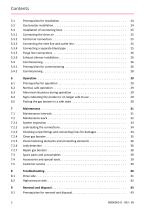
Prerequisites for installation . . . . . . . . . . . . . . . . . . . . . . . . . . . . . . . . . . . . . Gas booster installation . . . . . . . . . . . . . . . . . . . . . . . . . . . . . . . . . . . . . . . . . Installation of connecting lines. . . . . . . . . . . . . . . . . . . . . . . . . . . . . . . . . . . . Connecting the drive air . . . . . . . . . . . . . . . . . . . . . . . . . . . . . . . . . . . . . . . . Control air connection . . . . . . . . . . . . . . . . . . . . . . . . . . . . . . . . . . . . . . . . . . Connecting the inlet line and outlet line . . . . . . . . . . . . . . ....
Open the catalog to page 4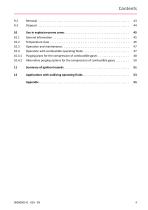
Removal . . . . . . . . . . . . . . . . . . . . . . . . . . . . . . . . . . . . . . . . . . . . . . . . . . . . . Disposal . . . . . . . . . . . . . . . . . . . . . . . . . . . . . . . . . . . . . . . . . . . . . . . . . . . . . General information . . . . . . . . . . . . . . . . . . . . . . . . . . . . . . . . . . . . . . Temperature class . . . . . . . . . . . . . . . . . . . . . . . . . . . . . . . . . . . . . . . . Operation and maintenance . . . . . . . . . . . . . . . . . . . . . . . . . . . . . . . . . Operation with combustible operating fluids . . . . . . . . . . . . . . . . . . . ....
Open the catalog to page 5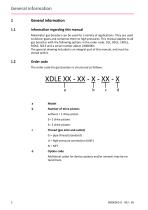
General information Information regarding this manual Maximator gas boosters can be used for a variety of applications. They are used to deliver gases and compress them to high pressures. This manual applies to all gas boosters with the following options in the order code: DLE, 8DLE, 14DLE, MDLE, SDLE and a serial number above 23000001. The general drawing included is an integral part of this manual, and must be stored with it. Order code The order code for gas boosters is structured as follows: b Number of drive pistons without = 1 drive piston 2= 2 drive pistons 3= 3 drive pistons c Thread...
Open the catalog to page 6
Rating plate The rating plate is located on the drive cylinder of the gas booster and contains the following information:1: 1 Maximum permitted operating pressure 2 Compressed air driven gas booster 3 Type (specifications from the or der code) 4 Maximum drive pressure 5 Minimum inlet pressure 6 Calendar week/year of manufac 7 Article number 8 Serial number 9 Gear ratio 10 Manufacturer contact information 11 Label according to applied guidelines 12 Operating temperature range Individual gas boosters may have different rating plates, e.g. made of metal
Open the catalog to page 7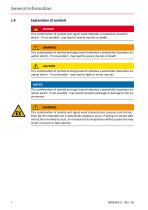
Explanation of symbols DANGER This combination of symbol and signal word indicates a hazardous situation which - if not avoided - may lead to severe injuries or death. WARNING This combination of symbol and signal word indicates a potentially hazardous situation which - if not avoided - may lead to severe injuries or death. CAUTION This combination of symbol and signal word indicates a potentially hazardous situation which - if not avoided - may lead to light or minor injuries. NOTICE This combination of symbol and signal word indicates a potentially hazardous situation which - if not avoided...
Open the catalog to page 8
List of abbreviations and formula signs used Abbreviation Tab. 1-2 Formula symbol Qualification of the personnel Only qualified personnel who are specialised and have been trained to do so must work on the product. Allowing unqualified personnel to work on the product or enter the danger zone creates hazards which could lead to death, severe injuries and significant property damage.
Open the catalog to page 9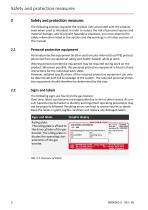
Safety and protection measures The following sections stipulate the residual risks associated with the product, even when used as intended. In order to reduce the risk of personal injuries and material damage, and to prevent hazardous situations, you must observe the safety information listed in this section and the warnings in all other sections of this manual. Personal protective equipment Personal protective equipment (in other sections also referred to as PPE) protects personnel from occupational safety and health hazards while at work. Wearing personal protective equipment may be required...
Open the catalog to page 10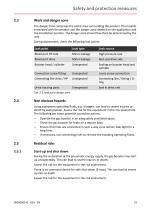
Work and danger zone The danger zone comprises the entire area surrounding the product. The hazards associated with the product and the danger zone depend on the application and the installation location. The danger zone should therefore be determined by the user. During assessment, check the following leak points: Tab. 2-2 Leak point danger zone Non obvious hazards Using asphyxiant operating fluids, e.g. nitrogen, can lead to severe injuries or death by asphyxiation. Assess the risk for the equipment in the risk assessment. The following are some potential corrective actions: - Operate the gas...
Open the catalog to page 11
Safety and protection measures 2.5.2 Risk of injury posed by noise The noise level emitted in the work area depends on the mounting and application. Assess the risk for the equipment in the risk assessment. Hazardous operating fluids Improper use of operating fluids can lead to serious accidents resulting in death. Assess the risk for the equipment in the risk assessment. Active leaks can lead to serious accidents resulting in death. Assess the risk for the equipment in the risk assessment.
Open the catalog to page 12All Maximator GmbH catalogs and technical brochures
 MAXIMATOR High Pressure Pumps
40 Pages
 Gas Booster and Air Amplifier
56 Pages
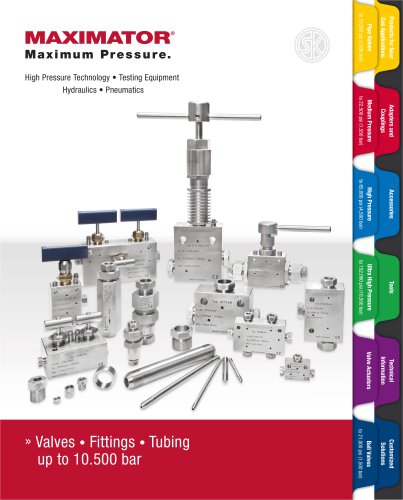 Valves, Fittings & Tubings
175 Pages
 High Pressure Pumps
40 Pages


Archived catalogs
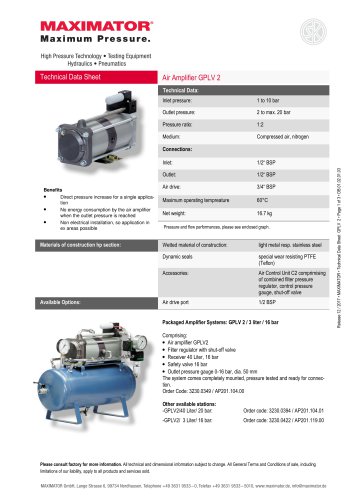 Air Amplifier GPLV 2
3 Pages
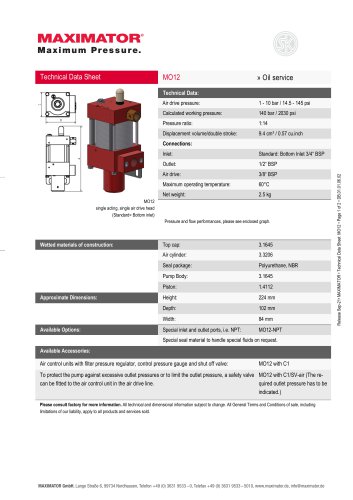 MO12
MO122 Pages
 ROB 8-37
2 Pages
 ROB 5-30
1 Page
 GSF60
GSF603 Pages
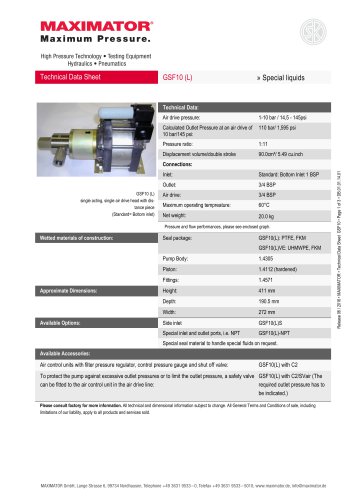 GSF10
GSF103 Pages
 GSF100
3 Pages
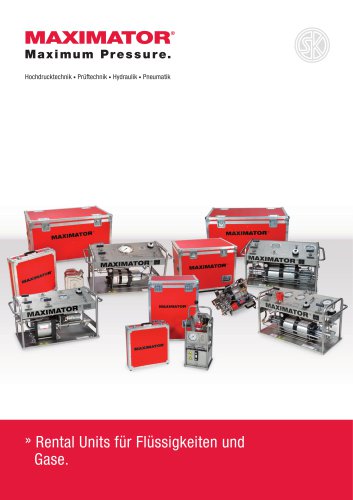 Maximator-Rental-Units-DE082014
28 Pages
 Air Amplifier SPLV 2
3 Pages
 ROB 22 (-HL)
2 Pages

- MAXIMATOR pump
- MAXIMATOR industrial pump
- Pump with electric motor
- MAXIMATOR stationary pump
- MAXIMATOR water pump
- Piping
- MAXIMATOR manual valve
- MAXIMATOR fitting
- Chemical pump
- Control valve
- MAXIMATOR stainless steel valve
- Hydraulic fitting
- MAXIMATOR stainless steel pump
- MAXIMATOR ball valve
- Screw-in fitting
- MAXIMATOR pneumatic valve
- Lubricant pump
- Pneumatic fitting
- Oil pump