
- Catalogs
- The MathWorks
- SimEvents

- Products
- Catalogs
- News & Trends
- Exhibitions
SimEvents

SimEvents
SimEvents is a tool integrated with Simulink for modeling and simulating discrete-event systems. It provides a simulation engine and a library of components to model event-driven communication, analyze performance metrics like latency and throughput, and optimize system operations.
- Discrete-event simulation engine for complex systems modeling in Simulink.
- Predefined block libraries for queues, servers, and routing.
- Customizable entities with data attributes for flexible system representation.
- Built-in statistics for performance metrics like delay and throughput.
- Domain-specific constructs for communication and process modeling.
- In-model animation for visualization and debugging.
Entities in SimEvents represent discrete items like packets or airplanes. Their movement and processing trigger events that modify system states. Entities can have attributes such as destination or processing time, and are represented by unique port styles for entity and event-signal lines.
SimEvents integrates with Simulink and Stateflow, allowing event-based modeling within time-based systems. It supports bidirectional conversion between time-based and event-based signals, enabling discrete mode-switching and communication modeling.
SimEvents offers libraries for creating and managing entities, including:
- Generators for entity creation.
- Entity Management for packaging and separating entities.
- Attributes for setting and reading entity attributes.
- Queues for handling entities.
- Servers for processing entities.
- Routing and Gates for statistical or deterministic switching.
SimEvents provides tools for analyzing model behavior through animation, statistics, and scopes. Animation helps visualize entity flow and event execution, while statistics and custom scopes offer insights into service times and utilization.
The debugger allows for detailed simulation inspection using MATLAB functions, enabling step-by-step simulation analysis and breakpoint setting for both discrete-event and hybrid simulations.
For more information, product details, and support, visit MathWorks' official website and explore their online community and training services.
Catalog excerpts
SimEvents Model and simulate discrete-event systems SimEvents® provides a discrete-event simulation engine and component library for Simulink®. You can model event-driven communication between components to analyze and optimize end-to-end latencies, throughput, packet loss, and other performance characteristics. Libraries of predefined blocks, such as queues, servers, and switches, enable you to accurately represent your system and customize routing, processing delays, prioritization, and other operations. With SimEvents you can design distributed control systems, hardware architectures, and sensor and communication networks for aerospace, automotive, and electronics applications. You can also simulate event-driven processes, such as the execution of a mission plan or the stages of a manufacturing process, to determine resource requirements and identify bottlenecks. Key Features ▪ Discrete-event simulation engine for multidomain modeling of complex systems in Simulink ▪ Predefined block libraries, including queues, servers, generators, routing, and entity combiner/splitter blocks ▪ Entities with custom data attributes for flexible representation of packets, tasks, and parts ▪ Built-in statistics aggregation for obtaining delay, throughput, average queue length, and other metrics ▪ Library blocks for defining domain-specific constructs, such as communication channels, messaging protocols, and conveyor belts ▪ In-model animation for visualizing model operation and debugging Discrete Event Simulation with SimEvents 2:27 Get an introduction to discrete-event simulation and the applications of SimEvents ® and explore online product resources. Discrete-Event Simulation in Simulink SimEvents provides a discrete-event simulation engine that manages and processes sequences of asynchronous events. These events can help model mode changes and trigger state transitions within time-based systems in Simulink. Entities and Events With SimEvents you can create entities to represent discrete items of interest, such as packets in a communication system or airplanes in an airport taxiway. The generation, movement, and processing of entities in the system causes events, such as the arrival of a packet or the departure of an airplane. In turn, these events modify the states in the system to affect system behavior. You can characterize your entity with attributes, such as a destination address, processing time, or server delay. SimEvents distinguishes between entity lines, which represent entity movement between blocks, and event-signal lines, which denote corresponding event-based computations, via unique port styles.
Open the catalog to page 1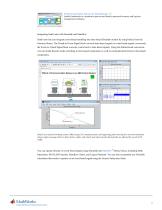
Production Simulation Software for Manufacturing 4:57 Identify bottlenecks in a production process and identify optimized inventory and logistics management techniques. Integrating SimEvents with Simulink and Stateflow SimEvents lets you integrate event-based modeling into time-based Simulink models by using blocks from the Gateway library. The Timed-to-Event Signal block converts time-based signals to event-based signals; conversely, the Event-to-Timed Signal block converts events back to time-based signals. Using this bidirectional conversion, you can model discrete mode-switching in time-based...
Open the catalog to page 2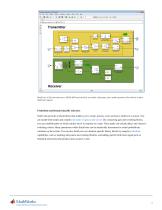
£i1e £drt glen QisplAy Diagtam Simulation Anatyiu £rfe JeeU U«lp Model of a CAN node that uses a MATLAB Function block, an atomic subsystem, and a math operation (Gain block) to alter SimEvents signals. Predefined and Domain-Specific Libraries SimEvents provides a block library that enables you to create, process, store, and move entities in a system. You can model both simple and complex networks of queues and servers. By connecting gate and switching blocks, you can establish paths on which entities travel in response to events. These paths can include delays and selective switching criteria....
Open the catalog to page 3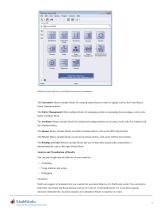
File Edit View Display Diagram Analysis Help Signal SimEvents Ports Management Management and Subsystems Copyright 2005-2012 The Math Works, Inc. SimEvents block libraries for building discrete-event simulations. The Generators library includes blocks for creating entities based on time or signals, such as the Event-Based Entity Generation block. The Entity Management library includes blocks for packaging entities or separating those packages, such as the Entity Combiner block. The Attributes library includes blocks for setting and reading attributes on an entity, such as the Set Attribute and...
Open the catalog to page 4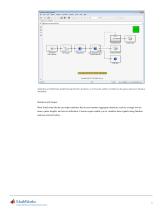
Fit* £[Jit Vitw Qifplty l>i*gfjrtt £rttgl*tion Anjtyjij £od* lOOli Help Time eased EnBjf Generator Entity r e r. artyre Event )c Functon-Cal Evtnt | Conveiimg n^-ns to Finer c-n Ca I Serais] coulter Resdt Animation of a SimEvents model showing the flow of entities, as well as the number of entities in the queue and server during a Most SimEvents blocks can output statistics that let you monitor aggregate measures, such as average service times, queue lengths, and server utilization. Custom scopes enable you to visualize these signals using familiar staircase and stem plots. Accelerating the pace...
Open the catalog to page 5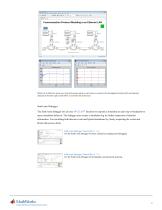
Communication Protocol Modeling in an Ethernet LAN Model of an Ethernet local area network using statistics and scopes to analyze the throughput (bottom left) and channel utilization (bottom right) of the MAC Controller (B) subsystem. SimEvents Debugger The SimE vents debugger lets you use MATLAB functions to suspend a simulation at each step or breakpoint to query simulation behavior. The debugger also creates a simulation log for further inspection of detailed information. You can debug both discrete-event and hybrid simulations by closely inspecting the events and blocks that process them....
Open the catalog to page 6
Resources Product Details, Examples, and System Requirements www.mathworks.com/products/simevents Online User Community www.mathworks.com/matlabcentral Trial Software www.mathworks.com/trialrequest Training Services www.mathworks.com/training Sales www.mathworks.com/contactsales Third-Party Products and Services www.mathworks.com/connections Technical Support www.mathworks.com/support Worldwide Contacts www.mathworks.com/contact © 2012 The MathWorks, Inc. MATLAB and Simulink are registered trademarks of The MathWorks, Inc. See www.mathworks.com/trademarks for a list of additional trademarks....
Open the catalog to page 7All The MathWorks catalogs and technical brochures
 MATLAB Production Server
6 Pages
 Database Toolbox
4 Pages
 MATLAB Report Generator
4 Pages
 Stateflow
8 Pages
 SimDriveline
7 Pages
 SimHydraulics
7 Pages
 SimPowerSystems
8 Pages
 Simulink Control Design
5 Pages
 Aerospace Blockset
5 Pages
 SimRF
SimRF6 Pages
 Simulink Coder
6 Pages
 Embedded Coder
8 Pages
 Simulink PLC Coder
4 Pages
 Fixed-Point Designer
9 Pages
 MATLAB Coder
5 Pages
 Simulink 3D Animation
10 Pages
 Gauges Blockset
2 Pages
 Simulink Report Generator
3 Pages
 Polyspace Bug Finder
6 Pages
 global-optimization-toolbox
10 Pages
 Phased Array System Toolbox
9 Pages
 OPC Toolbox
5 Pages
 Simulink Design Verifier
7 Pages
 Simulink Design Optimization
10 Pages
 Filter Design HDL Coder
5 Pages
 Bioinformatics Toolbox
9 Pages
 SimBiology
6 Pages
 Computer Vision System Toolbox
10 Pages
 DSP System Toolbox
11 Pages
 Fuzzy Logic Toolbox
5 Pages
 Polyspace Client for C/C++
5 Pages
 xPC Target
5 Pages
 SimMechanics
7 Pages
 Simscape
7 Pages
 Simulink
6 Pages
 Data Acquisition Toolbox
8 Pages
 Image Processing Toolbox
7 Pages
 Signal Processing Toolbox
10 Pages
 Control System Toolbox
6 Pages
 Symbolic Math Toolbox?
6 Pages
 Parallel Computing Toolbox?
7 Pages
 MATLAB®
6 Pages
 Mapping Toolbox 3.2
7 Pages
 Instrument Control Toolbox
7 Pages
 Optimization Toolbox 6.0
14 Pages



Archived catalogs
 MATLAB Release Notes
505 Pages
 C and Fortran API Reference
263 Pages
 External Interfaces
649 Pages
 Function Reference: Volume 3 (P-Z)
1696 Pages
 Function Reference: Volume 2 (F-O)
1568 Pages
 Function Reference: Volume 1 (A-E)
1298 Pages
 Creating Graphical User Interfaces
520 Pages
 3-D Visualization
212 Pages
 Graphics
667 Pages
 MATLAB Programming Tips
66 Pages
 Programming Fundamentals
840 Pages
 Data Analysis
220 Pages
 Mathematics
316 Pages
 MATLAB® Getting Started Guide
250 Pages


- Automation software solution
- Management software solution
- Analysis software solution
- Process software
- Real-time software
- Windows software
- Computer-aided design software
- Cloud-based software
- Control software
- Design software solution
- 3D software solution
- Measurement software
- Visualization software solution
- Programming software solution
- Automated software
- Network software
- Reporting software
- Engineering software
- Machine software